

How to Write a Romance Novel: A Step-by-Step Guide for Aspiring Authors
Writing a romance novel requires more than bringing two characters together. At its core, romance is about emotional transformation, rising tension, and a satisfying resolution that feels earned.
A romance novel is defined by two key elements:
➜ a central love story
➜ a satisfying romantic ending, typically a Happily Ever After (HEA) or Happy For Now (HFN)
If either element is missing, the book may include romance, but it does not qualify as a true romance novel.
Quick Answer: How Do You Write a Romance Novel?
To write a romance novel:
1. Build a central relationship that drives the plot
2. Develop internal and external conflict that keeps characters apart
3. Create strong emotional arcs for both leads
4. Escalate romantic tension over time
5. Deliver a satisfying emotional resolution (HEA or HFN)
In short, a successful romance novel balances structure, character development, and emotional payoff.
What Makes Romance Different From Other Genres?
Many stories include romantic elements, but in a romance novel, the relationship is the story.
If the romance were removed:
In a romance novel → the story collapses
In other genres → the story still functions
Romance readers are also highly genre-aware. They read with clear expectations around pacing, emotional intensity, and resolution. Meeting those expectations allows you to build trust, while your unique voice keeps the story fresh.
What Defines a Romance Novel? (Core Genre Rules)
A romance novel is defined by two non-negotiable elements: a central love story and a satisfying romantic ending.
While many stories include romantic elements, not all qualify as romance. The key distinction is narrative priority. In a romance novel, the relationship is the main plot. If it were removed, the story would no longer function.
In contrast, books with romance subplots use the relationship to support a larger narrative, such as fantasy, mystery, or literary fiction.
A satisfying ending is also essential. Most romance novels conclude with either a Happily Ever After (HEA) or a Happy For Now (HFN). This is not a stylistic preference—it is a core genre expectation. Without it, readers may feel the story is unresolved, regardless of its other strengths.
Romance Writers of America uses the phrase “emotional justice” to emphasize this point — a happy ending is the payoff for passionate struggle and emotional risk.
Romance readers are highly attuned to these conventions. They read not just for attraction, but for emotional progression, conflict, and payoff. Understanding these expectations allows you to meet genre standards while still bringing your own voice and perspective to the story.
Understanding Romance Readers and Subgenres
Romance is not a monolith. The genre includes a wide range of subgenres, tones, and reader expectations, and successful romance novels tend to be very clear about who they’re for.
Some readers gravitate toward contemporary romance grounded in everyday emotional struggles. Others prefer historical settings or paranormal elements. However, popular romance genres tend to form around common focuses within smaller groups of readers:
| Subgenre | Core Appeal | Common Focus |
| Contemporary Romance | Appeals to readers who want love stories rooted in modern, relatable experiences | Everyday emotional struggles, immediate chemistry, and realistic conflicts in present-day settings |
| Historical Romance | Attracts readers who enjoy love stories shaped by social rules, traditions, and power dynamics of a specific time period | Class differences, gender roles, and forbidden relationships enhanced by rich historical detail |
| Paranormal Romance | Draws readers who like romance mixed with supernatural elements such as vampires, witches, shifters, or ghosts | Romance at the center, with magical or otherworldly conflicts adding danger, symbolism, and heightened stakes |
| Romantic Fantasy (Romantasy) | Combines a central romance arc with a fully realized fantasy world | Epic settings, magic systems, or political intrigue alongside an emotionally intense love story |
Heat level is also important to think about. For example, a sweet, closed-door romance delivers a very different experience than an open-door or explicit novel, even if the emotional arc is similar.
That said, you don’t need to write in a strict formula to reach your target readers.The key is to know what kind of emotional experience you want to offer, and communicate that clearly through structure, tone, and content. The more aligned your story is with reader expectations, the more freedom you’ll have to innovate within them.
Core Elements of a Successful Romance Novel
While romance novels vary widely in style and setting, they share a small set of non-negotiable elements that anchor the genre. These elements may seem like constraints, but in truth, they are merely categorical tools. Without them, defining the genre and thus attempting to appeal to readers within it would be much harder.
The goal is to answer the perennial emotional questions in a way that feels authentic to your style, themes, and worldview. To avoid sounding formulaic, authors should treat the core elements of romance novels as important considerations as opposed to checkboxes. The core elements of romance novels are as follows:
1. Central Romantic Relationship: The romantic relationship is the engine of the story. The main plot stakes rise or fall based on whether the relationship succeeds, changes, or fails. If the romance were removed, the story would fundamentally collapse.
2. Dual Emotional Character Arcs: Both romantic leads undergo meaningful internal change. Each character starts with an emotional limitation or belief that prevents lasting connection, and the relationship catalyzes growth in both directions.
3. Internal and External Conflict: Romantic tension comes from obstacles that keep the characters apart. External conflict (circumstances, society, danger) creates pressure, but internal conflict (fear, belief, desire) gives the story emotional weight.
4. Escalation of Emotional Stakes: As the story progresses, the emotional cost of failure increases. The characters have more to lose, not just in terms of the relationship, but in who they are becoming.
5. Emotionally Satisfying Resolution: The ending resolves the central romantic tension in a way that feels earned, emotionally coherent, and aligned with the characters’ growth. This typically takes the form of a happily-ever-after (HEA) or happily-for-now (HFN).
❤ ❤ ❤
While these elements are all necessary to ensure your novel falls squarely into the romance genre, you aren’t required to employ them in the same way every time. Evaluate what each element affects the reader’s experience, and challenge yourself to provide that experience in a new way.
Consider how each core element is working within your story. Your answer can be as simple or as deep as your story requires, but it’s important to know what you want to say so that your voice can shine through the formula.
| Core Element | What It Does for the Reader | Key Question to Ask Yourself | Voice-Preserving Approach |
| Central Romantic Relationship | Creates emotional investment | If this relationship fails, what truly breaks? | Let the stakes reflect your themes (identity, power, healing, joy) |
| Dual Emotional Arcs | Makes the love feel earned | What must each character unlearn? | Allow uneven growth or messy progress |
| External Conflict | Adds momentum and tension | What keeps them apart physically or socially? | Choose obstacles that fit your world, not genre clichés |
| Internal Conflict | Creates emotional depth | What fear or belief blocks intimacy? | Draw from lived experience, not tropes alone |
| Escalating Stakes | Prevents emotional flatness | What does love cost them at this stage? | Escalate vulnerability, not just drama |
| Satisfying Resolution | Delivers catharsis | How do their final choices show change? | Match the ending tone to your story’s emotional truth |
Once you are confident in your ideas for each element as it relates to your story, pass over them again to check for cohesiveness. If you find that your approach to one element is particularly clunky, try starting with that element and building your ideas out from there. The more cohesion you can create, the more you will start to see the themes of your novel bear out and the story will flow more easily.
How to Structure a Romance Novel
Romance novels tend to follow a recognizable narrative rhythm, not because readers want predictability, but because emotional pacing matters. Attraction, resistance, vulnerability, and commitment need space to build.
Most romance novels begin with an inciting romantic encounter which could be a meeting, reunion, or disruption that brings the protagonists into each other’s orbit. From there, the relationship deepens through a mix of connection and conflict, often punctuated by a midpoint shift that raises the emotional stakes.
Knowing this, and with a knowledge of the core romance elements, review the sample story arc below. You can see how the core elements are present even within a story structure that can be applied to nearly any writing style:
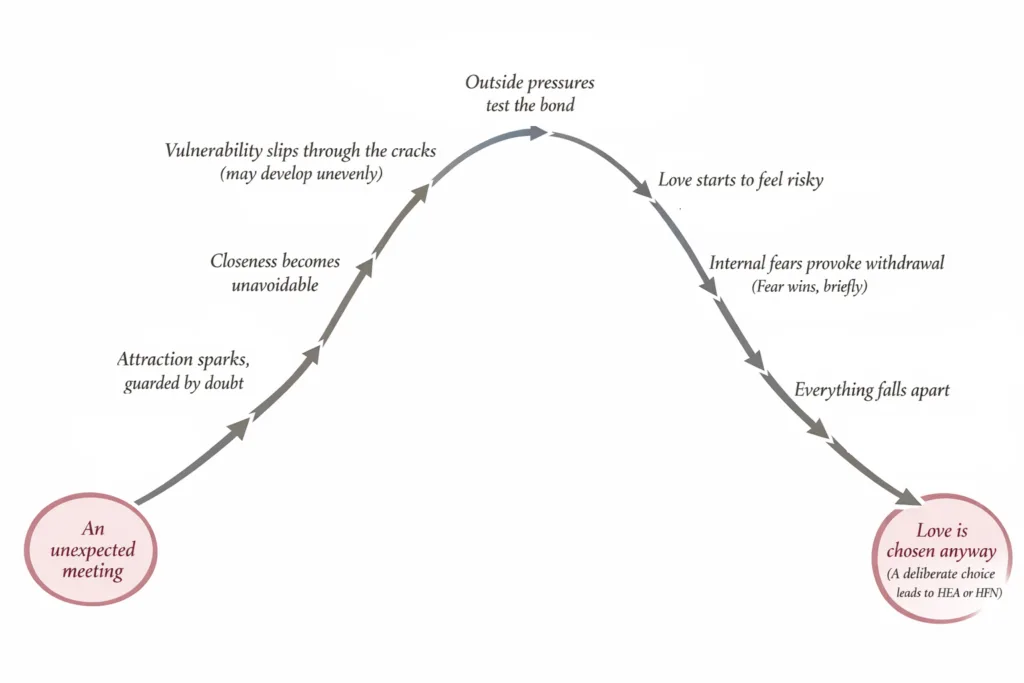
It’s important to note that in the story, the characters face a “black moment” where the relationship seems impossible. This isn’t just about misunderstanding or bad timing; it’s the point where internal fears and external obstacles collide. The resolution comes when those fears are confronted and the characters choose growth, leading to the HEA or HFN.This structure is especially important in styles like slow-burn romance, where tension accumulates gradually and payoff depends on careful pacing.
Romance Novel Structure (Beat Sheet)
Romance novels tend to follow a recognizable emotional structure. This is not a rigid formula, but a pacing framework that helps ensure tension builds naturally and the romantic payoff feels earned.
Typical Romance Story Structure (Beat Sheet):
➞ Meet Cute / Inciting Encounter
➞ Rising Attraction + Resistance
➞ Midpoint Shift (emotional turning point)
➞ Escalating Conflict
➞ Black Moment (relationship seems impossible)
➞ Resolution (HEA or HFN)
Each stage reflects a shift in emotional proximity between the characters. Attraction increases, resistance intensifies, and internal and external conflicts push the relationship to its breaking point before resolution becomes possible.
While not every romance novel follows this structure exactly, most successful stories use some variation of this emotional rhythm to guide pacing and reader expectation.
Creating Compelling Romantic Leads
Strong romance novels are driven by the characters, not plot mechanics. Readers fall in love with people before they fall in love with pairings.
Each romantic lead should enter the story with a clear emotional wound or limiting belief; one that makes love difficult or risky for them. These internal barriers are what give the romance depth. Without them, conflict feels artificial, and resolution feels shallow.
Equally important is chemistry. Chemistry isn’t just attraction; it’s the sense that these two characters change each other in meaningful ways. Dialogue, shared values, clashing worldviews, and emotional vulnerability all contribute to a building sense of compatibility. When executed well, chemistry makes even quiet scenes feel charged.
Chemistry is formed through contrast that is pronounced enough to provoke a reaction in each lead, but not enough to repulse them from each other. Sometimes this results in an initial spark that feels like love at first sight, and sometimes it’s just the social challenge a character needs to tread closer to their love interest.
At the beginning of their story, romance leads typically have one of a few common stances on romance. These stances affect how they love, problems they will run into, and how they form relationships.
| Lead’s Emotional Stance | How They Love | Where Conflict Comes From | How Chemistry Shows Up |
| Emotionally Guarded | Carefully, conditionally, or defensively | Fear of loss, exposure, or dependence | Sharp dialogue, restraint, tension beneath the surface |
| Emotionally Open | Freely, sometimes recklessly | Fear of rejection, imbalance, or being taken for granted | Vulnerability, emotional generosity, honesty |
| Control-Oriented | Through stability, plans, or rules | Fear of chaos or emotional uncertainty | Power struggles, boundary-testing, negotiation |
| Connection-Oriented | Through closeness and shared meaning | Fear of abandonment or emotional distance | Intimacy, shared rituals, emotional attunement |
| Escalating Stakes | Prevents emotional flatness | What does love cost them at this stage? | Escalate vulnerability, not just drama |
| Satisfying Resolution | Delivers catharsis | How do their final choices show change? | Match the ending tone to your story’s emotional truth |
One useful way to think about romantic leads is through contrasting emotional orientations, rather than personality types or tropes. These emotional orientations will carry significant weight when crafting conflict, and over time, will reveal what your leads love about each other.
Some of the strongest romantic dynamics emerge when:
➜ One lead is emotionally guarded and the other emotionally open
➜ One seeks control while the other seeks connection
➜ Both share the same fear, but cope with it in opposite ways
When designing romantic leads, consider:
➜ What emotional stance does each character default to under stress?
➜ How does the other character challenge that stance without fixing it?
➜ What kind of love feels most dangerous to each of them?
Answering those questions grounds chemistry in character rather than plot, and allows the romance to unfold naturally while still delivering emotional payoff.
Choosing Tropes (and Using Them Well)
Romance tropes aren’t always clichés, but they are used as emotional signposts that can give readers hints about what’s to come. This is especially true for romance enthusiasts interested in mapping the evolution of the genre.
When a reader sees enemies to lovers, friends to lovers, fake dating, or second chance romance, they don’t simply identify a familiar structure. They’re forming an expectation about how the story will make them feel.
| Trope | Reader Expectation |
| Enemies to Lovers | Emotional shift from conflict to trust |
| Friends to Lovers | Deepening existing bond |
| Fake Dating | Forced proximity + tension |
| Slow Burn | Gradual emotional payoff |
Tropes endure because they reliably deliver tension and payoff. Used well, they help readers orient themselves emotionally early, so they can relax into the story and focus on character, chemistry, and conflict.The key to strong use of tropes, and maximizing their positive effects, is intention. Readers don’t want to be surprised by the mere presence of a trope; they want to be surprised by how it unfolds. Fresh contexts, character-driven decisions, and thoughtful reversals are what keep familiar patterns feeling alive instead of mechanical.
📌 Reader Promise
If you choose Enemies to Lovers, readers expect:
A hard-won emotional shift from mistrust to vulnerability to earned trust. Banter alone isn’t enough, and the payoff comes from watching defenses crumble for believable reasons.
Tropes function best when you treat them as an emotional contract. You’re not promising exact plot beats, but you can signal a specific emotional journey. Break that promise, and readers feel cheated, even if the writing itself is strong.
Slow-burn romance is a classic example. Its appeal is the accumulation of emotional intimacy long before physical or verbal commitment appears on the page. Each glance, shared secret, and moment of restraint is part of the payoff.
📌 Reader Promise
If you choose Slow-Burn Romance, readers expect:
Sustained emotional tension, meaningful proximity, and a sense that every delay deepens the eventual connection rather than stalling it.
When you understand what a trope promises emotionally, you gain freedom instead of constraint. You can subvert surface-level expectations while still delivering the core experience readers came for, and that’s where the most satisfying romance novels live.
Setting, Mood, and Seasonal Romance
Setting does more than provide a backdrop; it shapes the emotional tone of a romance novel. A summer romance often carries themes of transience, intensity, and emotional risk, while a winter romance might emphasize intimacy, isolation, or comfort. Even if you don’t intend to position your book for a seasonal market, consider how climate, weather, and contemporaneous events may affect the story’s tone.
Place matters too. Small towns, workplaces, travel settings, and fantastical worlds each come with built-in dynamics that affect how characters interact and what obstacles feel believable.
When working with contemporary or historical worlds, place your characters in settings that can feel as safe as home and as challenging as a new frontier. In fantasy worlds or stories with supernatural elements, combine relatable tactile detail with the fantastic to give the world texture. Setting should reinforce the emotional arc of the relationship, so it can strengthen the story without adding unnecessary complexity.
Revising and Positioning Your Romance Novel
Revision is where romance novels often come into focus. This is the stage to examine emotional continuity, character growth, and whether the romantic arc truly drives the story from beginning to end.
Key Areas to Address During Revision
➞ Emotional Continuity: Check that your leads’ emotional journey is consistent and cumulative. Each scene should push them closer to, or farther from, their personal and relational goals.
➞ Character Growth and Chemistry: Ensure both leads show development in parallel with the deepening romance. Moments of vulnerability and connection should escalate in intensity, revealing how the characters shape each other.
➞ Conflict and Stakes: Reassess both internal and external conflicts. Are the obstacles compelling? Do they feel earned and proportional to the emotional investment of the characters? Avoid easy fixes or conflicts that feel tacked on.
➞ Pacing and Structure: Review the rhythm of tension and intimacy. Consider whether slower-paced elements build suspense effectively or if plot beats need tightening for maximum emotional impact.It’s also the time to think about positioning. Romance authors have more publishing paths than ever, from traditional and hybrid presses to independent publishing. Each route comes with different expectations around branding, audience, and distribution.
Revision Checklist for Market-Ready Romance
☑ Does the romantic arc carry the story without overshadowing subplots?
☑ Do the emotional arcs feel fully realized and complementary?
☑ Are the conflicts (internal and external) consistent and escalating appropriately?
☑ Is the story pacing aligned with the chosen subgenre? (i.e., slow-burn vs. fast-paced)
☑ Does the novel align with your intended publishing path in tone, content, and expectations? (i.e., heat level, subgenre, literary value)
☑ Are branding elements such as cover, blurb, and series placement consistent with market positioning?
Understanding where your novel fits in the romance market will help you revise with clarity, and prepare your book for the readers it’s meant to reach.
Common Romance Writing Mistakes to Avoid
Even strong romance concepts can fall flat if a few key craft issues aren’t handled carefully. Many early drafts struggle not because the idea is weak, but because the emotional logic of the relationship is underdeveloped.
Weak Emotional Stakes
If the characters don’t have meaningful personal stakes tied to the relationship, the romance can feel low-impact. Readers need to understand what each character stands to lose emotionally before they are invested in their love.
Relying Only on Physical Attraction
Physical chemistry can spark interest, but it cannot sustain a full novel. Strong romance requires emotional depth, conflict, and growth alongside attraction.
Miscommunication as the Only Conflict
Misunderstandings can work in small doses, but if they become the primary obstacle, the story can feel repetitive or artificial. Stronger conflict usually comes from values, fear, or incompatible goals.
Unsatisfying Ending
Romance readers expect emotional resolution. Whether the ending is a Happily Ever After (HEA) or Happy For Now (HFN), it must feel earned based on the characters’ growth and decisions.
Romance Novel Checklist (Quick Reference)
A strong romance novel consistently demonstrates the following elements:
➞ The romantic relationship is the primary force driving the story, not a subplot or secondary thread
➞ Both characters undergo meaningful internal change influenced by the relationship
➞ The central conflict creates genuine emotional barriers, not surface-level obstacles
➞ Emotional and narrative stakes increase as the relationship develops, rather than remaining static
➞ The ending resolves the romantic tension in a way that feels earned based on character growth (HEA or HFN)
Frequently Asked Questions About Writing Romance Novels
What makes a book a romance novel?
A romance novel is defined by two core elements: a central love story and a satisfying romantic ending, usually a Happily Ever After (HEA) or Happy For Now (HFN). The romantic relationship must drive the main plot, not function as a secondary or supporting storyline.
If the love story is not the primary narrative focus, the book is better categorized as a different genre with a romance subplot.
How long should a romance novel be?
Most romance novels fall between 70,000 and 100,000 words, though this varies by subgenre. The most important factor is not word count, but whether the emotional arc feels complete and satisfying.
Do romance novels have to end happily?
Yes. A romance novel must end with either a Happily Ever After (HEA) or a Happy For Now (HFN). This is a non-negotiable genre expectation. Endings that are tragic, ambiguous, or unresolved may include romance, but they do not qualify as romance novels and may frustrate genre readers.
Do romance novels need explicit sex scenes?
No. Romance novels exist across a wide range of heat levels, from sweet and closed-door to explicit and erotic.
What matters is emotional intimacy and romantic payoff. Physical intimacy should support character development and relationship growth, not replace it.
Can romance be a subplot instead of the main plot?
Yes, but if romance is a subplot, the book is not a romance novel.
Many genres, including fantasy, science fiction, literary fiction, and mystery, feature romantic subplots. In a romance novel, however, the relationship itself is the primary source of tension, conflict, and resolution.
This distinction is especially important for marketing and reader expectations.
What are the most popular romance tropes?
Some of the most enduring romance tropes include:
➞ Enemies to lovers
➞ Friends to lovers
➞ Fake dating
➞ Second chance romance
➞ Slow-burn romance
Tropes are not clichés by default. Readers enjoy them because they create familiar emotional frameworks that writers can reinterpret in fresh ways.
How do you write good chemistry between characters?
Strong romantic chemistry comes from meaningful interaction, not just attraction. This includes:
➞ Conflicting but compatible values
➞ Emotional vulnerability
➞ Subtext-rich dialogue
➞ Characters who challenge and change each other
Chemistry builds when characters feel inevitable together, even when obstacles stand in the way.
How much conflict should a romance novel have?
Romance novels need both external conflict and internal emotional conflict. External obstacles create plot momentum, but internal resistances such as fear of intimacy, past wounds, limiting beliefs are what gives romance its emotional depth. Without meaningful conflict, the relationship feels flat or unearned.
Can I blend romance with other genres?
Yes. Romance blends well with fantasy, suspense, science fiction, and young adult fiction, among others. However, if the romance is the central narrative and ends with an HEA or HFN, the book should still be marketed as a romance or romance-forward genre, such as romantasy.
Clarity in genre positioning helps readers find your book, and trust it.
What is the biggest mistake new romance writers make?
One of the most common mistakes is ignoring reader expectations around structure and ending. Other frequent issues include underdeveloped emotional arcs, weak internal conflict, or relying on miscommunication as the primary obstacle.
Understanding why readers love romance is essential to writing it well.
How do romance authors publish their books?
Romance authors publish through traditional publishers, hybrid presses, or independent platforms. Each path has different advantages depending on your goals, timeline, and audience.
Understanding the romance market and your intended readership will help you choose the publishing route that best supports your work.

Niccolo Mejia, SEO Assistant at Atmosphere Press (submit your manuscript here!), creates and maintains digital content that supports authors and keeps resources aligned with current publishing and marketing trends. He holds a B.F.A. from Emerson College and has worked across web content, outreach, and editorial projects, including serving as Lead Editor for Skies of Fortune: The Sky Pirate RPG.
