An Interview with Glenn Armocida
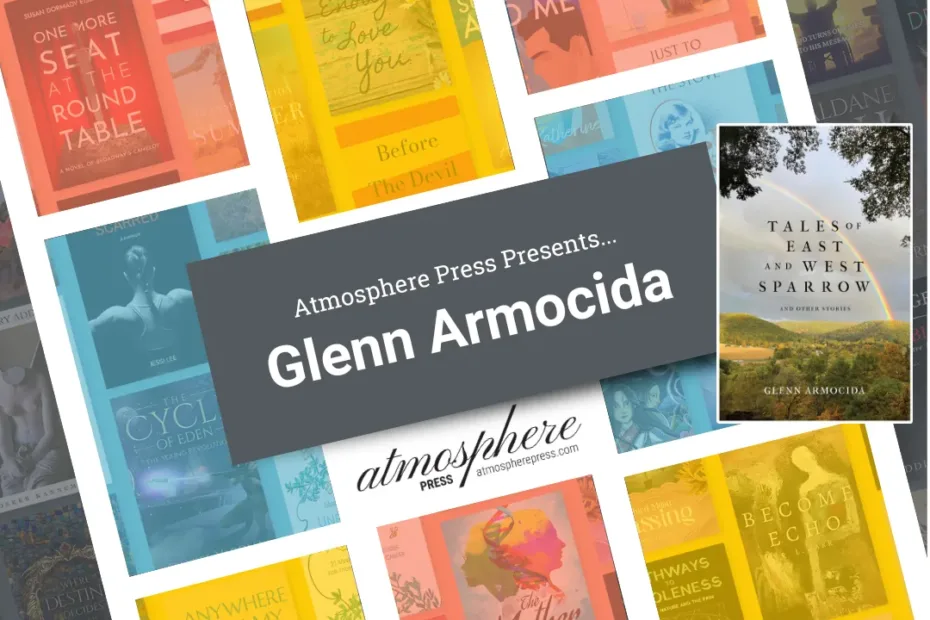
Glenn Armocida resides in western Pennsylvania. He was a finalist in the Rash Award in Fiction (2022 and 2024). His recent work appears in The Broad River Review, Solum Journal, Black Moon Magazine, Havik, Heart of Flesh Literary Journal, The Watershed Journal, and The Ground Up. In the 1980s, Armocida attended the University of Pittsburgh as an English major in the College of Arts and Sciences’ creative writing program. During this time, he published poems in Poetry ‘n Prose, Kiosk, and Afterimage, and feature articles in Pittsburgh Magazine, Pittsburgh Post-Gazette, and Executive Report. He has worked as a mill laborer, cook, radio news anchor, printer, technical and business writer, editor, and the past thirty-four years as an investment manager. When he is not writing, Glenn is with his family, ministering to the homeless, tending his gardens, or pursuing outdoor life.
Tell us the story of your book’s title. Was it easy to find, or did it take forever?
When I got back into writing after a long hiatus, I created and published my first three short stories, all completely different from each other. My wife and I own a cabin in the Allegheny National Forest; it’s the Pennsylvania Wilds section of Northern Appalachia. It’s been called ‘God’s Country’ forever by Pennsylvanians. We spend time at our cabin from spring through late autumn and it’s a great place for me to write. As I got to know the folks in the area, I began to envision creating a group of stories centered around a fictional community in this region. The idea blossomed into six intertwining stories – I think of it as a ‘community of stories’ – and I needed a name for the towns, and the book itself.
First of all, the word ‘stories’ didn’t really capture the nature of the atmosphere of what I was creating. There’s an element of magical realism to these stories and the word ‘tales’ seemed to fit just right. Thus, I had ‘tales,’ but ‘tales’ of what? It became obvious to make it ‘tales’ of these fictional communities. I needed a name for the two towns, and I tried a number of different options, some based on real villages in the region, others on made up names. Nothing truly fit.
One July day in 2023, we were returning from the cabin to our home near Pittsburgh and stopped at our favorite ice cream stand (Sweet Delights Ice Cream near New Bethlehem, the BEST ice cream stand anywhere!). As we enjoyed our treats sitting on a picnic bench, I was feeding bits of my cone to a clutch of friendly sparrows begging for food at our feet and inspiration hit! I turned to my wife, Ginny, and told her I would name the towns East Sparrow and West Sparrow. That night I decided to name the book, Tales of East and West Sparrow and Other Stories.
How did it feel when you first saw your book cover? Or when you first held your book in your hands?
I’m in my sixties now and I began writing in high school, then worked a bunch of jobs, and finally enrolled at the University of Pittsburgh’s creative writing program to pursue becoming a novelist and poet. I never finished my degree. In my senior year, my first wife and I bought a house, and I needed to earn money. I talked my way into a job at the university as technical writer, then moved on to one of the big accounting and consulting firms in the city to work as a business writer.
I kept writing fiction and poetry until, at age thirty-one, I changed careers completely and became an investment advisor. I was self-employed, so I worked so many hours six days a week that I left creative writing behind so that I could focus on my young family. Twenty-five or so years went by and, in my late fifties I realized that if I was going to ever become a published author, I had to get busy on it. So, I began creative writing again, finally, here and there.
When I was about sixty, I became serious about it and began creating short fiction and getting stories published in various literary journals around the country. In late 2023, I bundled those and other stories into a manuscript and submitted it to half-a-dozen publishers. Finally, Atmosphere Press accepted my work in November 2024, and we began into the publishing process in earnest in January 2025. So, I was thrilled to see the design for the book’s cover during the process and thoroughly overjoyed when I held the proof copy the first time. What a blessing! It was a very long road to get to that moment. I held that book in my hands for an hour or more.
Who/what made you want to write? Was there a particular person, or particular writers/works/art forms that influenced you?
I always loved to read. My dear mother instilled the love of reading in me and my three sisters at an early age. Two of my high school English teachers, Miss Williams and Mrs. Digiambattista, encouraged me to write outside of the assignments, on my own time, as they said I had a talent. I guess I did something right in high school at least once! I found that the more I wrote, the more I liked it, and my confidence grew. I guess I was about seventeen when I considered the notion of becoming a writer.
As for influences, my tastes were and are fairly eclectic. I would try reading most any writer. And at that time, in the 1970s, the public high school curriculum, at least at my school, was fairly robust and demanding. All of my English teachers considered it normal to assign the classics to us goofy, distracted teenagers. I remember reading Dickens’ A Tale of Two Cities, a portion of Tolstoy’s War and Peace, A Canticle for Leibowitz by Walter M. Miller Jr., a couple of Hemmingway’s novels. They challenged us and that was the right thing for them to do. I lapped it up. I was enamored with the form of the novel and with the idea that perhaps I could do this. One of my girlfriends in school introduced me to Kurt Vonnegut’s work and that was a mind-opener; I read many of his books and was particularly entranced by Breakfast of Champions and Slaughterhouse-Five. This gal also turned me on to In Watermelon Sugar by Richard Brautigan, which I disliked, thought it was hippie juvenile nonsense, and so I stayed away from those writers.
Over time I came to love the classics, just really great literary fiction. I think Charles Dickens is the greatest writer, I love his works, his narrative style. Ernest Hemmingway, too – he’s the master of dialogue and I was drawn to his masculine stories. Others I admired in my early years were William Faulkner, Ray Bradbury, Shakespeare, of course, and I read a lot of Stephen King’s early novels. In my twenties, while at the university, I got into Raymond Carver and his spare, tight style of narrative. I had to read some of Thomas Mann’s works, which are just beautiful and difficult because he was such a learned scholar. I became captivated by the magical realism genre, the great Latin American writers: Gabriel Garcia Marquez, Mario Vargas Llosa, Jorge Luis Borges. More recently, I’ve read much of Cormac McCarthy’s work, it’s beautiful genius, but admittedly pretty dark stuff. He’s another master of efficiency in dialogue and narrative.
What other professions have you worked in? What’s something about you that your readers wouldn’t know?
I’ve been working since I was thirteen years old. I’ve worked as a laborer in an aluminum mill, short-order cook, a radio news anchor when I was nineteen, for a low-budget public radio station in Pittsburgh, a printer, and all of the technical and business writing and editing. For the past thirty-four years I’ve been and financial advisor and an investment manager.
Most readers, other than my immediate family, would not know that I trained and was schooled in my high school years to become a cosmetologist. I learned how to set women’s hair with curlers and even learned to cut hair (not very well). My father was a professional stylist and really wanted me to join him in his business. I didn’t want to do that, but I did as I was told. Until I didn’t! I finally made it clear to him, after butting heads figuratively and literally, that hair styling wasn’t for me.
What was the most rewarding/meaningful part of publishing your book?
Writing the book’s dedication to my wife, Virginia. I’ve always known in my heart that I would one day publish a book, and I’d daydreamed of writing a dedication. She has been the proverbial pillar of support for me and my writing. That short, simple dedication line was what I’d wanted to write for decades.
If your book had a soundtrack, what are some songs that would be on it?
A lot of the songs by Jamestown Revival, especially their Utah album. They tell stories of simple, everyday people in their music, stories with characters that resonate with my characters and my muse. For certain of the narrative passages in my stories, in which I bring the reader into the beautiful Allegheny Forest, I think that the four concerti of Antonio Vivaldi’s The Four Seasons would be an ideal soundtrack.
What is one thing you hope readers take away from reading your book? How do you envision your perfect reader?
I’ve learned that life is not for the faint of heart. The world is a tough place, and it can beat you upside your head and down to the dirt. Like so many people, I’ve experienced my share of that. I’ve come to lean on and lean into my relationship with Jesus, my Lord and Savior, to not only get me through the ugly, hard times, but to also fully realize and experience all the good in this world. I know that my Creator gifted to me the talent for writing and I work hard to create stories that glorify Him in some way or another. God’s Spirit, the Holy Spirit, inspires my muse, my creative force, and the Spirit is at work in every one of the stories in my book (except for the first one), subtly or overtly. This is a reality for us Christians. So, my stories all have different themes of the Christian life and faith – sacrificial love, forgiveness, prayer, reconciliation, and so on. Not every character gets the faith right (who does?), and not every character has a classic happy ending in my stories. But I do wish that readers would find the common theme of hope in all of my works. It’s there, that living hope, because it’s in me and it flows out of my imagination when I write.
The perfect reader? Someone who enjoys reading my stories as much as I’ve enjoyed writing them and then is sad when the story ends because they want the story to go on and on.
What creative projects are you currently working on?
After submitting this manuscript for Tales of East and West Sparrow and Other Stories to publishers in late 2023 and into 2024, I began on a sequel, which will be called Letters from East and West Sparrow and Other Writings. I have ideas for eight or so new Sparrow stories in which a letter or letters will figure into the plot for each one. I’ve finished the first two so far and published those in literary journals at the beginning of this year. I’ve begun two more stories but have slacked off over the past six months as I’ve been consumed with the work of selling my investment practice so that I can retire write full time. I am on the cusp of that now, here in November 2025. I will work full force on that book over this winter.
I have also written two children’s books, one last year one just recently, which is tentatively titled Trinny Cherry Seed. It will be a story book for ages four to seven, I guess. I have enticed one of my granddaughters, Hazel (age fifteen), who is very talented, to create the illustrations for this book. We have just begun that collaboration and I’m pretty jazzed for it all!
How was working with Atmosphere Press? What would you tell other writers who want to publish?
The Atmosphere Press team has been supportive, professional, so very enthusiastic about my book, very flexible and accommodating in every phase of the process. Working with my developmental editor, Charlie Westerman, was a superb experience; he worked me hard and helped make each story the best that it was meant to be. Overall, everything was about as efficient as could be, a few bumps, and all was transparent. I am pleased.
As for what I’d tell other writers who want to publish: work, work, work. And when you’re done doing that – work some more. Keep your end goal always in your mind: there is a day on the calendar when you will hold your published book in your hand. Play the long game. And use honest, sincere beta-readers to critique your drafts; avoid the folks who will tell you ‘I liked it’ just because they like you. You must write and revise and revise and revise until you get that story to where it is meant to be. It may take ten or twelve or more drafts. Don’t settle for anything less than crafting the gem that the story was meant to be. You owe it to the story. If you want to short cut your writing, then go find something else to do, for you are not meant to be a writer.
Are you a writer, too? Submit your manuscript to Atmosphere Press.
Atmosphere Press is a selective hybrid publisher founded in 2015 on the principles of Honesty, Transparency, Professionalism, Kindness, and Making Your Book Awesome. Our books have won dozens of awards and sold tens of thousands of copies. If you’re interested in learning more, or seeking publication for your own work, please explore the links below.