An Interview with Chelsea Muzar
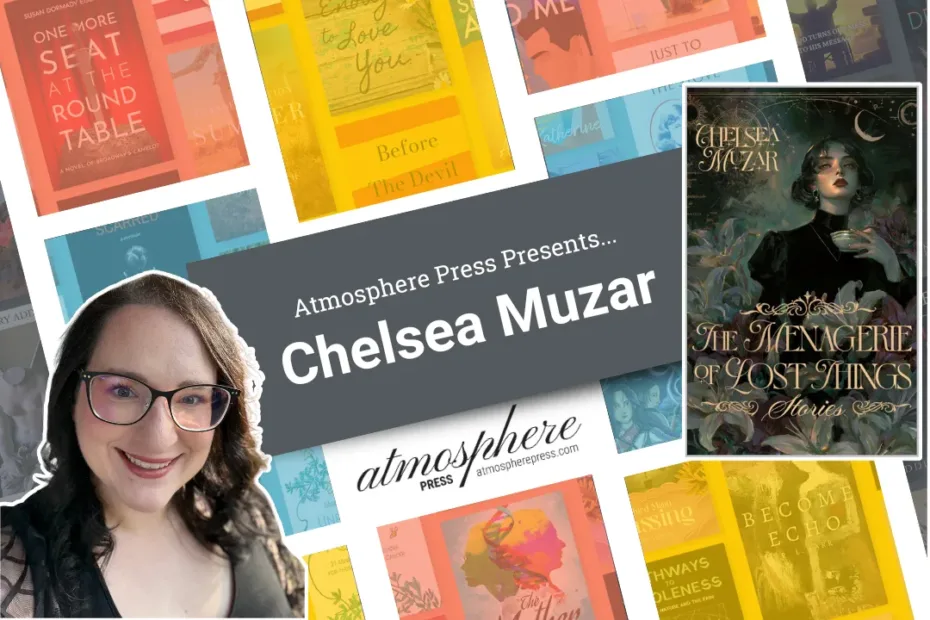
Chelsea Muzar holds her MFA in creative writing from the University of Nebraska Omaha. Her work has been published in Clarkesworld Magazine, Planet Scumm, and Kansas City Voices. When she isn’t writing, she’s enjoying time with her husband, daughter, and their toy poodle.
What inspired you to start writing this book?
Many things inspired The Menagerie of Lost Things, but I have to say the biggest inspiration was folklore. At the time of writing the collection, I was steeped in these fantastical stories that share threads of truth across different continents and cultures. I wanted to tug on those threads and see what I could come up with. When reading tales about Selkie wives, we have these elementals of the mystical – shedding their sealskin, for example – but we also have this underlying trauma. The seal wife has been stolen from the sea and forced to marry the fisherman. I wanted to examine that piece of the story and expand on it. I don’t have a story about the Selkie wife in my collection, it’s actually a Selkie husband, but the themes of control and loss are still there.
Another large piece of inspiration came from swimming. I would go to the pool in the morning, do some laps, float around, and just enjoy being in the water. Six out of the thirteen stories have something to do with water, whether that’s swimming or just the creatures that come from the lakes and the seas. I’ve always been an avid swimmer, and the pool has always been a relaxing space for me. So, I guess it’s natural that water has worked its way into so many of my stories.
Tell us the story of your book’s current title. Was it easy to find, or did it take forever?
I flipflopped between calling the collection A Guide for Drowning and The Menagerie of Lost Things. Both of which are short stories within the collection, and I’m fond of both titles. That is what took forever, deciding which direction to go. Ultimately, I settled on Menagerie because I felt that it fit the overall mood better.
The Menagerie of Lost Things came to me relatively easily. I really enjoy the word menagerie, and the story I was writing at the time was about a collection, a circus, of mythological creatures. ‘Lost things’ came from two ideas. The first is that, in this day and age, mythical creatures are sort of shoved aside. They are forgotten. For some of them, their stories are lost to time. The other, is that the main character of the story has lost something important, something she feels defined her whole being. She’s just as lost as the creatures themselves.
What books are you reading (for research or comfort) as you continue the writing process?
I like to read Karen Russell’s collections of short stories, Vampires in the Lemon Grove and St. Lucy’s Home for Girls Raised by Wolves. Her work really helped me find my voice and style. Before, I was trying very hard to fit into what I thought was the basic literary voice. I’d been studying for my master’s in writing and much of the work I was reading was very masculine, very of its time. It was stiff for me and didn’t give me any breathing room when I tried to capture that voice in my own work. But when I read Russell’s stories, I realized I could relax. I could lean into my natural voice and the things I enjoyed instead of trying to fit into this authorly mold that I had created in my head.
When I’m writing, the authors I read write in the same or similar genres as I do. I read authors whose work inspires me to try something different or to work a bit harder on that descriptive phrase. I really enjoy Krystal Sutherland, Madeline Miller, and Kiersten White.
Who/what made you want to write? Was there a particular person, or particular writers/works/art forms that influenced you?
I started writing when I was very young. I remember keyboard smashing on my mother’s computer thinking I was writing about a princess escaping from the villain’s castle. In truth, I was a Disney kid, so Disney most likely inspired these first creative attempts. As I grew older, it was books by authors like Lynne Ewing, Laurie Faria Stolarz, and Holly Black who opened me up to the magic of writing. I wanted to write about romance. I wanted to write about people my age and the adventures we could go on.
I also really wanted to write fanfiction (and I did!) of the shows and movies I was watching. Those were some of my earliest attempts at writing something substantial.
I had an English teacher in high school, Mrs. Gross, who pushed me to give writing a serious chance. She’s the reason that I tried out for the Coterie Theater’s Young Playwrights Roundtable, and submitted work for the Iowa’s Young Writers Studio, both of which I was accepted into. She would sit with me and go over each section of a story and help me piece together where I could polish it, where I could push it, and how far I could stretch myself creatively. She’s the main influence behind me sticking to writing for as long as I have.
Where is your favorite place to write?
So, I usually write in my office, but my favorite place to write is actually my daughter’s room. She’s a toddler, and we still have the super comfortable rocking recliner in her room that we used when she was an infant. I sit on that chair with a pillow on my lap and it’s so comfortable and cozy that it’s become the best place for me to write. Well, when she’s not home! She wants to play with my laptop whenever she catches me writing. At some point I will steal the chair from her room.
What advice would you give your past self at the start of your writing journey?
Focus on the basics. Don’t get wrapped up in trying to be the best writer of a generation (that’s not going to happen). Step back and really look at the structure of plot and character development. That will save you lots of tears and self-doubt when it comes to receiving feedback from writing workshops. Oh, and speaking of workshops, they can be more harmful than good. Find a close group of writer friends instead. Ones who won’t be afraid to mark up your manuscript, yes, but who are also your biggest cheerleaders. You’ll need the support when it comes to taking all that hard work and trying to get it published.
There’s another thing. Publishing won’t make you feel any different. You’ll always be changing, growing, and learning. Having something published is great! You’re still going to feel like you have no idea what you’re doing.
What’s one thing you hope sticks with readers after they finish your book?
A lot of my stories deal with very heavy themes. Loss and grief are at the center of many of them. What I want readers to take away is that there’s still hope outside of that trauma. There’s still a light at the end of the proverbial tunnel. For example, Cave of the Lost Frog Woman, the last story in the book, focuses a lot on pain, suffering, and abuse, but that’s not the overall message of the story. Breaking the cycle, recovering from trauma, healing from what’s been lost. Those are the messages I hope stick with readers.
Are you a writer, too? Submit your manuscript to Atmosphere Press.
Atmosphere Press is a selective hybrid publisher founded in 2015 on the principles of Honesty, Transparency, Professionalism, Kindness, and Making Your Book Awesome. Our books have won dozens of awards and sold tens of thousands of copies. If you’re interested in learning more, or seeking publication for your own work, please explore the links below.