An Interview with J.B. Bozie
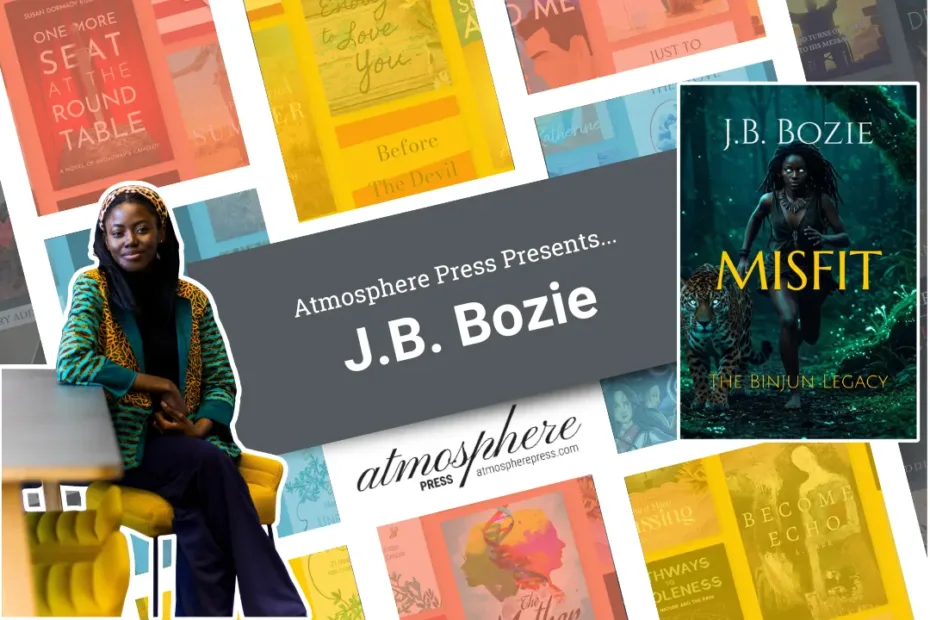
J.B. Bozie is a Ghanaian author, storyteller, and creative strategist whose work blends African mythology, futuristic science, and intimate human emotion. She is the mind behind MISFIT, a multi-era, time-bending novel that threads together 699 AD Binju lore and the raw coming-of-age journey of a mysterious girl on the verge of a spiritual awakening.
She is an award-winning entrepreneur recognised for her creativity and ambition. Her background spans business, fashion, floristry, education, and the arts, an eclectic path that shapes the emotional layering and cinematic quality of her narratives. She has written across mediums as a ghostwriter, scriptwriter, and content creator, and has traces of her artistic dexterity in the world of film and screen as that has always been what she calls her ‘end game.’
J.B. holds a BSc in Business Administration from Central University (Ghana) and an MBA from the University of Northampton. She has participated in internationally recognized business and creative challenges. Her work is known for its cultural depth, psychological insight, and the way it bridges ancient symbolism with contemporary identity.
Whether exploring themes of belonging, ancestry, grief, or power, J.B. writes with a voice that feels both intimate and universal, inviting readers to step into worlds where time bends, secrets breathe, and identity becomes a quest. She prides herself as a writer on a mission to represent Africa in a way that is not just different but also appealing to readers globally.
She is currently based in the UK and is working on her second book.
What inspired you to start writing this book?
Honestly? MISFIT started because I was tired of seeing Africa portrayed like one long documentary soundtrack: drums, droughts, and the occasional lion that looks like it pays rent. I grew up knowing an Africa that was layered, spiritual, unpredictable, and, let’s be honest, dramatic in the best way. So, I wanted to write a story that reflected that version. The one we actually know.
I’ve always believed that African stories don’t have to sit in the ‘cultural corner’ of the global bookshelf. They can be cosmic. Futuristic. Dark. Playful. Even time-bending with a side of ancient suspense. So, I built a world where a young girl can hold a soul stone in one chapter and jump into the future in the next…because why not? Our histories are already wild; I just gave them a passport.
Writing MISFIT was also my way of rebelling against the idea that identity must be neat. It isn’t. It spills. It confuses. It shape-shifts, especially when you come from a place where tradition and modern life constantly eye each other like siblings fighting for the front seat. I wanted a story where a character like Inka doesn’t just ‘find herself’ but chases herself across centuries and cultures, because sometimes that’s what growing up feels like.
And if I’m being fully transparent, I wanted Africans, especially young girls, to see themselves in a fantasy that doesn’t apologize for its roots. A world that isn’t ‘inspired by Africa’ but is African, boldly, magically, and sometimes chaotically so.
MISFIT is my love letter, my side-eye, and my plot twist all aimed at rewriting what the world thinks our stories can be.
Tell us the story of your book’s current title. Was it easy to find, or did it take forever?
It definitely was not easy to find. The entire story took five years to reach its published state, and during those five years the title gave me the most stress. I knew from day one that I wanted the title to be MISFIT. It captured the heart of the story, the tension, the identity struggle, and the mystery. But I also knew that using just MISFIT on its own would create a marketing challenge for me. It is a strong word, but it is also a common one, which meant it could easily get lost in a sea of similar titles.
So I had to improvise. I needed something that felt unique, something that carried the weight of the story’s cultural and mythological roots without sounding complicated or unfamiliar. That was the real balancing act. What would stand out? What would intrigue readers? What would carry the essence of this world I built without giving too much away?
That is how I eventually landed on The Binjun Legacy. It felt distinct. It felt purposeful. And it allowed me to honour the mythology and mystery at the core of the story. It gave the title a sense of depth and heritage, while still allowing MISFIT to be the beating heart of the narrative.
In the end, the title became a reflection of the book itself. A blend of identity, legacy, and the courage to stand apart. It took a long journey to get there, but it now feels like the only title the book ever could have had.
Describe your dream book cover.
My dream book cover is the kind that doesn’t just sit quietly and behave. I want a cover that looks like it has a pulse. Something that feels alive, even the title is written in a way that speaks of both futurism and ancient symbols. In fonts that seem out of this world but readable. In my ideal version, the forest is darker, richer, and thick with mystery. The air glows with that deep green-blue bioluminescence that makes you feel like something ancient is paying attention. The girl in the centre is fierce and untamed, her skin catching light in a way that hints she is not just human. Her eyes are bright with power, almost too bright, like she knows something the rest of us are not ready for.
And beside her is a mysterious jaguar. Not just any jaguar, but one that looks carved from legend. Its coat is glossy, alive with subtle flickers of gold, and its eyes glow like embers. Imagine fire woven into the scene. Not wild flames, but controlled power. Sparks drifting through the air like ancient spirits. The entire cover should be high definition that presents the wow factor. That is my dream cover for MISFIT. Bold. Luminous. Charged with magic. A cover that makes you open the book because you simply need to know what this world is hiding.
If your book had a soundtrack, what are some songs that would be on it?
I’m glad you mentioned this because my book already has an entire ALBUM! But if it has a soundtrack it will definitely be Chinchilla’s Little Girl Gone with a few choral elements and a touch of Hans Zimmer.
What books are you reading (for research or comfort) as you continue the writing process?
Right now, I’m deep into African mythology, and honestly, it still shocks me how many of our stories have been erased or forgotten. The more I read, the more I feel this fire to protect and reimagine what’s left.
I’m also balancing that with some self-development – The Let Them Theory by Mel Robbins is sitting on my bedside table and humbling me daily. And when my brain needs softness, I go back to my comfort classics: Anne of Green Gables, a little Jane Austen… the books that reset my energy and remind me why I love storytelling in the first place.
It’s my personal therapy for the ‘bloops,’ that sneaky writer’s block that tries to creep in.
What other professions have you worked in? What’s something about you that your readers wouldn’t know?
Before I became an author, I collected job titles the way some people collect fridge magnets. I’ve worked in floristry, which basically means I’ve survived the emotional rollercoaster of wedding brides, last-minute bouquets, and the occasional ‘I’m sorry I messed up’ flower order. You learn a lot about people when you’re the middleman between their feelings and a bunch of roses. I’ve been a somewhat mixologist and a cocktail vendor for parties, I’ve also worked in events and services, two industries that should qualify as extreme sports. If you can coordinate an event, manage guests, smile through chaos, and still remember which tray goes where, you can survive almost anything, including writing a novel.
Then I went to co-founding an NGO to founding my own fashion business in the creative industry, where I create drawstring bags with African and cultural fabric. For me, African representation is very important. I’ve been a teaching assistant focusing on SEN, which I still do part time, worked as a student ambassador back in university, done some freelancing as a non-fiction ghostwriter and scriptwriter, even for film and drama. My career path slightly resembles a zigzag drawn by a toddler and you can call me a ‘Jack of all trades’ but sometimes circumstances makes you swing between passion and necessity just to survive. Every role taught me something, how people move, how they think, what they hide, and what they hope for. And all of it ended up in my writing. Honestly, if I hadn’t lived so many little lives, MISFIT wouldn’t exist the way it does. I have loved doing most of these things as I have learned a lot, but ultimately I want to find myself working in the world of film and screen. So yes, I’ve worn many hats. Some glamorous, some stressful, some hilarious. But each one sharpened a different part of me and somehow, they all led to storytelling.
Who/what made you want to write? Was there a particular person, or particular writers/works/art forms that influenced you?
I would say my first inspiration was my brother. By class three, he was already known by all the teachers and seniors in school for being a talented story writer, and I admired that. His books were so hilarious, and in a way, he encouraged me to read more. My parents were avid readers as well, and our home was always filled with books. I come from a family of book lovers, not just in the nuclear sense, but extended too. Everyone in my family read, and books were often given to us as gifts. As a child, I loved reading Enid Blyton, as well as works by Ghanaian writers like Ama Ata Aidoo and Efo Kodjo Mawugbe. In class six, I became the third runner-up in a regional competition, and my prize was a poetry book by Lawrence Darmani, who quickly became one of my favorites. By high school, I was already writing novels, and it was around that time that I discovered my grandfather had been a writer too.
Where is your favorite place to write?
I really don’t have a favourite place to write, I’m not one to be easily distracted when I’m writing, but I definitely love coffeeshops. They’re the perfect place for me to sort my thoughts.
What advice would you give your past self at the start of your writing journey?
Everything eventually falls into place. You will definitely hit some hurdles but you will also have so many opportunities. You will give up writing at some point and you will struggle to find it again, but it will come to you and when it does. Treat it as something sacred this time.
What’s one thing you hope sticks with readers after they finish your book?
What I hope sticks with readers after reading MISFIT is the quiet power of belonging to yourself. Mabu/Maia’s journey is about finding her identity, understanding her roots, and embracing the parts of herself that the world might call strange or broken. I hope readers feel seen in her struggles, inspired by her courage, and reminded that it’s okay to be different, to be misunderstood, and still shine. Misfit is a story about resilience, self-discovery, and the deep, unshakeable magic of owning who you truly are. If readers close the book feeling a little braver, a little more understood, or a little more themselves, then I know the story has done its job.
Are you a writer, too? Submit your manuscript to Atmosphere Press.
Atmosphere Press is a selective hybrid publisher founded in 2015 on the principles of Honesty, Transparency, Professionalism, Kindness, and Making Your Book Awesome. Our books have won dozens of awards and sold tens of thousands of copies. If you’re interested in learning more, or seeking publication for your own work, please explore the links below.