An Interview with Tyler Baker
I live in Vermont with my wife and daughters, one of whom we just adopted. I recently graduated Summa Cum Laude from Southern New Hampshire University with my bachelor’s in social work with a concentration on children and families.
Tell us the story of your book’s title. Was it easy to find, or did it take forever?
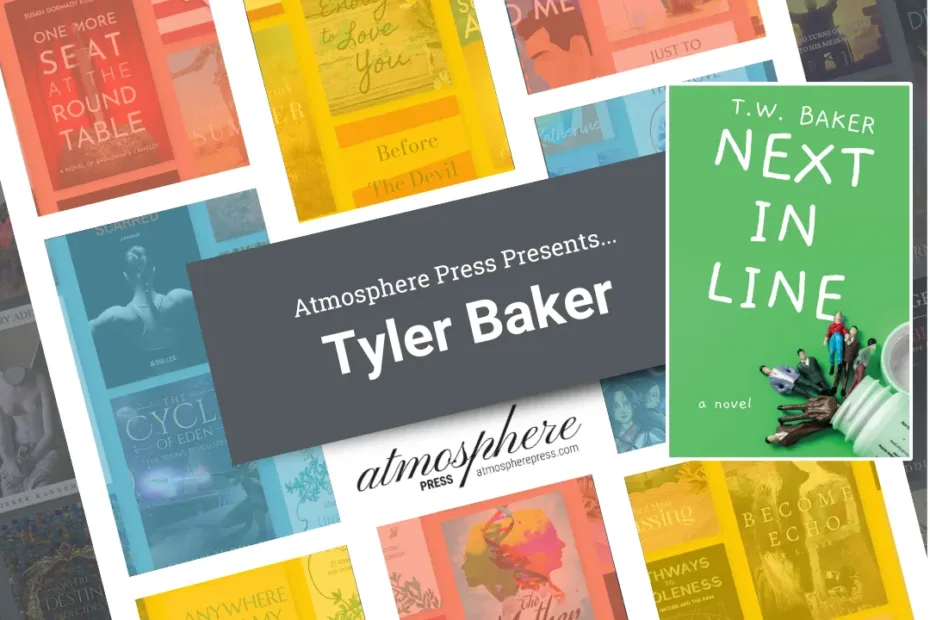
It wasn’t an epiphany moment, but the title, Next in Line, was inspired by the countless times over the years I had to say ‘next in line’ at the pharmacy counter.
How did it feel when you first saw your book cover? Or when you first held your book in your hands?
Seeing my book cover for the first time felt surreal – like a private dream suddenly made public. Until that moment, the story had lived only in my head and on my screen, fragile and unfinished in a way that only writers understand. The cover made it real. It gave the story a face, a promise to readers, and I remember a rush of pride mixed with vulnerability – because once it has a cover, it’s no longer just mine. It’s stepping out into the world, open to interpretation, judgment, and connection.
Holding the physical book in my hands was even more powerful. The weight of it carried every late night, every doubt, every moment I wondered if the story was worth finishing. Turning the pages felt like tracing proof of persistence – of choosing to keep going when it would have been easier to stop. There was gratitude in that moment, and a quiet awe. Not just because I had written a book, but because a story that once existed only as an idea now had the chance to live in someone else’s hands, to be felt, remembered, and maybe even loved.
Who/what made you want to write? Was there a particular person, or particular writers/works/art forms that influenced you?
I love this question! Although, it certainly is loaded.
My desire to write came from a deep need to make sense of emotion – especially the kind that lingers quietly beneath the surface. I was drawn to storytelling as a way to give shape to feelings that didn’t always have clear names: grief, longing, displacement, hope. Writing became a space where I could slow things down, examine moments more closely, and explore the inner lives of people who are often navigating pain or transition in silence.
I was also inspired by all my former and current colleagues. Ultimately, I write because it allows me to connect to myself first, and then to others who might recognize their own experiences in the characters and find comfort in knowing their story matters.
What other professions have you worked in? What’s something about you that your readers wouldn’t know?
Twenty-plus years working as a pharmacy technician. But prior to that I was bus boy at a fancy restaurant.
What was the most rewarding/meaningful part of publishing your book?
The most meaningful part of publishing my book wasn’t the moment it went live or seeing my name on the cover – it was realizing that the story no longer belonged only to me. Once it was published, it became a bridge. Readers brought their own experiences, griefs, hopes, and memories to the pages, and suddenly the story was doing work I could never have planned for it to do on my own.
If your book had a soundtrack, what are some songs that would be on it?
Well, there certainly would be some trance or trap music as Mik loved himself some trap music.
What is one thing you hope readers take away from reading your book? How do you envision your perfect reader?
I imagine (and hope) readers recognize the characters are deeply human and flawed. That they see pieces of themselves in the pages, pausing often, and finishing the book with a sense of reassurance – that their story is unfolding exactly as it should like the characters, even if it doesn’t look the way they once imagined.
What creative projects are you currently working on?
I have a contemporary romance novel that is also ready to go with a completed manuscript. It’s a tearjerker! I also would love to co-author a book with my wife about adoption.
How was working with Atmosphere Press? What would you tell other writers who want to publish?
Working with Atmosphere Press was a collaborative and affirming experience. What stood out most was the sense that my story mattered – not just as a product, but as a piece of art. The team treated the book with care and respect, guiding me through each stage of the process while still honoring my voice and vision. Publishing can feel overwhelming and impersonal, but Atmosphere Press made it feel intentional and human, which allowed me to stay creatively invested rather than intimidated by the logistics.
To other writers who want to publish, I would say this: Don’t rush the process, and don’t minimize your work. Take the time to find a publishing path that aligns with your values and goals, whether that’s traditional, hybrid, or independent. Be open to feedback but protect the heart of your story. Most importantly, keep going – even when doubt creeps in. If you’ve written something honest, something that matters to you, there is a reader out there who needs it. Publishing isn’t just about putting a book into the world; it’s about trusting that your voice deserves to be heard.
Are you a writer, too? Submit your manuscript to Atmosphere Press.
Atmosphere Press is a selective hybrid publisher founded in 2015 on the principles of Honesty, Transparency, Professionalism, Kindness, and Making Your Book Awesome. Our books have won dozens of awards and sold tens of thousands of copies. If you’re interested in learning more, or seeking publication for your own work, please explore the links below.