An Interview with Effie Soumelidis
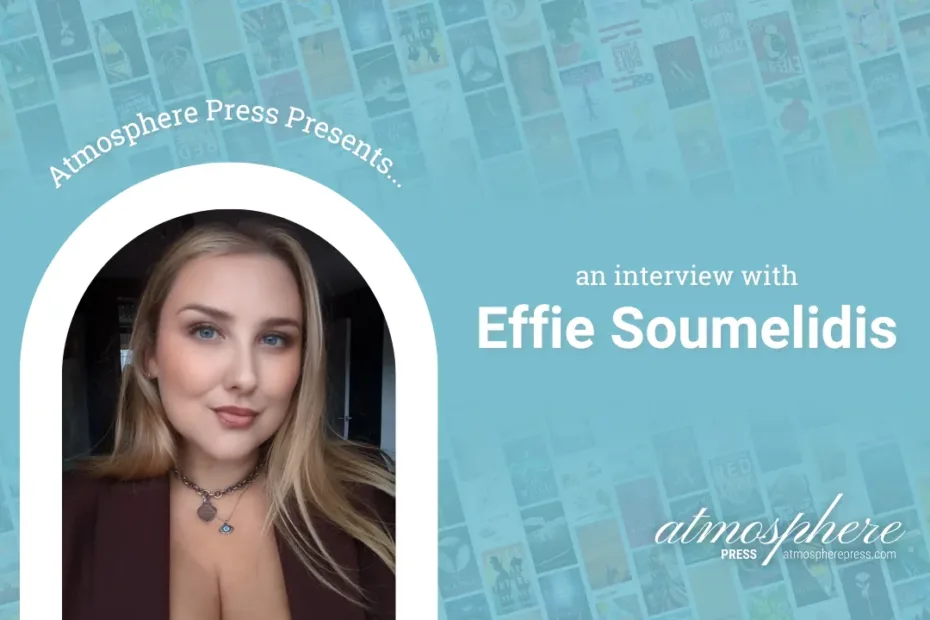
Effie is an indie author from the North of England, where she lives with her husband of over twenty-five years and their two children. Influenced by her Greek heritage, she is drawn to stories shaped by history, legacy, and the ties that bind people long after they should have let go. She writes emotionally charged romance with a darker edge, often blending contemporary and paranormal elements to explore love, grief, power, and what it means to truly belong.
Her stories are driven by complex characters, found family, and slow-burning relationships that don’t come easy. Whether set in the real world or something far more dangerous, her work leans into the tension between control and desire, connection and consequence.
Her debut series, The Soulbound Series, is a genre-blending paranormal romance that explores the cost of survival, the weight of loyalty, and the fragile line between humanity and something more. With morally grey characters and high emotional stakes, it’s a story where power is never free—and love may be the most dangerous risk of all.
When she’s not writing, Effie is usually adding to her ever-growing TBR pile or planning her next trip to Greece to visit her family. A lover of history and photography, she enjoys capturing the character of old buildings, binge-watching a good series, and finding a quiet corner in Starbucks—unless her kids decide otherwise.
What inspired you to start writing this book?
I actually started writing You and Only You over twenty years ago. I’ve always been drawn to the supernatural and stories that explore the darker side of love, but what stayed with me most was the ending—that came to me first. Everything else grew around that final moment.
At its core, the story is inspired by my love of Shakespeare and Greek mythology, particularly the idea of tragic, forbidden love—two souls bound together in a way they can’t escape, yet constantly held apart. That sense of inevitability, of love intertwined with loss and consequence, really became the emotional heartbeat of the book.
For a long time, I held off on publishing. I think part of me was waiting for the ‘right moment’ or a traditional deal, but in reality, I was probably just finding reasons to put it off. When I turned forty, my husband encouraged me to stop waiting and just go for it—to bite the bullet and publish it myself. He knew I’d keep procrastinating otherwise.
That push was exactly what I needed. The story had been with me for so long, and when I finally committed to finishing and releasing it, it became something far more emotionally layered and character-driven than I’d originally imagined.
Tell us the story of your book’s current title. Was it easy to find, or did it take forever?
The title actually came quite naturally once I understood the heart of the story. You and Only You reflects that central idea of two people who are completely bound to one another—not just by love, but by something deeper and more inescapable. Given the themes of forbidden, fated love running through the book, it felt like the simplest and most honest way to capture that intensity.
I did play around with other titles early on, but none of them quite held the same emotional weight. You and Only You just stayed with me.
Describe your dream book cover.
I actually love my current cover, so I wouldn’t change that—it really captures the tone of the book beautifully. But in an ideal world, I’d love to see a special edition version with sprayed edges and foil detailing. I think something like a subtle moonlight-inspired foil for the lettering would be really striking, symbolising the supernatural and the sense of connection that runs through the story. I love covers that feel like objects you want to keep on your shelf, something a bit immersive and atmospheric, and I think those kinds of details would really elevate that feeling.
If your book had a soundtrack, what are some songs that would be on it?
I actually have a curated Spotify playlist for You and Only You, which is available for readers. Music is a huge part of my writing process—I’m very much a mood writer, so I often listen to specific songs when I’m working on key chapters or emotional scenes. Some of the tracks even appear directly in the book, while others helped shape the tone and atmosphere as I was writing. The playlist is quite eclectic. It includes everything from Fightstar, Teddy Swims, Ella Mai, Harry Styles, Jade LeMac, The Goo Goo Dolls, Dermot Kennedy, and Ludovico Einaudi. I tend to be drawn to music that feels emotionally immersive—whether that’s lyrical storytelling or more instrumental, cinematic pieces like Einaudi’s work.
For me, it’s always about songs that make you feel something immediately and capture a very specific mood or moment. That’s what I want readers to experience as well—to be able to listen, sink into that atmosphere, and feel like they’re living inside the story for a while.
What books are you reading (for research or comfort) as you continue the writing process?
At the moment, I don’t get as much time to read as I’d like, as I’m starting work on a romantasy trilogy of my own. But when I do manage to steal a quiet moment, I tend to read quite widely across romance and beyond.
I love light, feel-good contemporary romance, especially authors like Lucy Score, Ana Huang, and Colleen Hoover. I also enjoy stories that explore family dynamics and relationships in a more grounded way, such as Marian Keyes’ Walsh Sisters series. On the other end of the spectrum, I’m drawn to darker or spicier romance as well, including authors like Roni Loren, Brynne Weaver, and Ali Hazelwood. I like books that make me feel something—whether that’s comfort, tension, heartbreak, or humour.
I also return often to the classics. Wuthering Heights is a particular favourite for its intensity and doomed romanticism, and I’ve always been fascinated by The Great Gatsby for its atmosphere and sense of longing. I also appreciate dystopian and allegorical works like 1984 and Animal Farm, which explore power, control, and human behaviour in such a sharp, enduring way.
For me, it’s always about emotional impact and connection to character—whatever the genre.
What other professions have you worked in? What’s something about you that your readers wouldn’t know?
Before writing, I trained as a barrister and spent time working in Houston, Texas, on capital murder cases. It was an intense and formative period of my life, and it gave me a deep understanding of human behaviour, consequence, and the darker sides of decision-making and justice.
After that, I moved into education, which felt like a natural shift in focus. I trained as a teacher and spent over a decade teaching law, politics, religious education, and citizenship in secondary schools in the UK. A lot of my motivation came from wanting to help young people understand systems of power and hopefully steer them away from ending up within the criminal justice system themselves.
Something my readers might not expect is just how much those experiences shape my writing. Even in romance and paranormal fiction, I’m still drawn to questions of morality, consequence, loyalty, and what people are willing to risk for connection or survival.
Who/what made you want to write? Was there a particular person, or particular writers/works/art forms that influenced you?
I’ve always been a voracious reader, even from a very young age, and I think that’s really where my love of writing began. My earliest introduction to the magical and fantastical came through Enid Blyton and Roald Dahl—those stories completely captured my imagination and made me realise how powerful books could be.
I also wrote my first ‘novel’ when I was around ten years old. It makes me laugh now because it was called Shh! And the Dagger Fell and was apparently a very dark thriller—though I don’t remember much of it beyond the title!
As I grew older, Shakespeare became a huge influence. Studying his work in school opened my eyes to language, rhythm, and emotional intensity in storytelling. I was very fortunate to have two English teachers who were real powerhouses when it came to creative writing. They encouraged me to take risks with language and expression, and they really nurtured my love of poetry and storytelling. I owe them a great deal, as they helped give me the confidence to start writing seriously.
Where is your favorite place to write?
My favourite place to write would definitely be a grand library somewhere—like the Bodleian. I’ve always been a little fanatical when it comes to libraries, and I tend to seek them out wherever I go, even when I’m abroad. There’s something incredibly inspiring about being surrounded by that atmosphere and history. Ideally, I’d be there with a good coffee and something sweet, wearing headphones and completely immersed in writing … although I’ll admit the books on the shelves are usually very distracting, as they always seem to call to me!
Closer to home, though, I tend to write in my office. Nine times out of ten, I’m in pyjamas with a pot of tea and an unreasonable amount of sugary snacks within reach. I also like to write with dimmed lighting, which I know probably isn’t great for my eyes, but it really helps me get into the right headspace and build atmosphere while I’m working.
What advice would you give your past self at the start of your writing journey?
I would tell my past self to be braver, and to start sooner. I think for a long time I saw myself in very defined roles—as a teacher, a wife, a mother—and didn’t fully allow space for myself as a writer in the way I should have.
While I do think life experience has shaped my voice and helped me hone my craft, I can also see now that I had so many stories in my head even then. Part of me wishes I had trusted that earlier and given myself permission to start writing seriously sooner.
At the same time, I can recognise the value in having waited—those experiences have given depth to my work. But if I could speak to my younger self, I’d simply say: Don’t wait to feel ‘ready.’ There will never be enough time for all the stories, so start now.
What’s one thing you hope sticks with readers after they finish your book?
I hope what stays with readers is the emotional weight of connection, the idea that some bonds feel inevitable, even when they’re dangerous or complicated. I want them to sit with the question of what they would risk for love, and whether being bound to someone is a gift or a curse.
At its heart, my writing often explores deep emotional connection, whether that’s through fated bonds or relationships shaped by circumstance, choice, or timing. I want that feeling to linger long after the final page. Even when the story ends, I hope the emotion of it, the intensity, the longing, the sense of ‘what if?’ stays with readers.
Are you a writer, too? Submit your manuscript to Atmosphere Press.
Atmosphere Press is a selective hybrid publisher founded in 2015 on the principles of Honesty, Transparency, Professionalism, Kindness, and Making Your Book Awesome. Our books have won dozens of awards and sold tens of thousands of copies. If you’re interested in learning more, or seeking publication for your own work, please explore the links below.