
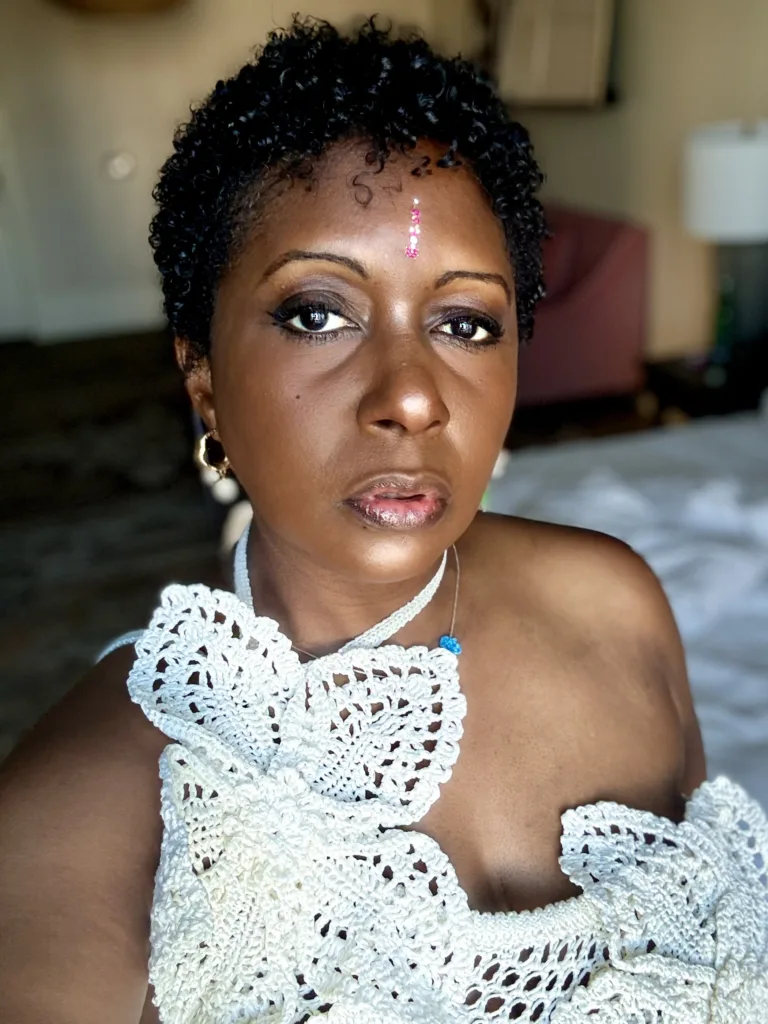
Aziza Kibibi is an author, speaker, advocate, and founder of Precious Little Ladies Inc., a New Jersey–based nonprofit dedicated to preventing child sexual abuse, supporting survivors, and strengthening families through education, outreach, and community-centered resources.
A survivor of long-term incestuous abuse, Aziza uses storytelling, advocacy, and public education to challenge silence, protect children, and help others reclaim their voices. She is the author of Unashamed: A Life Tainted…, a chef, and an experiential trauma coach, guiding others on their healing journey via lectures, personal sessions, and social media.
Aziza continues to write about survival, healing, truth-telling, the power of transforming pain into purpose, and living life to the fullest.
Like a magic spell, the literary spell uses different formulas for different purposes.
I stopped writing after my father discovered the secrets he forced me to keep laid bare in black and white. I stopped writing for myself, that is. I was assigned the task of writing synopses and treatments for the music videos my father directed, and though it didn’t compare to my diary, narrating someone else’s story was still an escape.
Though not an intentional transference of the trauma I was experiencing, the practice of any type of writing proved cathartic for me. That said, each form of writing can provide a distinct path to healing. No single form works for every writer, and not every painful experience needs to become a published work.
The Forms That Help Us Survive
Journaling is often the most private and immediate form. It does not require structure; it doesn’t need to be edited, and it will not be critiqued. It allows the writer to record feelings, dreams, triggers, memories, questions, and contradictions without having to explain them to anyone. Journaling can be especially useful when the wound is fresh or when the writer is not ready or has no intention of shaping the experience for an audience. My book Unashamed: a life tainted… began as a therapeutic journal I chose to share with the world because, while it was helping me survive, I realized that it had the potential to help others survive as well.
Stream-of-consciousness writing is different. It lets the mind speak before the inner critic takes hold of the microphone. This kind of writing can be raw, strange, nonlinear, and surprising. For trauma survivors and grieving writers, that freedom can be powerful because pain does not usually arrive in clean paragraphs. It arrives as fragments—the smell of a room; the sound of a voice; the memory of a touch. It can be a sentence that keeps repeating itself. Stream-of-consciousness writing allows those fragments to surface undisciplined.
Poetry can hold what prose sometimes cannot. A poem does not have to explain everything. It can rely on image, rhythm, silence, and compression. For writers who are afraid of telling too much too soon, poetry can create a veil without creating a lie. Personally, poetry has been my wand of choice for heartbreak and loss because it can tell the truth backwards, sideways, or inside-out.
Creative nonfiction allows the writer to turn lived experience into crafted meaning. It asks not only “What happened?” but “What did it mean? What did it cost? What did I believe then? What do I know now?” This is where pain can become testimony, reflection, and art. Memoir is a form of creative nonfiction. Giving meaning to my lived experience is why I went against the legal advice I received to publish my book as fiction.
Fiction, too, can be a vessel for truth. Some writers need distance from the literal facts before they can approach the emotional truth. Through invented characters, altered settings, and imagined plots, fiction can give writers a safer way to explore grief, fear, shame, longing, and survival without exposing every private detail of their lives.
All of that said, the form matters less than the honesty.
Honesty Without Self-Abandonment
Writers are often told to “go deep,” “bleed on the page,” or “tell the whole truth.” I understand the sentiment, but I am careful with that advice.
You do not owe the page your destruction.
Writing honestly about trauma does not mean forcing yourself to relive every detail. It does not mean publishing before you are ready. It does not mean handing strangers the most tender parts of your life just because pain can be powerful material.
Self-care in writing is not avoidance. It is strategy.
Set boundaries with the work. Decide what you are writing for. Ask yourself: is it for release, clarity, testimony, art, advocacy, publication, or private healing? Give yourself permission to stop when your body says stop. Write in fragments if full scenes feel like too much. Keep a grounding ritual nearby. I usually have a cup of tea within arm’s length and, sometimes, Beethoven playing in the background. Some of my most fluid work comes after making love, while the pieces that literarily deconstruct my walls are written during times of sexual abstinence. Whether it’s music, prayer, a walk, a trusted friend, a therapist, or a favorite blanket, anything that helps you stay grounded in the present is necessary when braving this endeavor.
One practical approach is to move between “heat” and “distance.” Write the hot version first if you need to: the uncensored, furious, grieving, trembling version. Then step away. Later, return as the craftsperson. Ask what the piece needs. What is the emotional center? What details serve the story, and which don’t? What can be implied rather than exposed? What are you bestowing on the reader, and what are you keeping for yourself?
That second stage is important. Trauma may give you material, but craft gives the material shape. Craft is how we keep the wound from swallowing the whole page.
For the Writer Who Is Afraid
If you are afraid to put grief, trauma, or healing on the page, I want to say this: fear does not mean you are not ready to write. Fear may simply mean the work is meaningful.
Start small.
Write one sentence you know is true.
Write a letter you never send.
Write the scene without naming anyone.
Write around the wound before writing directly into it.
Write the smell of the room, the sound of the phone call, the object you kept, the thing you wish someone had said.
You do not have to begin with the worst thing. You can begin with the door. The weather. The shoes you were wearing. The song that was playing. The silence afterward.
And you do not have to publish everything you write. This is important. In a world that quickly turns pain into content, writers must remember that privacy is not cowardice. Some pages are medicine. Others are rehearsal. Some are evidence. Other pages are burial grounds.
You get to decide which pages become offerings.
Storytelling as Resilience
Storytelling becomes a source of resilience because it creates connection where trauma created isolation. When we tell the truth with care, someone else may see themselves and feel less alone.
The most common phrase I receive from my readers is some version of “Your book was devastating and empowering at the same time.” However, that does not make suffering worthwhile. I do not believe we need to romanticize pain to make meaning from it. Some things should never happen. Full stop.
But when tragedy breaks us, storytelling can help us gather the pieces.
It can help us honor who we were before, who we became to survive, and who we are still becoming. It can turn memory into witness, grief into language, and silence into a bridge.
At fourteen, I thought a spell could save me.
In a way, I was wrong.
In another way, I was not.
The spell did not destroy the monster. The diary did not open the locked door for me to escape through. The words did not carry me away from my childhood on moonlit sound waves.
But they gave me somewhere to exist honestly and freely.
They gave me proof that even then, even in the dark, some part of me was still speaking. Some part of me knew I deserved to be heard. Some part of me was already practicing survival through story.
That is the quiet power of writing through grief and trauma.
Not that it magically makes us whole, but that it helps us find the pieces, name them, hold them, and sometimes—when we are ready—offer them back to the world as something stronger than silence.
Keep Up with Aziza Kibibi . . .
Book
Unashamed: a life tainted… Vol 1 & 2
Websites
Podcast
Social media
Instagram, Twitter/X, Facebook: @azizakibibi
TikTok: @IamAzizaKibibi
YouTube: @azizakibibi
