
An Interview with Basil Creese
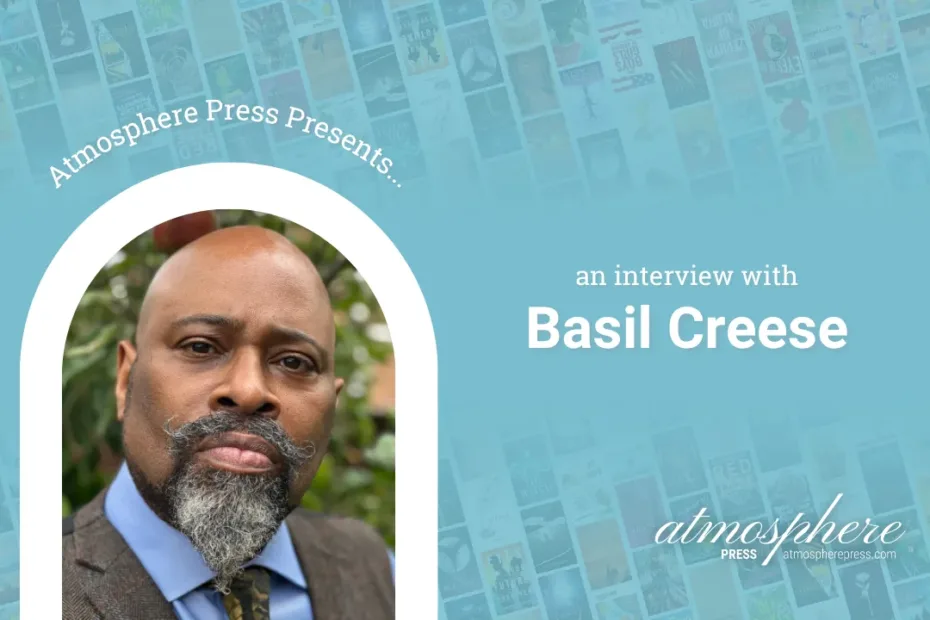
Basil Creese is a former musician and culture writer whose work includes several albums and a cover feature for Tribune magazine examining the legacy of slavery in Britain. He is a recipient of the Curtis Brown Literary Agency’s Black Breakthrough Writers’ Award. Dark Red Traces is his debut novel.
What inspired you to start writing this book?
I wanted to explore the long shadow of empire, the injustices it leaves behind, and the ways stereotypes are created and sustained. Rather than asking what oppression looks like, I wanted to ask what it does to ordinary people, and what resistance looks like in everyday life. Fiction gave me the freedom to ask those questions through character rather than sermonising.
Tell us the story of your book’s current title. Was it easy to find, or did it take forever?
It took a very long time. The novel went through several titles before Dark Red Traces finally emerged, and the moment it did, I knew I’d found it. I liked it so much that I wove it into both the prologue and the final chapter, allowing the title to become part of the novel’s own internal rhythm rather than simply something printed on the cover.
Describe your dream book cover.
I think about book covers the way musicians think about album covers. I’d love to collaborate with an artist who reads the novel and creates something from their own interpretation rather than simply illustrating a scene. The best covers don’t explain a book, they haunt you.
If your book had a soundtrack, what are some songs that would be on it?
Dark Red Traces is, among other things, a novel about resistance: what it costs, what it demands, and how ordinary people practise it every day. The soundtrack would therefore be built around songs of rebellion, solidarity, and defiance:
• Rage Against the Machine—Killing in the Name
• The Clash—White Riot
• Black Sabbath—War Pigs
• Steel Pulse—Ku Klux Klan
• N.W.A—F**k Tha Police
• The Wildhearts—Shut Your F**king Mouth and Use Your F**king Brain
• Gil Scott-Heron—The Revolution Will Not Be Televised
• Kendrick Lamar—Alright
• Fela Kuti—Zombie
• Bob Marley & The Wailers—Get Up, Stand Up
• Víctor Jara—El Derecho de Vivir en Paz
• Nina Simone—Mississippi Goddam
• Sam Cooke—A Change Is Gonna Come
• Nine Inch Nails—The Hand That Feeds
What books are you reading (for research or comfort) as you continue the writing process?
My reading tends to oscillate between thrillers and political history. Ian Fleming’s From Russia, with Love and Richard Stark’s The Hunter remind me how much can be achieved through pace and economy, while Peter Fryer’s Staying Power, Edward S. Herman and Noam Chomsky’s Manufacturing Consent, and Michael Parenti’s Against Empire continually deepen my understanding of Britain’s history, power, and the narratives societies construct about themselves.
What other professions have you worked in? What’s something about you that your readers wouldn’t know?
Before focusing on writing, I worked internationally as a learning consultant, helping managers and executives think more critically, challenge assumptions, and make decisions based on evidence rather than instinct. Looking back, I realise that approach has shaped my fiction, too. I’m interested in what people believe, why they believe it, and what happens when those beliefs are challenged.
Who/what made you want to write? Was there a particular person, or particular writers/works/art forms that influenced you?
I’ve always been drawn to writers who use story to explore power, history, and morality without sacrificing character. C. L. R. James taught me to think historically, Walter Mosley showed me how crime fiction can illuminate society, Ian Fleming demonstrated the power of narrative propulsion, and Richard Stark’s economy of style has been a constant influence. Outside literature, music has probably shaped me just as much. Songs can compress enormous emotional and political ideas into a few minutes. I’m interested in rhythm, cadence, and silence as much as plot.
Where is your favorite place to write?
My office, surrounded by vinyl, CDs, books, and Alan Moore comics. I like to write while a Wagner opera fills the room. It’s become part of the ritual. Once the music swells, I’m inspired.
What advice would you give your past self at the start of your writing journey?
Just keep going. Most of writing isn’t inspiration; it’s persistence. The only way to finish a novel is to keep turning up, even on the days when you don’t feel like it, or you think your work is terrible.
What’s one thing you hope sticks with readers after they finish your book?
I hope readers leave asking themselves a simple but uncomfortable question: At what point does self-preservation become complicity? That question sits at the heart of Dark Red Traces, and I hope it lingers long after the final page.
Are you a writer, too? Submit your manuscript to Atmosphere Press.

Atmosphere Press is a selective hybrid publisher founded in 2015 on the principles of Honesty, Transparency, Professionalism, Kindness, and Making Your Book Awesome. Our books have won dozens of awards and sold tens of thousands of copies. If you’re interested in learning more, or seeking publication for your own work, please explore the links below.