
An Interview with William Amos
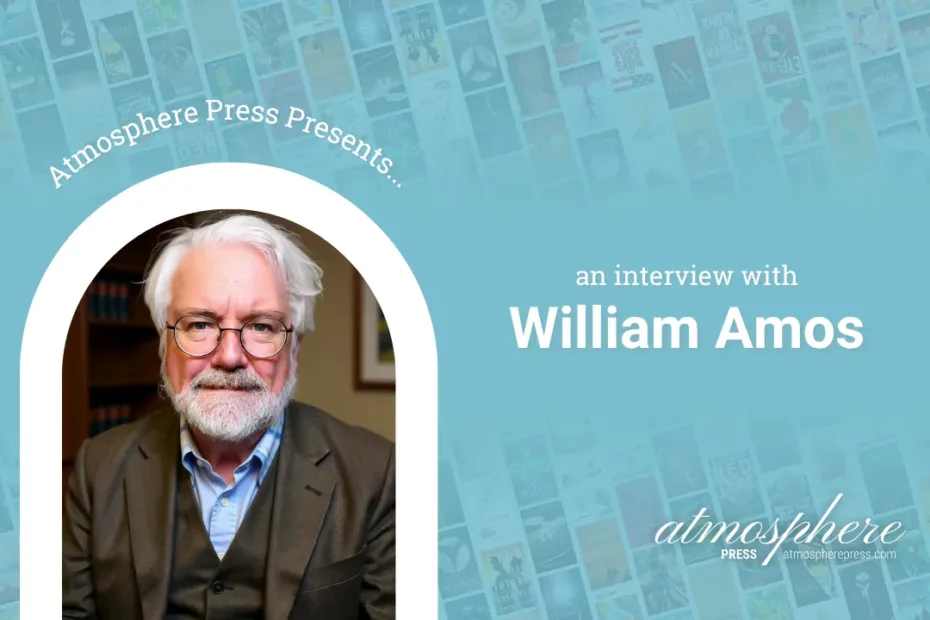
I was born and raised in Madison, Wisconsin and graduated from the University of Wisconsin in 1978. In 1979, I was a last-minute addition to a Peace Corps group departing for South Korea—one of the best things that has ever happened to me. After Peace Corps, I got a law degree from the Loyola University of Chicago School of Law. I’ve been a technical writer and medical writer almost my entire career. My Korean-born wife and I have two sons who grew up and moved away from home years ago. We live in Boise, Idaho.
Who/what made you want to write? Was there a particular person, or particular writers/works/art forms that influenced you?
I’ve loved reading for as long as I can remember, and my first efforts at what would now be called fan fiction happened when I was eight or nine, when I asked my dad if I could play with his old 1930s-era typewriter. My first opus was about Tom Swift inventing some kind of atomic gun. It was terrible, but I found that I enjoyed telling stories that I made up all by myself. As I grew and my literary tastes matured, I got hooked on the works of P. G. Wodehouse. Also, I loved the evocative, elegant prose of James Hilton in Lost Horizon; the grand intricate storytelling of Tolstoy in War and Peace and James A. Michener in all of his great epics; and the wonderful lyricism of my favorite translation of Boris Pasternak’s Doctor Zhivago. Most recently, I’ve enjoyed many excellent K-dramas, which focus on character development and imaginative storylines.
What other professions have you worked in? What’s something about you that your readers wouldn’t know?
I really was a Peace Corps volunteer in real life, just like the main character in The Seed of Joy. In fact, many of my experiences (working in a health center, living in Mokpo, living in a leprosy village, getting caught in a student riot in Seoul, etc.) made it into the book. Later, even though I didn’t pursue a law career, law school provided me with a good classical education; I learned to think and write in a focused, precise manner. After graduating from law school, I was an investigator for the US Department of Labor in San Francisco for a few years. Then I became a technical writer and later a medical writer, which I am to this day. Most of my career has involved shoving words together, so I guess it was inevitable that I’d write a novel someday, especially considering all that I witnessed in Korea.
Tell us the story of your book’s title. Was it easy to find, or did it take forever?
My working title for a long time was Made in Korea, which I guess summed up how the main character grew through the story. But I wanted something less flippant and with a more “classic” feel to it. I looked up Korean sayings and proverbs for ideas and found “Trouble is the seed of joy,” which expressed the whole point of the story quite well. The Seed of Joy stuck.
What part of publishing your book made it feel real for the first time?
The very first edition of the book was picked up by the now-defunct e-publisher Online Originals in England. This was around 2000 or 2001, when e-publishing was very much in its infancy. They invited me to come to London to speak at an e-publishing conference about my experiences in the field. That’s when it became real for me. When the publisher went under and I got the rights to the book back, exercising complete control over making much-needed changes to it became the second milestone in the book’s journey.
If your book had a soundtrack, what are some songs that would be on it?
My answer is going to seem very esoteric. Korea has a fine tradition of classical-style lyric songs that still have a wonderful native flavor. The song featured in the story called Se No Yah is an actual song, and one not mentioned in the book, Tears of Mokpo was written specially for that city many years ago. Aside from that, the third movement of Henryk Górecki’s Third Symphony (Symphony of Sorrowful Songs) hits the right mood of sorrow in the aftermath of the Gwangju Uprising. The track Epilogue on the soundtrack of I Am Legend by James Newton Howard nicely captures the overall tone of the book.
What’s one thing you hope sticks with readers after they finish your book?
That “Freedom isn’t free” is far more than a catchphrase. In the struggle for democracy, people must sometimes take to the streets, and some, even those we love, make the ultimate sacrifice out of conviction to their ideals. In the case of South Korea, it eventually turned out well: Korea now has a robust, responsive democratic government. We in the United States can learn from their example. It feels like we’re moving into a dark period, not unlike that of Korea before the Uprising. I hope we can catch ourselves and set things right without having a tragic uprising of our own.
What was the most rewarding/meaningful part of publishing your book?
I received a lot of support from experts. One is a university professor in Korean history who was a former Peace Corps volunteer and was present at the Gwangju Uprising. The other is the former director of the National Fact-Finding Commission for the May 18 Democratization Movement. They both helped me get the facts right about the political landscape of Korea and of the Uprising itself. Even though I was in-country at the time of the Uprising, I wasn’t there to see it with my own eyes. The first edition of the book was written in the 1990s when the facts were still covered up by the Korean Government. I got a lot wrong. In this latest (and final) edition, my experts enthusiastically stepped up and helped make the book a true picture of what happened, even though the story itself is fiction. E. L. Doctorow once said, “The historian will tell you what happened. The novelist will tell you what it felt like.” My experts assure me that I got it right on both scores.
What creative projects are you currently working on?
I’ve been playing around with the idea of writing a multigenerational saga about Korea along the lines of Michener’s great epics. The first part, currently called The Tigers of Shinshi, follows two men—one an aristocrat and one a lowborn but wealthy merchant—at the time of the Japanese invasion of 1592. The story is mostly plotted out, and it looks like it’s going to be a large novel in its own right. As far as The Seed of Joy is concerned, I’m nursing my dream of it becoming a K-drama on Netflix someday—and I’ll be there to help write the teleplay. And be an executive producer, of course. Hey, a guy can dream!
Are you a writer, too? Submit your manuscript to Atmosphere Press.

Atmosphere Press is a selective hybrid publisher founded in 2015 on the principles of Honesty, Transparency, Professionalism, Kindness, and Making Your Book Awesome. Our books have won dozens of awards and sold tens of thousands of copies. If you’re interested in learning more, or seeking publication for your own work, please explore the links below.