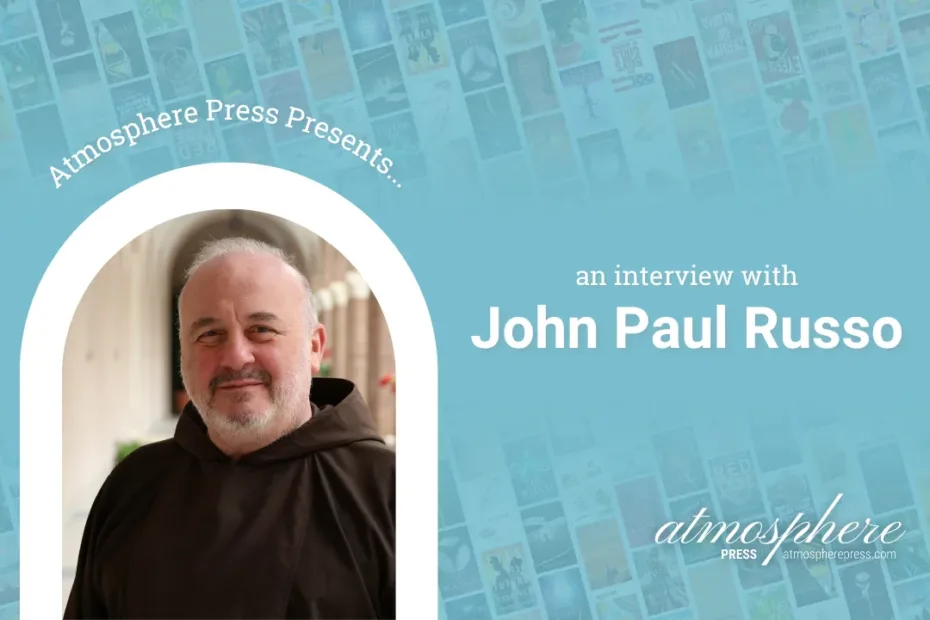
An Interview with John Paul Russo
I have been a brother in the Capuchin Franciscan Order since 1991. I was born in 1967 and was raised in Wilmington, DE, and pursued music, which was my first passion in my youth. I studied piano and composition and was building a career as a composer until I made a left turn when I felt a call to the consecrated life. I searched for a while and ended up joining the Capuchin Franciscans. I went through formation as a friar and professed vows in August of 1993. Since then, I’ve been living the fraternal and prayer life of the Friars Minor Capuchin and ministering to others. Once I finished my novitiate, I was director of a series of inner city soup kitchens for three years, I worked as a parish associate in Tampa, Florida, for ten years, I was engaged with internal ministry for my province at our provincial headquarters (called a “provincialate”) for eleven years and then I was summoned to Rome to take the English language secretary’s office at the Order’s General Curia. I’m still in Rome after almost eight years.
As a writer, I really only began focusing when I tried my hand at writing songs on the guitar back in 1992–’93. I found that I wasn’t bad at writing lyrics and this encouraged me. I then tried my hand at poetry and produced a small body of poems between 1995 and 1997. I did have a sonnet published by a literary magazine in CA that no longer exists (Penwood Review). And it wasn’t long thereafter that I and another friar started imagining a movie about Italian families immigrating to NYC and maintaining tensions that started in Italy. This became my first feature film screenplay in 2004. I then wrote four more scripts and some short stories over the next decade, more song lyrics (for songs I wrote annually for our church’s summer vacation Bible school—I had a really good youth group band and a parishioner with a great voice who sang them with the kids; these summer engagements were always a blast!). By 2015, after writing my last screenplay (Lady Midday—a psychological thriller which was a thrill to write!) and after having received some positive interaction with directors and readers in Hollywood and Austin (AFF), I decided to quit writing screenplays. I came to realize that if you don’t live in Hollywood, you’ll never get anywhere, so why spend the energy? And as a religious man, I couldn’t go there and give it my all anyway. After a couple of years, I kept thinking about my third script, which was the prototype for my novel. It was called Missioner and the world-building was so rich and exotic that I thought I’d try my hand at recreating it as a novel. It was completed on September 11, 2017. And since then, I wrote its prequel and chipped away at both books in terms of refining, editing, rewriting—all through the Covid lockdowns, etc.—and finally, I got the first one off the ground. I expect to return to the USA by late 2028. And I want to eventually publish the prequel. But one book at a time!
Tell us the story of your book’s title. Was it easy to find, or did it take forever?
I wrote this first as a screenplay in 2009. That was almost eighteen years ago. I can’t remember, honestly, how I settled on The Last Missioner. First, I remember tossing around “The Prelates of Atalan Jur.” I remember this all came about while cutting grass sometime in 2006 in Tampa. I was playing a game in my mind of how city names might change after long periods of time … like centuries. I think I read about a city (I can’t remember which) and how the name of it evolved. For some reason, this spurred me into the world-building for this story. The real beginning of all of this was when Salvadore Dali’s The Last Supper came to the Dali Museum in St. Petersburg, FL (the sister city of Tampa) earlier that year, in 2006. I went to see it, and the whole feel and look of the world in my eventual script came from my impressions of that work. I kept imagining this world, and a general idea of the story developed. I changed “The Prelates” to “The Missioner of Atalan Jur” at some point as a general idea for the story began to gel and a protagonist began to emerge. But I didn’t really start writing it until 2009 after I moved to NJ from FL. I constructed my scripts very carefully in the pre-write stage. I remember using index cards and placing them around a room as I worked out the action and character development over the three acts. I was also very busy in terms of ministry and being transferred after ten years, etc., (not to mention writing music, as well!) so I couldn’t concentrate “full time” on my writing projects.
How did it feel when you first saw your book cover? Or when you first held your book in your hands?
I was bedazzled when I saw the cover for the first time. Much thanks to artist Kevin Stone! It is very inviting and suggests a strength and a “call to action” in my protagonist before one can even open the book! It also has a very enticing “retro” character that I love. I thought, “Perfect!” Other than a color adjustment I suggested in one little detail, I thought, “Don’t change a thing!”
When I finally got the paperback proof copy, I almost forgot that I wrote a book. I watched the tracking info and it moved normally through England and France, but when it got to Italy, suddenly everything screeched to a halt. It ended up sitting idle on a warehouse shelf for nearly two weeks in Carpi, Italy—an eight-hour drive north of Rome—it was almost torturous looking at the tracking info every day: “scanned,” “scanned,” “scanned” for two weeks! Anyway, once I opened it and fanned through it, etc. I thought, “Wow! This is for real. I actually wrote THIS book!” It’s a unique feeling. I’ve printed it out before as a PDF for a couple of friars to read—for my brother who beta read both of my novels. But nothing compares with holding that actual, “professionally done” book in your hands!
Who/what made you want to write? Was there a particular person, or particular writers/works/art forms that influenced you?
As I mentioned before, this whole project was born in 2006 when I saw Salvadore Dali’s The Last Supper in St. Petersburg. Of course, I knew the painting beforehand and was always beguiled by its futuristic look (at least to me) because of that frame-like structure that houses the subjects. There are so many aspects in that painting that always drew me: the “late afternoon” amber sun, the barrenness of the landscape, the long shadows, the draping white garbs on the Apostles. When I finally saw the original displayed at the museum, something kindled within me. I had the “flavor” for the eventual tale that was to come.
What other professions have you worked in? What’s something about you that your readers wouldn’t know?
I define myself first and foremost as a religious brother in the Capuchin Franciscan Order. I go by Brother John and my daily life with the friars is central to who I am. In addition, I still compose music, although not as much as in my youth. Over the years, I have written many works, including three big suites for piano and numerous other piano works, a cello sonata, a string quartet, a piano quintet and other chamber pieces, a couple of orchestral works, and several sacred pieces including a Mass commemorating the new millennium, which I finished in 2006 and dedicated to Pope Benedict XVI, and which was actually brought to him via a friar in my province. The Pope received my dedication, kept a copy for himself, and returned a second copy to me with his autograph on the title page! It was since performed professionally in Tampa two times, in 2008 and 2010, by a sacred music ensemble called Florida Pro Musica.
What was the most rewarding/meaningful part of publishing your book?
I must be honest and say that I really valued the dynamism, professionalism, and efficiency that I witnessed at every step of the process of making this manuscript into an actual book. I was fascinated by the process and could feel the creative energy moving along as we shaped it. I am very thankful to all who were involved. It was a really great experience of teamwork that I’ll never forget!
If your book had a soundtrack, what are some songs that would be on it?
Songs off Led Zeppelin IV, especially “Stairway to Heaven,” “The Battle of Evermore,” “Going to California,” and “Four Sticks.”
What is one thing you hope readers take away from reading your book? How do you envision your perfect reader?
I would hope that the reader will get an enticing notion that the far-future exoticism indulged in my story actually points to true institutions in our present world. The images I portray are fresh angles that may bring novelty to the familiar tropes of real religious rituals, postures, and practices, etc. There are obvious Christian (esp. Catholic) overtones, Jewish overtones, and also some Muslim overtones throughout the story. So, where some high school student reads Dune or Lord of the Rings and then lays on the bed wrapped up in the fantasy and thinking, “Wouldn’t it be great if this world really existed?” Well, in my fantasy, that same student might say, “THIS really does exist, just in a different light!” Also, I hoped to have executed the arc of my protagonist effectively enough to demonstrate the real power of faith as a transformative power and the need to trust in providence to keep to one’s path as God—who has a plan for each one of us—intends for us.
What creative projects are you currently working on?
I have done the preliminary work and read two pertinent books to prepare for the writing of my third book—the second book of the prequel series. My plan goes like this:
I. The Last Missioner (finished and published)—A story about the end of the thousand years of the primary’s reign when the Devil will be let out for a short time … then the final battle.
THEN … there will be a series of four prequels called The Constancy Quartet
II. Awaken Elect! (finished and ready to be published)—A story about the Eclecti, who awaken in the Caves of Plashan and slowly adapt to the new world around them. This is the BEGINNING of the same thousand-year period that ends with The Last Missioner.
III. The Grati (thoroughly prepared and about to be written)—This is the story of the children of the Eclecti—the Grati. They are the first generation born during this thousand-year period. They are gifted by God with new powers of quantum perception and the psychic ability to utilize them for affecting the world around them. They have an uncanny advantage over their parents and are met with challenges both socially among themselves and with their parents, and in taking responsibility of and honing their powers to prepare the world for the Universal Communion.
III. Fall of House Exer—The story of Jude Isa Exer IX and his influence in bringing about the Great Exer Dispersion in years 700–702 of the Constancy as the Golden Age of Meric comes to an end and tensions between the three nations begin to stir.
IV. Light of the Jurans—The Prelatory Dean must rise above Juran convention to outwit his rival forces from among the Twelve Houses and pave the way for the final series of House Pome, “Christophers of Light.” This is only a few generations before the time of The Last Missioner.
How was working with Atmosphere Press? What would you tell other writers who want to publish?
It was a wonderful experience all the way around. I enjoyed the professionalism, the efficiency, and the ample creative control I was able to maintain with their full consent and cooperation. For this reason, it’s worth investing a little into the process. I would be glad to recommend hybrid publishing with Atmosphere Press to other writers without hesitation.
Are you a writer, too? Submit your manuscript to Atmosphere Press.

Atmosphere Press is a selective hybrid publisher founded in 2015 on the principles of Honesty, Transparency, Professionalism, Kindness, and Making Your Book Awesome. Our books have won dozens of awards and sold tens of thousands of copies. If you’re interested in learning more, or seeking publication for your own work, please explore the links below.