
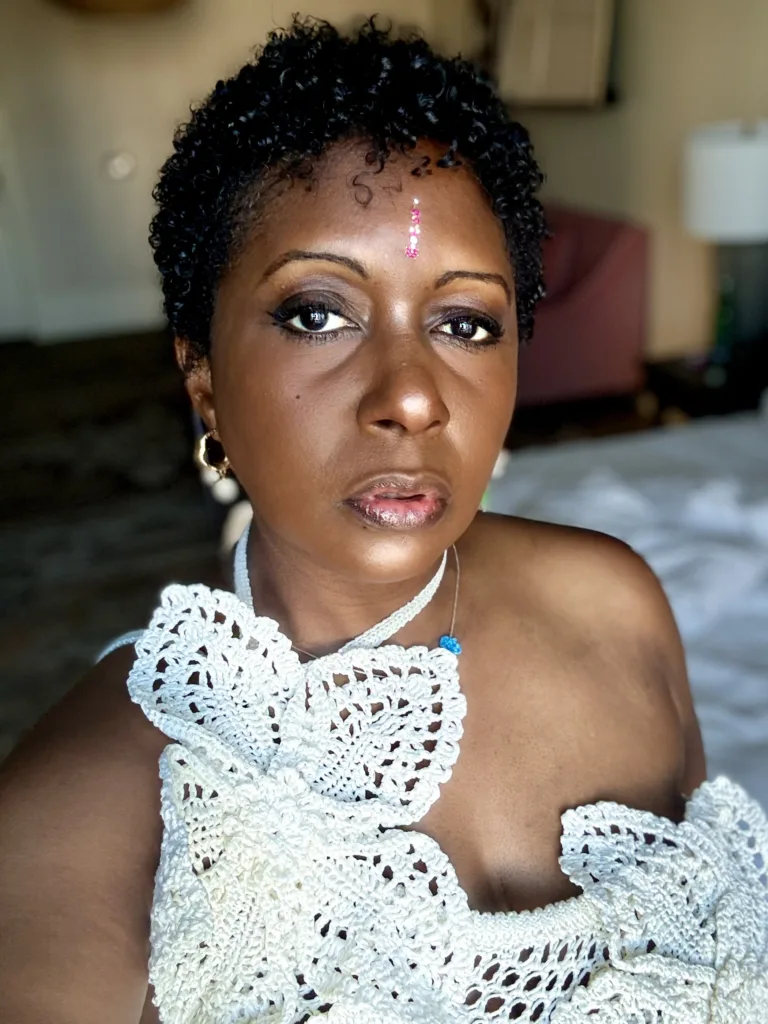
Aziza Kibibi is an author, speaker, advocate, and founder of Precious Little Ladies Inc., a New Jersey–based nonprofit dedicated to preventing child sexual abuse, supporting survivors, and strengthening families through education, outreach, and community-centered resources.
A survivor of long-term incestuous abuse, Aziza uses storytelling, advocacy, and public education to challenge silence, protect children, and help others reclaim their voices. She is the author of Unashamed: A Life Tainted…, a chef, and an experiential trauma coach, guiding others on their healing journey via lectures, personal sessions, and social media.
Aziza continues to write about survival, healing, truth-telling, the power of transforming pain into purpose, and living life to the fullest.
A magic spell is a spoken or written incantation believed to manipulate supernatural forces.
The word spell also has another meaning. In Old English, it meant a story, saying, or a tale. Maybe that is why, at fourteen years old, inspired by my love of fairy tales, I believed I could cast a spell to save myself from the horror of my childhood. I convinced myself that if I wrote a rhyme rooted in intention, sprinkled it with herbs, and left it under the moonlight, my troubles would be carried away like ships on sound waves from the utterance of nouns, verbs, and prepositions.
Unfortunately, my magic spell did not work.
Instead, I found comfort in the other kind of spell, the kind that took the form of confessions, secrets, and silent disclosures. The kind kept under lock and key, between lines and on leaf, encased in a lavender, plastic-laminated 4×6” booklet that was my Dear Diary.
Inside that diary, I spelled words that confessed traumas no child should experience. Surrounded by awkward doodles of genitalia, descriptions, questions, and reflections about how my father came into my room and invaded my body, my writing became an attempt to move the pain from the inside of myself to outside of me.
It helped.
I would read back what I wrote and feel less alone. The page did not rescue me or stop the abuse. And it did not expose the truth to the world. But it believed me before anyone else did. It held what I was not allowed to say out loud.
That is one of the first gifts writing gave me: evidence.
Writing as a Place to Put the Pain
There is a particular kind of suffering that comes from carrying an experience no one around you is willing or able to acknowledge. In scientific terms, trauma is a negative incident or experience that overwhelms your brain’s ability to cope. When you’ve had such an experience, you are left in a reality that feels unstable. Trauma can fracture memory, distort time, and convince you that silence is a safe place.
Writing can interrupt that.
Not always beautifully, eloquently, or even coherently. Sometimes the first honest sentence is messy, angry, repetitive, misspelled, grammatically incorrect, or barely legible. That does not make it less valuable. In fact, when writing is used to process grief or trauma, polish is often the least important part.
The first purpose of the page is not performance. It is permission.
Permission to say: This happened.
Permission to admit: I am angry.
Permission to wonder: Why did this happen to me?
Permission to confess: Yes, I survived, but I am tired.
For writers, especially those writing from grief, abuse, loss, or betrayal, the page can become a container. It gives shape to what feels shapeless. It creates a boundary around the pain, so the pain is no longer everywhere at once. When an experience lives only inside the body, it can feel endless. But when it is put into words, it becomes something you can look at, question, revise, analyze, confront, and, when necessary, close the notebook on for the night.
Writing does not erase trauma, but it can help organize the chaos left behind.
Returning to the Page
My life changed a great deal between that childhood diary and the next time I wrote as a therapeutic outlet.
I stopped keeping a diary because my brother found mine and gave it to my father. For a child living in an abusive environment, that kind of discovery is not a small embarrassment. It is danger. It taught me that even my private words were not safe.
Years passed, and I endured more abuse. I became pregnant five times through that abuse. I had four children whom my father delivered at home, and two of them had adverse health defects. Eventually, I escaped, and my father was arrested for various crimes of child sexual abuse. During his trial, my youngest daughter was hospitalized for pneumonia. My father’s case became a national story, and the most private horrors of my life were suddenly public. But not in my voice.
There is a difference between people knowing what happened to you and you owning the story of what happened to you.
That difference is everything.
Remembering the emotional freedom writing once gave me, I chose to ignore my fear of writing down secrets and allowed myself to be vulnerable with words again. Not because I was brave in some cinematic way. I was stressed, overwhelmed, and in a state of panic because my daughter, a result of the abuse, was fighting for her life. I needed somewhere to put the terror, the rage, the disappointment, the sadness, the memories, the questions, the grief.
So, I returned to the spell.
Not the moonlit kind. The written kind.
Reclaiming Your Story
To reclaim your story after trauma is not simply to tell people what happened. Sometimes people think storytelling is just the disclosure of a timeline, a confession, or a perspective. But reclaiming is deeper than recounting.
Reclaiming your story means becoming more than the event.
It means deciding what language belongs to you. It means refusing to let the person, persons, or circumstances that harmed you be the only ones with power over the narrative. It means discovering that you are not merely a character in someone else’s antagonism. You are the witness. The narrator. The interpreter. The one who survived long enough to pick up the pen.
This is where writing can become an act of restoration.
In trauma, safety, innocence, trust, sometimes family, sometimes faith, sometimes the body’s sense of home are taken from you. Writing gives something back. Not all at once, and not without cost, but it returns agency. You decide where the sentence begins, what is named, and what remains private. You decide whether the piece becomes a poem, a memoir, a journal entry, a novel, an essay, or a page you set aflame.
That choice matters because trauma often removes choice. The writing process gives it back in small, precious increments.
Keep Up with Aziza Kibibi . . .
Book
Unashamed: a life tainted… Vol 1 & 2
Websites
Podcast
Social media
Instagram, Twitter/X, Facebook: @azizakibibi
TikTok: @IamAzizaKibibi
YouTube: @azizakibibi
