

What to Expect from Manuscript to Launch
Publishing a book is a process with many moving parts—from shaping your manuscript to final launch. At Atmosphere Press, we’ve designed a hybrid publishing timeline that balances quality, clarity, and efficiency, so authors know exactly what to expect at every stage.
For authors already working with us, this guide provides a clear roadmap to help you stay on schedule and maintain momentum. For those considering hybrid publishing, it shows how a structured, professional approach keeps projects on track and delivers polished, market-ready books. Let’s break down each phase—from developmental editing to proof copies and release—explaining what happens, how long it takes, and what’s expected from you to ensure a smooth, successful launch!
Why Clear Timelines Matter: The Big Picture
Before diving into individual stages, it helps to understand the full arc of the publishing process.
At Atmosphere Press, our standard production timeline looks like this:
~6 months from manuscript handoff to print-ready files
This milestone is called your Print Goal.
~9 months from manuscript handoff to public release
This includes proof copies, final approvals, and launch preparation.
This timeline begins on the date your manuscript is officially sent to your Developmental Editor—not when you sign your contract or submit early materials. From that point forward, each phase builds on the one before it, and delays in earlier stages naturally affect everything downstream.
It’s important to note that this is a goal-based timeline, not a rigid guarantee. Some authors move through the process more quickly, while others need additional time in certain phases. Our priority is always producing a polished, professional book—while maintaining steady momentum so your project doesn’t stall or lose energy.
Print Goal
Your Print Goal is the point when your book’s files are finalized and ready to be sent to the printer—meaning your physical proof copy is just about to be ordered. This is not the same thing as your publication date, but it’s an important milestone to reach.
At Atmosphere Press, this date is set six months from the day your manuscript is sent to your Developmental Editor, and it acts as the anchor for your entire production schedule.
Why this date matters:
➜ It shows where your book should be in the process at any given time.
➜ It helps both our team and you stay aligned on deadlines and revisions.
➜ It keeps the project moving forward without rushing or cutting corners.
Reaching the Print Goal depends on timely collaboration. Each phase of the hybrid publishing timeline includes clear responsibilities for both our team and the author. When revisions and feedback are returned on schedule, the process stays efficient and predictable.
Some projects do move faster, particularly when revisions are minimal and turnaround is quick. However, this timeline reflects our standard, quality-focused approach to hybrid publishing—designed to balance speed, accuracy, and a smooth path to launch.
Your Hybrid Publishing Timeline
To make the production process clear and manageable, Atmosphere Press divides it into defined phases. Each phase has a specific purpose, an estimated duration, and responsibilities for both the author and our team.
Understanding these phases helps you:
➜ See what’s happening at each stage of your book’s journey
➜ Know when your input is needed to keep things on schedule
➜ Avoid bottlenecks that can delay your Print Goal
Phase One: Developmental Editing (≈8 Weeks)
Developmental Editing (DE) is the first major phase of your hybrid publishing process. This stage focuses on shaping your manuscript so it’s polished, cohesive, and ready for design.
Timeline Overview:
➣ 2 weeks: Editor review of your manuscript
➣ Meeting: Discussion of major structural or content changes
➣2 weeks: Author revisions; manuscript is returned to your editor for their review
➣2 weeks: Editor reviews your changes
➣Meeting: Follow-up to review changes and discuss additional feedback
➣2 weeks: Final revisions before moving to interior design
Key Points for Authors:
➜ The cover design team begins gathering your ideas during this phase, so your book starts taking visual shape early.
➜ Timely responses keep the project on track—delays here impact all subsequent phases.
➜ This stage is about refining structure, flow, and story clarity—not line-by-line copyediting.
Tips to Stay on Schedule:
➜ Review editor notes carefully before making changes.
➜ Ask clarifying questions early—don’t wait until your next revision round.
➜ Submit revisions on or before the deadlines provided by your editor.
By sticking to the DE timeline, you set the foundation for a smoother proofreading, design, and launch process. Efficient collaboration here is the single biggest factor in meeting your Print Goal.
Phase Two: Proofreading (≈4 Weeks)
Proofreading is the second major phase of your hybrid publishing timeline. This stage ensures your manuscript is free of errors and ready for layout and printing.
Timeline Overview:
➣ 2 weeks: Our proofreading team reviews your manuscript
➣ 2 weeks: Author review and approval
Key Points for Authors:
➜ This phase is focused on catching typos, grammar issues, and formatting inconsistencies—not rewriting or revising content.
➜ Timely feedback from the author is critical to keeping your book on schedule.
➜ Clear communication during this phase helps prevent errors from carrying into the interior design stage.
Tips to Stay on Schedule:
➜ Review all suggested corrections carefully before approving.
➜ Delete any remaining proofreader comments before returning the manuscript.
➜ Return your clean manuscript within the 2-week window.
➜ Keep a checklist of changes to confirm nothing is overlooked.
By completing proofreading promptly and thoroughly, you help ensure the Print Goal remains achievable and set your book up for a smooth interior design process.
Phase Three: Interior Design & Layout (≈8 Weeks)
Interior Design (ID) is where your manuscript transforms into a professional, print-ready book. This phase focuses on formatting, layout, and overall readability across all formats.
Timeline Overview:
➣ 3 weeks: Initial layout creation by our design team
➣Up to 3 rounds of revisions: Feedback and adjustments from author and design team. Each round of revisions can take up to two weeks to complete.
Key Points for Authors:
➜ Revisions at this stage are about refining the layout, not altering content.
➜ Timely, focused feedback ensures your book moves to print without unnecessary delays.
➜ Your front cover design should already be completed, so interior and exterior elements work together seamlessly.
Tips to Stay on Schedule:
➜ Review layouts carefully and provide clear, consolidated feedback.
➜ Stick to the revision limits—additional rounds can delay the Print Goal.
➜ Keep in mind readability, formatting consistency, and flow as you review.
By staying engaged and responsive during the interior design phase, you help ensure your book meets the Print Goal and is polished for the proof copy stage.
Flex Time (≈4 Weeks)
Flex Time is a built-in buffer in your hybrid publishing schedule. It accounts for vacations, unexpected delays, or extra time needed for revisions.
Why Flex Time Matters:
➜ Keeps the overall timeline realistic without compromising quality
➜ Absorbs small delays so your Print Goal remains achievable
➜ Provides breathing room if either you or the team needs extra time
Key Points for Authors:
➜ Use this time wisely—don’t rely on it for late revisions or unfinished work
➜ Communicate proactively if you anticipate needing extra days
➜ Staying within Flex Time ensures the next stages, like proofing and final launch prep, stay on track
This buffer helps maintain steady progress while allowing for the natural variability of the publishing process. When authors respect Flex Time, the full timeline—from manuscript submission to launch—remains predictable and efficient.
Phase Four: Proof Copy & Final Approvals (≈6 Weeks)
After your book is print-ready, we move into the proof copy stage. This is your chance to review a physical (or digital) copy before final production.
Timeline Overview:
➣ 1–3 weeks: Printing and shipping of proof copy
➣Remaining weeks: Proof copy corrections and approving final files
➣ Includes hardcover or special edition checks if applicable
Key Points for Authors:
➜ Carefully review your proof copy for formatting, typos, and design consistency
➜ Approve or request changes promptly to avoid pushing back your launch
➜ Any major changes at this stage can extend timelines, so focus on corrections that are essential
Tips to Stay on Schedule:
➜ Have a checklist to track corrections systematically
➜ Provide consolidated feedback in one round whenever possible
➜ Communicate clearly with your production team to prevent misinterpretation
➜ If there are coloring or image issues with your proof, make sure to include photos when you send in your corrections.
Completing the proof copy stage efficiently ensures your book is fully polished and ready for a successful launch. It’s the final opportunity to catch errors before your audience sees your work.
Phase Five: Release & Launch (≈6 Weeks)
Once your proof copy is approved and final files are ready, your book enters the launch phase. This period focuses on preparing your book for distribution, marketing, and promotion.
Timeline Overview:
➣ 6 weeks: Preparation for release, including promotional planning, retailer setup, and publicity
➣ Final files are sent to printers and digital platforms for publication
Key Points for Authors:
➜ Your book is now in the home stretch—timely collaboration ensures your launch stays on track
➜ Marketing and promotional activities may require your input, so stay responsive
➜ The release date is planned to maximize visibility and align with any promotional campaigns
Tips to Stay on Schedule:
➜ Confirm all metadata, author bios, and book descriptions are final
➜ Approve retailer and distribution details promptly
➜ Coordinate with our marketing or publicity team if requested
When all phases are completed on schedule, your book can reach the public around 9 months from manuscript submission, aligning with our standard hybrid publishing timeline. Following these steps ensures a smooth, professional launch while maintaining the high quality expected from Atmosphere Press.
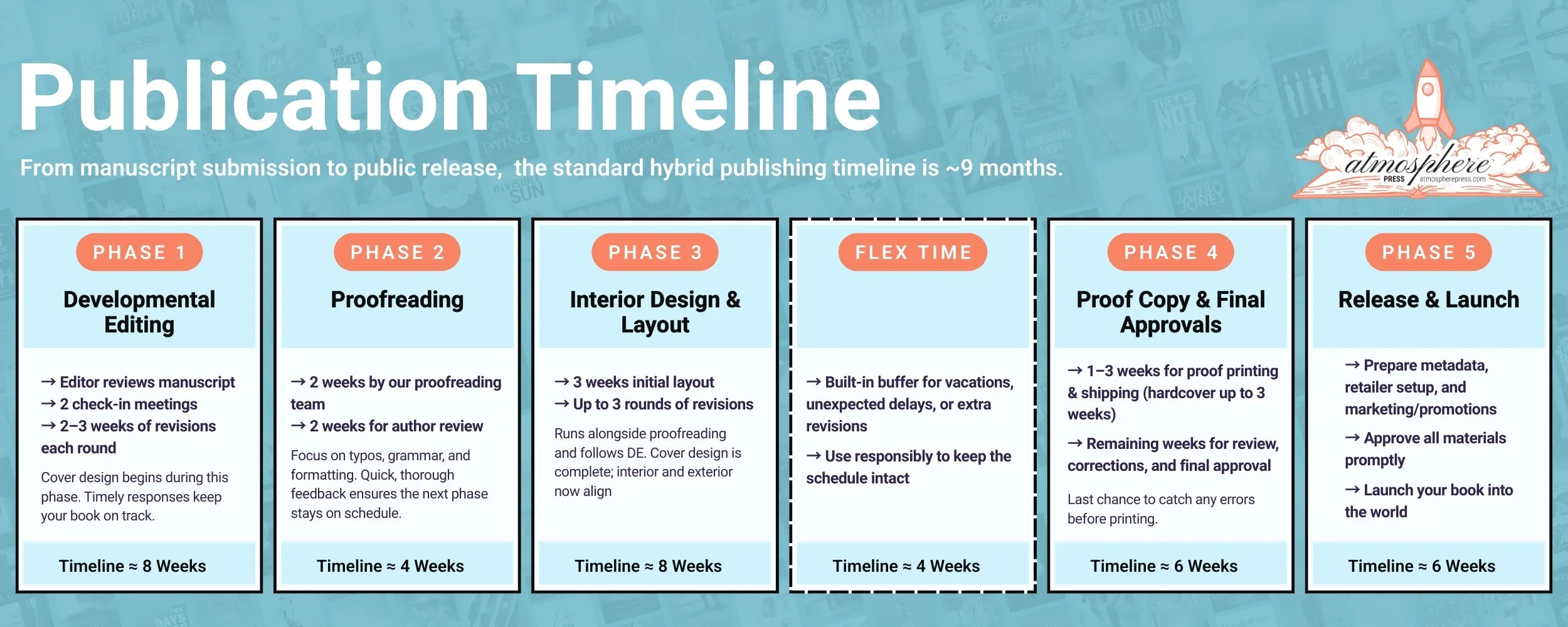
Your Quick Guide: Hybrid Publishing Timeline
For authors who want a fast overview, here’s how your book moves from manuscript to release at Atmosphere Press. Follow these milestones to stay on track and meet your Print Goal:
Developmental Editing (≈8 weeks)
Editor reviews your manuscript → 2 check-in meetings → 2–3 weeks of revisions each round. Cover design begins during this phase. Timely responses keep your book on track.
Proofreading (≈4 weeks)
2 weeks by our proofreading team → 2 weeks for author review. Focus on typos, grammar, and formatting. Quick, thorough feedback ensures the next phase stays on schedule.
Interior Design & Layout (≈8 weeks)
3 weeks initial layout → up to 3 rounds of revisions. Runs alongside proofreading and follows DE. Cover design is complete; interior and exterior now align.
Flex Time (≈4 weeks)
Built-in buffer for vacations, unexpected delays, or extra revisions. Use responsibly to keep the schedule intact.
Proof Copy & Final Approvals (≈6 weeks)
1–3 weeks for printing/shipping proof copy (hardcover may extend to 3 weeks) → remaining weeks for review, corrections, and final approval. Last chance to catch errors before printing.
Release & Launch (≈6 weeks)
Prepare metadata, retailer setup, and marketing/promotions. Approve all materials promptly.
From manuscript submission to public release, the standard hybrid publishing timeline is ~9 months. Some books may reach print-ready in as little as 6 months if revisions are minimal and responses are timely, though rushing can increase risk of errors.
Bottom Line: Staying on schedule requires timely responses and collaboration at every step. Following these milestones helps you stay on schedule while maintaining quality at every stage. With clear communication, timely revisions, and attention to each phase, your book can move efficiently from manuscript to a polished, professional launch—setting you up for success as an author!
