An Interview with A.M. Harker
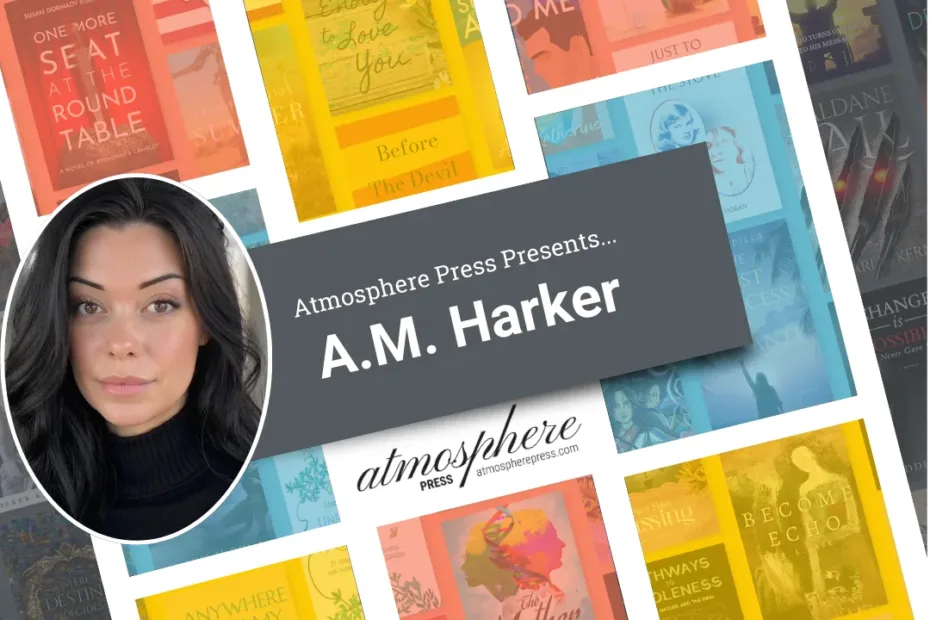
A.M. Harker is a literary fiction writer based in St. Louis, Missouri. Drawn to the classics and existential philosophy, Harker wrote Evangeline (2026), a debut novel narrated by a vampire who participated in the Romantic period and contributed to the birth of the modern vampire myth. The work engages with questions of existence, memory, and purpose against the indifference of an eternal life. Harker studied English literature at Truman State University. When not writing, she works as a tattoo artist, travels often, and studies Russian language.
What inspired you to start writing this book?
Evangeline came to me in segments. First, while revisiting Camus’s The Myth of Sisyphus and considering what it means to find value in an existence defined by suffering. Then, I returned to my love of the Romantics (Mary Shelley, John Keats, and John Polidori in particular) in preparation for a trip to Italy. Some months later, I visited the Keats-Shelley House in Rome. Standing in Keats’ bedchamber, the idea solidified: a vampire who lived through the Romantic period, who knew these people, now reckoning with centuries of unwanted existence.
I grew up in a religious household and while I no longer hold those beliefs, my upbringing gave me a framework to explore what a ‘meaningful’ existence could entail if you don’t have faith and cannot die. I’ve had an affinity for vampires since childhood thanks to Bram Stoker and Anne Rice, later intensified by studying folklore, and I wanted to craft my own version. My protagonist, Sorin Chernov, was born from that impulse.
The meta-fictional structure emerged when I thought about making him a writer. Instead of turning people into vampires, he could make them immortal through witness, through writing. The vampire myth allowed me to explore philosophical questions about goodness and choice in a way that felt both Gothic and deeply human.
Tell us the story of your book’s current title. Was it easy to find, or did it take forever?
Evangeline was the only title I considered because of the novel’s meta-fictional structure. The name means ‘bearer of good news’ (gospel) and that’s exactly what my deuteragonist, Evangeline Martin, is to Sorin. She embodies the goodness and moral clarity he desperately seeks to understand, and he immortalizes her by writing his final work, which is titled Evangeline – the novel the reader holds in their hands.
I did hesitate briefly because of Longfellow’s Evangeline, but ultimately the name felt essential. I couldn’t see her as anyone else, and the etymological connection felt integral to her character. Once I committed to it, there was never any question.
Describe your dream book cover.
For Evangeline, I envision something that evokes the Romantic period: muted colors, minimal illustration, generous negative space. A locket, perhaps, or natural elements like maple leaves. I would avoid depicting people; the cover should suggest mood and theme rather than literal representation.
For typography, classical serif type, centered, with the title most prominent. Quietly Gothic rather than explicitly supernatural, since the novel is about philosophy as much as plot.
If your book had a soundtrack, what are some songs that would be on it?
I wrote Evangeline primarily to instrumental music, particularly the compositions of Joshua Kyan Aalampour. His Return to Versailles, The Forsaken Waltz, and La Solitude would absolutely be on the soundtrack and remind me of Sorin. I’d also include Kepa Lehtinen’s In The Heart Of Winter and Abel Korzeniowski’s Ghost Waltz, as they capture that Gothic melancholy and romanticism that permeates the novel.
Beyond the instrumental pieces, some of Evangeline’s taste would come through: Billie Holiday’s I’ll Be Seeing You, Frank Sinatra’s Strangers In The Night, David Bowie’s The Man Who Sold the World, and The Smiths’ Asleep. They feel like songs she’d keep in her record collection – nostalgic, achingly human.
What books are you reading (for research or comfort) as you continue the writing process?
I’ve been balancing reading for enjoyment and inspiration. I just finished Dostoevsky’s White Nights and The Dream of a Ridiculous Man. I have a deep love for Soviet-era Russian literature and have read his larger works, but those novellas have been on my list for years. I’ve been listening to Tolstoy’s Anna Karenina on my commute because it was the first novel from that period I experienced, and his emotional depth continues to inspire my own work. Before that, I reread The Picture of Dorian Gray for Wilde’s prose style, and I’m working through Milton’s Paradise Lost when time allows (for the theological and philosophical frameworks that inform Sorin’s crisis of faith).
What other professions have you worked in? What’s something about you that your readers wouldn’t know?
I am a tattoo artist and have been in the industry since 2017. Before that, I worked as a waitress and in department store retail from high school through college, aspiring at the time to become a high school English teacher.
Following surgery on my hands, I couldn’t tattoo for a time and worked as a librarian in the St. Louis Public Library system. It was a wonderful experience, though frustrating to be surrounded by books while physically unable to create. During that recovery, I sought other creative outlets and began studying opera. I continue to train as an opera singer as a hobby and play piano. Music has been part of my life since childhood and continues to serve as an outlet outside of art and writing.
Who/what made you want to write? Was there a particular person, or particular writers/works/art forms that influenced you?
I’ve written for as long as I can remember, initially as escapism. In high school, I used writing and characters to navigate mental struggles and trauma. My English teachers encouraged me, particularly Mr. Hayes, who gave me books to read outside the curriculum. I remember learning that S.E. Hinton was eighteen when she published The Outsiders and it inspired me, as did Mary Shelley. Young women who were successful writers felt like proof it was possible. I wrote constantly then, emulating Hemingway and Fitzgerald. (I thought The Sun Also Rises was everything. At the time, it was.)
In college, I fell in love with Soviet Russian literature and modernism, which ultimately shaped my style as an adult. I challenged myself with reading and spent most of college managing – and dismissing – my mental health through creativity. I felt a kinship with Sylvia Plath and Virginia Woolf, which worried my professor, though she understood why their work resonated. I started producing poetry and dabbled in short fiction, eventually writing my first serious novel as my senior capstone project with hopes of pursuing an MFA.
Life had other plans and I didn’t end up pursuing the MFA. Years later, after reading Stephen King’s On Writing, I realized writing had taken a pause while I pursued tattooing, which is all-encompassing as a profession. But at thirty, I decided to make my dreams of publication a reality. That’s when Evangeline began.
Where is your favorite place to write?
I often write at home with headphones in. My partner has graciously given me space to work through the early hours of the morning since my day job eats up most of the daylight. I’m typically curled up on the couch or in a corner of the bed, writing until two or four in the morning.
When I can, I’ll write at a cafe or jot down ideas in a notebook while out. But realistically, I squeeze in writing wherever possible. Even at work between tattoo appointments. I’ve learned to write in fragments and make do with whatever time I have. I wouldn’t say I have a favorite place – really, whatever space allows me to work.
What advice would you give your past self at the start of your writing journey?
I’d tell myself to keep writing. Not because you think you’ll be anything, or prove a damn thing, but because you know it’s part of you. I’d tell her to worry less about outside opinion and craft something she actually wants to read.
I’d tell her that in time, her world will expand. Her ideas will deepen, her goals will clarify, and the books she hasn’t discovered yet will reshape everything she thought she knew about writing.
And I’d tell her that despite wanting to end things, she shouldn’t – because it wouldn’t be fair to the work she still needs to create. The stories that haven’t been written yet deserve to exist, and she’s the only one who can write them, so long as she chooses to stay.
What’s one thing you hope sticks with readers after they finish your book?
I hope readers come away understanding that finite lives have meaning precisely because they end – and that makes the time we’re given precious. We have limited years to instil goodness, to make choices that matter, and that finitude is what gives our actions weight.
Evangeline chooses goodness despite having every reason not to, and that choice matters. Not because of divine recognition, but because she made it, freely, in the time she had.
Sorin spends centuries believing his existence lacks purpose because it won’t end, that it’s riddled with suffering, and witnessing Evangeline’s single mortal life teaches him otherwise. We don’t have to ‘imagine ourselves as happy,’ as Camus wrote of Sisyphus. We can find meaning in the act of living itself: in choosing to stay, in bearing witness to each other, in using our limited time to leave the world better than we found it.
Evangeline is set to be published in 2026. Readers can follow publication updates and find ordering information at amharker.com.
Are you a writer, too? Submit your manuscript to Atmosphere Press.
Atmosphere Press is a selective hybrid publisher founded in 2015 on the principles of Honesty, Transparency, Professionalism, Kindness, and Making Your Book Awesome. Our books have won dozens of awards and sold tens of thousands of copies. If you’re interested in learning more, or seeking publication for your own work, please explore the links below.