
An Interview with Brian Martin
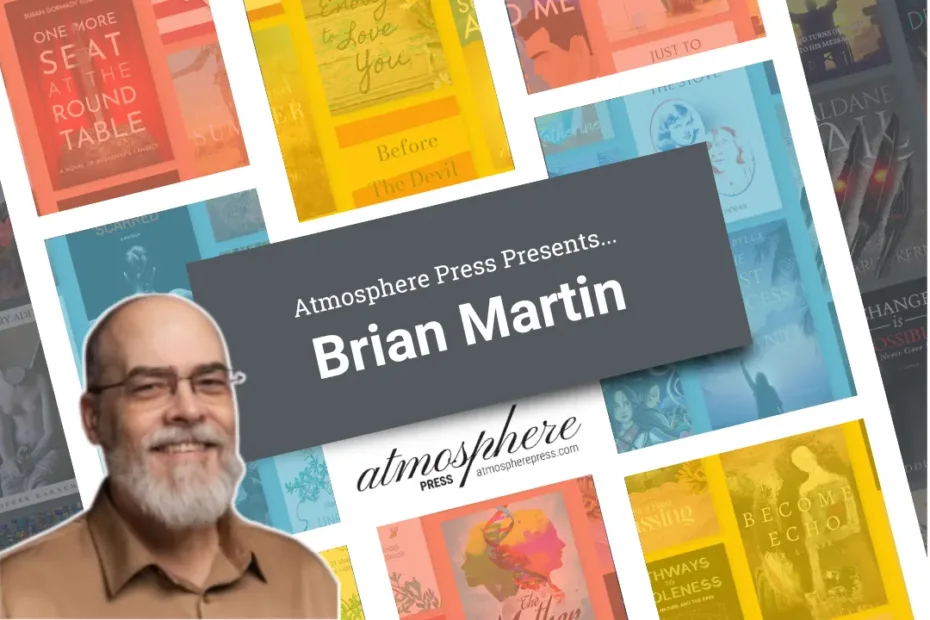
Brian Martin has a long love of and fascination with medieval history. He studied history at The University of Texas at Austin with the intent to become a history professor, but life took a different course. Although he spent thirty-five years working in the software industry, Brian never lost his love of medieval history and studied it as a hobby while also enjoying medieval reenactment. Brian still lives in the Austin area and has been happily married to the love of his life, Pam, for thirty-two years. They have one son, Trevor, and a rescue dog.
What inspired you to start writing this book?
I’ve always enjoyed writing – in fact, I wrote conversations in computer games in the early nineties – and I’ve long loved and been fascinated by the Middle Ages. I said for decades that I was going to write a book ‘someday,’ but never had the time because of work, hobbies, raising our son, etc. Last year, my wife pointed out that, since I was retired, ‘someday’ was now here. Oddly enough, I set out to write an entirely different book. The book I intended to write was going to be about the life of King Edward III of England. (He’s the fellow who started the Hundred Years War.) In researching that book, however, I realized that I couldn’t tell Edward III’s story without first telling his parents’ story. So, my focus shifted to tell the story of how Edward II’s terrible reign led directly to Edward III’s glorious reign, only to realize that the real story there was Isabella’s triumph over her weak husband and his evil advisor whose greed was destroying England.
Tell us the story of your book’s current title. Was it easy to find, or did it take forever?
Well, I’m pretty terrible at thinking of names of things. I have to hear them or find them in a book or something, they don’t just come to me. At some point, not long after I realized that Isabella was the protagonist of this story, my wife referred to Isabella as ‘a queen among kings’ and I liked it. And she is surrounded by kings in this story; her husband, her brother, and her father were all kings who loomed large in her life. I made two small changes; first, changing the ‘a’ to ‘the’ to make her definitively the queen, because while she was affected by numerous kings, she was her own person and the victory was hers. Recently, I added Isabella’s name to the title because she triumphs where others failed. Also, for centuries, Isabella has been known as ‘The She-Wolf of France,’ a quote from an Elizabethan play. She’s gotten a bad rap for being the evil and duplicitous wife who had Edward II deposed. In truth, she was a victim of Edward’s crony and court favorite and she turned her victimhood into victory.
Describe your dream book cover.
My wife, the visual artist in the family, came up with a cover concept that I like and will pitch to the graphic designer when we get there. It has Isabella standing in the center of the image with four men standing behind her in a semi-circle: King Charles IV of France (her brother), Lord Roger Mortimer (her lover), Hugh Despenser (her husband’s greedy advisor and possible lover), and King Edward II (her husband). Standing in front of Isabella is her son, Edward of Windsor, the future Edward III. Unlike most medieval historical fictions, they’ll all be wearing proper and accurate early fourteenth-century clothing. (I’m super nerdy about that kind of authenticity.)
If your book had a soundtrack, what are some songs that would be on it?
Wow, that’s a good one…Actual medieval music would definitely be in it so it would sound terrible to the modern ear. Maybe borrow from the movie Excalibur and have music from Wagner and Orff’s Carmina Burana? This is a big story with battles, intrigue, romance, and even a prison break (all of which really happened), so the music would need to run the gamut of emotions and experiences. Overall, though, it would need to be bold.
What books are you reading (for research or comfort) as you continue the writing process?
For research, I read books on Edward II and Hugh Despenser by Kathryn Warner; Queen Isabella by Alison Weir; The Perfect King, The Greatest Traitor, and The Time Traveller’s Guide to Medieval England by Ian Mortimer; and Edward III by W. Mark Ormrod. For fun, I’m reading Flashman at the Charge by George MacDonald Fraser. It has nothing to do with my project; I just love MacDonald Fraser’s books because he’s hilarious and makes the nineteenth century come to life.
What other professions have you worked in? What’s something about you that your readers wouldn’t know?
I worked in the software industry for thirty-five years. It wasn’t my calling, but it paid the bills. Something about me readers wouldn’t know: I (and a LOT of others) helped create the world’s greatest ‘spook house’ in the home of an Austin millionaire called Britannia Manor in 1990, 1992, and 1994. I (with five others) founded a Shakespearean theatrical troupe, The Baron’s Men, that’s been performing for over twenty years. I’ve had the good fortune of sharing the list field, feast table, and campfire with heroes and legends who have gifted me with more stories and greater memories than any man could ever hope for. I married the greatest and most beautiful woman I’ve ever known and together we’ve shared a life and raised a son into a man of whom we are immensely proud.
Who/what made you want to write? Was there a particular person, or particular writers/works/art forms that influenced you?
I’ve enjoyed literature since middle school, so I guess the germ was always there. I also thought it was cool that my dad took some college courses when I was young, and I read something he did in a creative writing class and just loved the words and imagery he used. I never thought I could actually write a book, you know? That’s what people like Steinbeck did, then a friend of mine got published and that really inspired me. Ultimately, though, it was my wife who pushed that rock and got it rolling downhill. Her support and the encouragement of our son has been tremendous in this endeavor.
Where is your favorite place to write?
I have a home office from which I worked for the last ten years of my career. It’s still my office and it’s still where I work. I just get to do something I love now. I also do sometimes go to a cigar lounge to write, but not often.
What advice would you give your past self at the start of your writing journey?
The same advice my published friend Robert gave me: Write every single day. Don’t take a day off. Also, I’d tell my past self that he doesn’t have to be (can’t ever be) Steinbeck or any other author he admires. He just has to be himself and tell the stories he loves.
What’s one thing you hope sticks with readers after they finish your book?
That history isn’t dry and boring; it’s exciting and romantic and bloody and joyous, and tragic, and hilarious, and that they want to read and experience more of it.
Are you a writer, too? Submit your manuscript to Atmosphere Press.

Atmosphere Press is a selective hybrid publisher founded in 2015 on the principles of Honesty, Transparency, Professionalism, Kindness, and Making Your Book Awesome. Our books have won dozens of awards and sold tens of thousands of copies. If you’re interested in learning more, or seeking publication for your own work, please explore the links below.