An Interview with Chris Cage
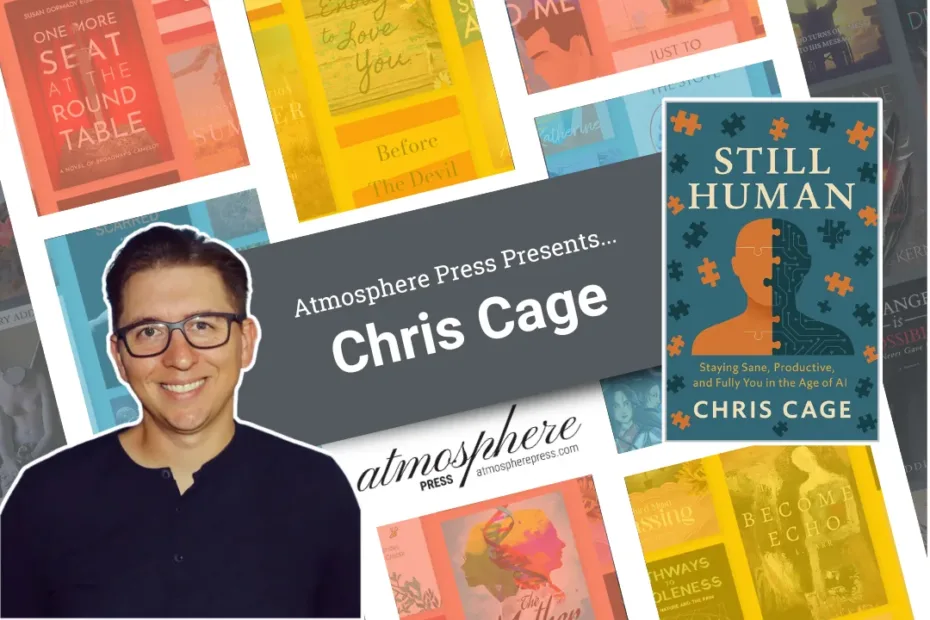
Chris Cage is a product manager, writer, endurance athlete, and the voice behind The Mental Lens blog and the podcast Through the Mental Lens. After years in high-pressure environments that prized efficiency over empathy, Chris set out on a journey toward clarity and connection.
Blending experience from healthcare tech, Ironman training, parenting, and his own mental health struggles, Chris shares tools and stories that encourage readers to embrace imperfection, protect their energy, and thrive as whole humans – even in an AI-driven world.
When he isn’t writing or recording episodes, you’ll likely find him carting his kids around to endless activities, building furniture in his garage, or logging long training runs that make him question why he keeps signing up for races requiring swim caps and energy gels.
What inspired you to start writing this book?
What inspired Still Human actually started long before I wrote a single chapter. After coming to terms with my own mental health, I found myself wanting to help others do the same: to break down the barriers, the stigma, and the quiet isolation so many people feel. That led me into mental health advocacy, where I learned how powerful something as small as a supportive conversation or a well-timed resource can be. My role is to ‘signpost’ and guide others to support. No one should have to navigate their inner world alone.
At the same time, my professional life was being reshaped by the explosion of AI tools. I was learning how to prompt, how to build agentic AI, how to leverage these tools creatively…and like so many people, I fell into the trap of using them blindly. I stopped questioning the output; not just whether it was accurate, but whether it still sounded like me. I started to feel my own creativity slipping away, almost like the tool was writing for me rather than with me.
And as people began producing more content, faster than ever, I noticed something: the quality wasn’t keeping up. So much of it felt rushed, flat, or disconnected from the humans who created it. It made me pause and ask bigger questions, not about AI itself, but about how we’re using it, and whether we’re unintentionally trading away clarity, creativity, and mental wellbeing in the process.
Somewhere in the middle of all that, I had the spark for a mental health blog. And that spark grew into something more when I started researching what already existed. There were plenty of academic papers on AI and mental health, and plenty of books on how to use AI, but almost nothing that spoke to everyday people trying to stay grounded, productive, and emotionally healthy in a world of constant technological acceleration.
So I set out to write the book I couldn’t find. Something accessible, relatable, grounded in research, and deeply human. A guide to using AI, not as a driver but as a co-pilot, and to protecting your creativity, wellbeing, and sense of self along the way.
Tell us the story of your book’s current title. Was it easy to find, or did it take forever?
The title Still Human came surprisingly early in the process, and once it appeared, it never really left. I knew I wanted the book to focus on the human side of artificial intelligence, not the technical debates, but the emotional and mental ones. How we stay grounded. How we protect our creativity. How we rest. How we remain fully ourselves in a world that keeps speeding up.
The subtitle, Staying Sane, Productive, and Fully You in the Age of AI, came from the same place. It captured the four core pillars I wanted to explore: rethinking focus, redefining rest, reclaiming creativity, and giving mental health an actual seat at the AI table.
I wanted readers to feel from the book cover that this wasn’t another ‘how to use AI’ manual but a guide to using these tools without losing the parts of us that matter most.
I also had a sense, even early on, that this might grow into something bigger. I have several future book ideas that could live under the Still Human umbrella, so the title became not just a phrase for one book, but a potential foundation for an entire series. It’s the message at the center of everything I’m building: no matter how advanced our tools become, we’re still human and that’s our strength.
Describe your dream book cover.
I’m genuinely thrilled with how the cover turned out. From the start, I wanted something visually striking. Something that immediately told readers, this is a book about being human in a world full of machines. The half-human, half-circuit face paired with the puzzle-piece motif captured that perfectly. It suggests both fragmentation and wholeness, which is exactly what the book explores.
Getting there, though, was a journey. We tried everything: digital glitch effects, more literal interpretations with humans and robots, even creative, abstract paint-splotch concepts. Each version had potential, but none of them fully captured the emotional center of the book.
Finalizing the cover might have been the hardest part of the entire process. Writing the book felt easier than deciding how to visually represent it. But seeing the finished design, one that feels both modern and deeply human, made the process worth it.
If your book had a soundtrack, what are some songs that would be on it?
If Still Human had a soundtrack, it would be almost entirely instrumental. I’ve always done my best thinking and writing to music without lyrics: everything from piano to string arrangement playlists. There’s something about instrumental music that clears my mental space instead of filling it.
One constant for me, though, has been the Lord of the Rings soundtracks. Ever since college, I’ve returned to them anytime I need focus. If I had to choose one album to represent the emotional arc of the book, it would be The Fellowship of the Ring’s soundtrack. It has that blend of wonder, tension, and introspection that mirrors what it feels like to navigate both technology and mental health today.
What books are you reading (for research or comfort) as you continue the writing process?
I tend to bounce between fiction and nonfiction every few books. It helps keep my brain balanced between imagination and learning. For fiction, I’m a huge science-fiction fan, and my newest obsession is Dungeon Crawler Carl by Matt Dinniman. It’s clever, chaotic, wildly imaginative, and honestly a great mental reset.
On the nonfiction side, I recently finished Mel Robbins’ Let Them, which I absolutely loved. Her central idea of letting people be who they are without absorbing their reactions or expectations really resonated with me. It’s actually a concept I had started doing earlier this year, so reading her take on it not only gave me new tools but also validated the intentional effort I’ve been making to be more self-aware in how I respond to the world around me. It was a timely read, especially while writing a book centered on mental clarity and emotional resilience.
Both kinds of books feed me in different ways: fiction fills my creative tank, and nonfiction sharpens the insights I try to bring into my own writing.
What other professions have you worked in? What’s something about you that your readers wouldn’t know?
I’ve spent my entire professional career in healthcare technology. I started in a hospital setting and eventually moved into roles that let me deploy and support clinical systems, help sales teams from a technical angle, and ultimately work in product management. I always knew I wanted to be in the medical field and help people, but I also knew I wasn’t cut out to be a frontline caregiver. (Blood and needles? Absolutely not.)
So helping people through technology became my path. It’s a space where I can make a real impact on patient care without needing to be the one holding the syringe.
As for something readers might not know about me…I have a recurring dream that I never officially quit my teenage job bussing tables at Big Boy. In the dream, they keep calling me, as an adult, asking if I can pick up a shift. It’s bizarre, oddly persistent, and probably says something about my relationship with unfinished business…or maybe just the lingering trauma of half-eaten burgers and sticky syrup bottles.
Who/what made you want to write? Was there a particular person, or particular writers/works/art forms that influenced you?
I’ve always enjoyed writing, especially when I have the freedom to be creative. It did, however, take me a long time to actually believe I was good at it. In my junior year of high school, my English teacher told my parents I didn’t belong in her advanced class. My work wasn’t what she wanted, and even though I did perfectly fine, that comment stuck with me. It dented my confidence more than I realized at the time.
Fast forward a few years: my freshman year college English professor pulled me aside mid-semester, praised my writing, and suggested I switch majors. Whether she genuinely saw potential in me or was just trying to recruit for the department, I’ll never know, but I choose to believe she meant it. And honestly, that moment gave me a confidence boost I hadn’t realized I needed. It reminded me that writing wasn’t just something I enjoyed; it was something I could actually do.
Professionally, technology has always been my world. But personally, writing has been the place where I process things, explore ideas, and create something from scratch.
The funny part? When I first decided to write a book, it wasn’t supposed to be about mental health or AI at all. It was going to be a cookbook. I love cooking and baking, and I’ve collected so many family recipes and personal creations over the years. I’m still working on it, actually. I’ve got the theme. Now I just need to finish writing it…and take pictures of everything before I eat it.
But the cookbook had to take a back seat when I started my blog, The Mental Lens, and began leaning more intentionally into mental health advocacy. That mission felt urgent and meaningful in a way I couldn’t ignore. So, the story shifted, but the love of writing never did.
Where is your favorite place to write?
My favorite place to write is our screened-in porch that overlooks the backyard and a small pond. The windows run from floor to ceiling, so it almost feels like I’m sitting right outside. It’s quiet, calming, and there’s something about the natural light and the view that helps my brain slow down enough to actually think.
I also love writing in my office. It’s comfortable and it has a built-in bookcase I made myself. I’m a woodworking hobbyist. That bookcase holds my ever-growing library and having it right next to me provides me with inspiration.
What advice would you give your past self at the start of your writing journey?
I’m not sure if this is advice from me or wisdom borrowed from my wife, but I would absolutely tell my past self to stop trying to do everything at once.
When I started writing this book, I also decided it was the perfect time to launch a website, start a blog, build an online store, and grow a brand, all while working a full-time job and raising a family. It’s been an incredible, messy, rewarding, and completely exhausting experience.
If I could go back, I’d tell myself to focus on one big thing at a time, to give each project the space and attention it deserves, and to trust that things don’t all have to happen simultaneously. There’s room for ambition, but there’s also value in pacing yourself.
What’s one thing you hope sticks with readers after they finish your book?
I hope readers finish the book with a genuine sense of hope: hope in themselves and hope in their ability to stay human in a world that’s becoming more chaotic and automated by the day. I want them to walk away with clarity, perspective, and maybe even a renewed appreciation for their own creativity. So many of us have started handing pieces of ourselves over to our tools without realizing it. If this book helps readers slow down, question that impulse, and reconnect with their own voice, their own imagination, and their own wellbeing, then it’s done what I hoped it would do.
Are you a writer, too? Submit your manuscript to Atmosphere Press.
Atmosphere Press is a selective hybrid publisher founded in 2015 on the principles of Honesty, Transparency, Professionalism, Kindness, and Making Your Book Awesome. Our books have won dozens of awards and sold tens of thousands of copies. If you’re interested in learning more, or seeking publication for your own work, please explore the links below.