An Interview with Christopher Cole
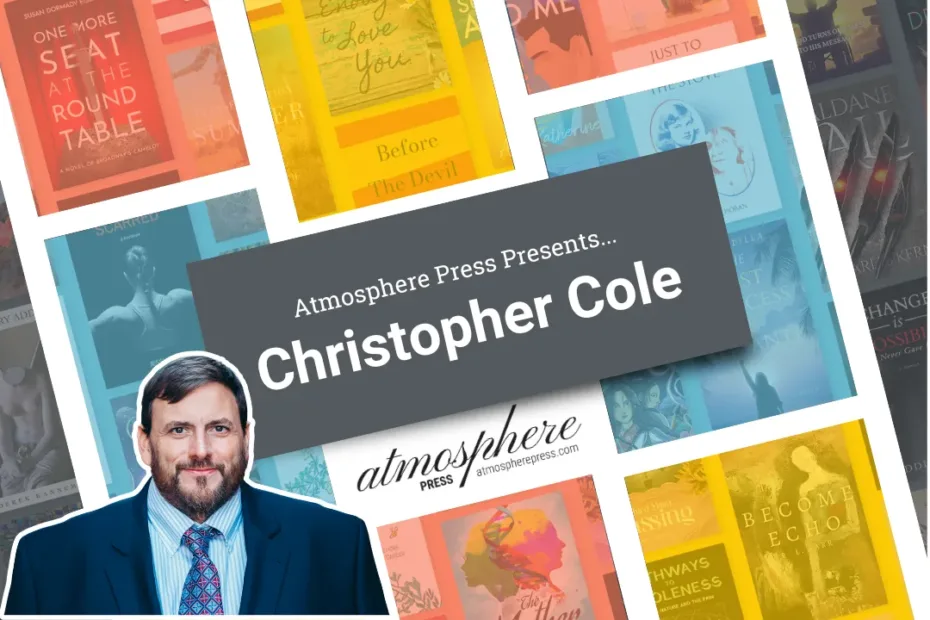
Christopher Cole is currently editing his first book, Ephemeris, which he wrote while winding down a thirty-year career in marketing and communications in the higher education and public utility sectors. During that time, he has also earned his Master of Public Administration and Juris Doctor. He passed the Kentucky Bar Exam in 2009 and the Kentucky Real Estate Exam in 2022.
What inspired you to start writing this book?
I was up at three a.m., reading an article in Wired magazine about different things that could end the world and one of them surprised me. So, I started researching and by the time I had to go to work, I had a rough idea for a novel.
Tell us the story of your book’s current title. Was it easy to find, or did it take forever?
I’d never heard the word ‘ephemeris’ when I read that Wired article, or when I started writing my book for that matter. But as I continued researching, I came across it and thought it was beautiful and perfect for my book. So, in that way, I suppose it was easy. It’s from the Greek ‘ephemeros,’ meaning ‘lasting only a day.’ It also gave us the modern word ‘ephemeral.’ In astronomy, it’s a table that shows the positions of a heavenly body on a number of dates in a regular sequence. My book is a story that maps how people survive and connect, even if only for a time, when their digital coordinates fail. So, it’s a really nice metaphor.
Describe your dream book cover.
The cover features a textured, weathered, grayscale backdrop that evokes age, tension, and the erosion of certainty. Centered on the page is the profile of a man facing right. His expression is severe and burdened, with heavy shadows defining the lines beneath his eyes and the set of his jaw. His shoulders and upper chest are fully visible. On his chest, stitched into the fabric of a worn, utilitarian jacket, is a rectangular name patch. It reads MADDOX in stark, block lettering. The patch is subtly frayed, suggesting long use and a life spent working in harsh or unforgiving environments. Superimposed across the lower portion of his chest, fading naturally into the fabric as if projected from his memory, is a muted but detailed silhouette of downtown Cincinnati, Ohio. The skyline is recognizable by its signature contours and gleaming tiara. Roaming freely between the buildings are two African elephants, large and wandering with quiet surrealism. Their presence adds a dreamlike, post-collapse tone to the composition. Inside the silhouette of the man’s head, as if carved from shadow, sits a forest of dark evergreens beneath a starless sky. Floating above the treetops is a damaged satellite, one solar panel bent and drifting. This element appears as part of his inner world, a visual metaphor suspended in the hollowed space between memory and dread.
Above the artwork, stretching across the top in bold serif type, is the title, EPHEMERIS: A Record of Signal Lost. Centered beneath the title, a tagline: WHEN THE GRID FAILS, WHAT WILL TETHER YOU?
At the bottom of the cover, large and commanding, is the author credit: CHRISTOPHER COLE.
The overall mood is stark, cinematic, and foreboding, blending grounded realism with symbolic imagery that foreshadows collapse, isolation, and the fragile maps that hold a people together.
If your book had a soundtrack, what are some songs that would be on it?
1. Elegia – New Order
2. The Mighty Rio Grande – This Will Destroy You
3. World Sick – Broken Social Scene
4. Lux Aeterna (Requiem for a Dream) – Clint Mansell
5. In the House – In a Heartbeat – John Murphy
6. I Don’t Love Me Anymore – Quicksand (Instrumental Edit)
7. No Cure for the Lonely – Swans (Instrumental sections)
8. Song for Jesse – Nick Cave & Warren Ellis
9. The Last Day – M83
10. Nightcall – Kavinsky & Lovefoxxx (Instrumental)
11. Holocene – Bon Iver (Instrumental)
12. The Way Out is Through – Nine Inch Nails
13. Surface of the Sun – John Murphy
14. Abraham’s Daughter – Arcade Fire (Instrumental adaptation)
15. Your Hand in Mine – Explosions in the Sky
16. Outro – M83
What books are you reading (for research or comfort) as you continue the writing process?
Right now, I am taking an agentic AI course at MIT, so I’m not reading as much as usual. But I am currently reading The Man No One Believed by Joshua Sharpe, about the 1985 murders at Rising Daughter Baptist Church, and Mark Twain by Ron Chernow.
What other professions have you worked in? What’s something about you that your readers wouldn’t know?
Public relations, law, marketing, real estate, sports information, journalism, and graphic design. I have several tattoos and at one point was training to do cage fighting.
Who/what made you want to write? Was there a particular person, or particular writers/works/art forms that influenced you?
My biggest writing influences are Mark Twain, Edgar Allan Poe, Jason Isbell, and Stephen King. The two people who probably had the most direct influence on me becoming a writer were J. Patrick Moynahan and Don Owen. The former found me when I was lost on campus as a freshman and talked me into changing my major from accounting to journalism. The latter indoctrinated me into the real world of writing. I have both of them to blame…I mean, thank for the way my career has turned out!
Where is your favorite place to write?
I love to write anywhere. I don’t really need the fabled quiet nook or writer’s desk. I’ve come up with some of my favorite pages at BW3s. As long as my laptop has some juice, I’m good.
What advice would you give your past self at the start of your writing journey?
Don’t be afraid to stretch yourself. Write what makes you nervous. The quicker you’re able to kill every last ounce of hesitation inside you, the faster you’ll be ready to do this thing for real.
What’s one thing you hope sticks with readers after they finish your book?
The urge to buy the sequel!
Are you a writer, too? Submit your manuscript to Atmosphere Press.
Atmosphere Press is a selective hybrid publisher founded in 2015 on the principles of Honesty, Transparency, Professionalism, Kindness, and Making Your Book Awesome. Our books have won dozens of awards and sold tens of thousands of copies. If you’re interested in learning more, or seeking publication for your own work, please explore the links below.