An Interview with D.K. Dillenback
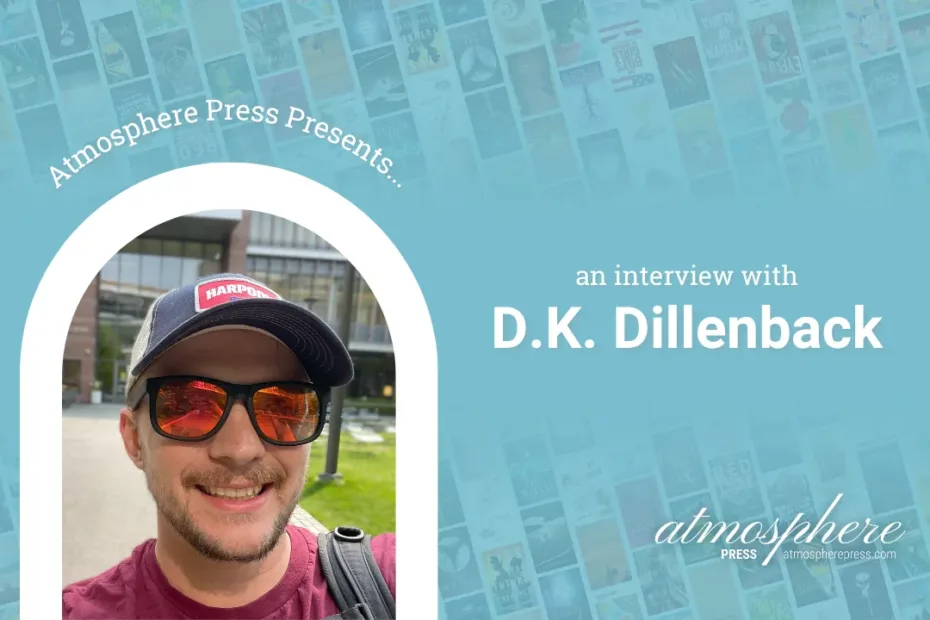
D.K. Dillenback is an American author and military strategist who explores the intersection between the human condition and our perceived reality. His writing attempts to capture reason, order, and peace from an infinite web of complex adaptive systems. Inspired by his time working homeland defense issues for the Department of the Army, Dan started scribbling the first thoughts of MIR.EXE on a plane from Anchorage to D.C.
He lives in Hawai’i with his family, the sixth state they’ve called home. He spends his time daydreaming about the world between tattoo appointments, sketches, and Futurama reruns.
Tell us the story of your book’s title. Was it easy to find, or did it take forever?
I usually can’t decide on a title until the story is nearly complete. In this case, the title MIR.EXE is the filename of a virus that drives the story’s main conflict. Beyond the first-order benefits – most obviously that the filename-style title gives the reader an idea of the genre – there were a few other reasons I chose this name at all. ‘Mir’ is ‘peace’ in Russian (the likely origin of the virus), and the ‘exe’ of a filename is short for ‘execute.’ I liked the dichotomy that mirrors what I was trying to accomplish. I almost named the book Peace Execution, which carries a couple of the themes I obsessed over. But at the beginning, this novel, like all of my novels, started with the title Book.
How did it feel when you first saw your book cover? Or when you first held your book in your hands?
There is a moment when, after dozens of rounds of editing, you perfect a scene. Then another when that scene fits perfectly in a chapter. There is another when a chapter does exactly what it is supposed to in the greater story arc. And all of that culminates with a physical book in your hand. It’s hard to top the feeling of seeing your thoughts morph into a physical thing. It’s not why I write, but it definitely helps to keep it going.
Who/what made you want to write? Was there a particular person, or particular writers/works/art forms that influenced you?
I disliked English in high school, largely because I couldn’t stand being told what, when, or how to write. After a while, I just chalked it up to being a bad writer. Like any good, bad writer, I took solace in poetry and songwriting. It took years of trying to write and refusing to share it that I built up enough frustration to finally say ‘f— it’ and get started. I never intended to publicize or even to write a second novel; I just wanted to vent. That’s where my first novel, The Voices are Real, came from. Reading that book is getting to know me at my most vulnerable, angry, and distraught.
In the end, both of my books so far have been inspired by my obsession with complexity. I obsessively and often self-destructively ruminate on patterns in existence. The more I try to find meaning, the more formulaic and predictable they seem. Writing is a way of expressing that understanding more coherently than my many drunken rants at college parties.
What other professions have you worked in? What’s something about you that your readers wouldn’t know?
I am still an active-duty army officer. I was commissioned in 2011 as an engineer and became a military strategist in 2021. Continuing my full-time military career has advantages and disadvantages. On the one hand, I can invest in my writing and publishing companies without worrying about making a profit. On the other hand, it means that most of my novel writing happens between 4am and 7am.
What was the most rewarding/meaningful part of publishing your book?
Listening to my audiobook for the first time. I hired a wonderful narrator who breathed new life into the characters and interpreted the scenes so uniquely. I used to think that hearing a recording of your own voice was weird. Hearing my words read in an English accent was far weirder!
In addition, as someone who is persistently his own harshest critic, listening to some of my passages brought a distinct pride. I felt, as I often don’t, ‘this is real. I am a good writer.’
If your book had a soundtrack, what are some songs that would be on it?
This is a highly appropriate question for this book! My wife and I joke that I am a ‘method writer.’ When writing horror, I dove into Southern Gothic, murder folk, and horror films. For MIR.EXE, I listened obsessively to Synthwave and Darksynth. Some staple tracks included:
MEAN STREETS (Power Glove Remix) by ALEX, TOKYO ROSE, and THE AKUMA; Event Horizon by Dark Smoke Signal; BLOODRAVE by DreamReaper and MAGNAVOLT; and Nightcall by Kavinsky.
What is one thing you hope readers take away from reading your book? How do you envision your perfect reader?
I want my reader to abandon their pre-conceived understanding of the nature of good and evil. I want them to feel the conflict between what they want to happen and what is best. This is not a story about an evil megacorporation. It is an exploration of the nature of evil itself. If all members of the system have the best of intentions and there are unintended consequences, where does the blame lie?
My perfect reader is intellectually curious. I often think of the adage ‘within every cynic is a disappointed idealist.’ Someone who understands and feels the massive injustices of the world, but who isn’t ready to turn full nihilist.
What creative projects are you currently working on?
While I hadn’t thought about it before, I’ve had requests from readers to explore both the next chapter in Echo’s story as well as a prequel. I’m exploring the space and writing new scenes, building from there. I’m going to stick with this universe for a little while, until I’ve said all that I want to say. Keep an eye out in 2027!
How was working with Atmosphere Press? What would you tell other writers who want to publish?
The team at Atmosphere was knowledgeable, responsive, and easy to work with throughout our contract. While the value proposition they provide is an excellent ‘author experience,’ I wanted to learn about the modern publishing industry and made that clear from the beginning. Each team member was professional and helpful. They approached me, the customer, with respect, but were confident and competent enough to assert themselves when they felt I was making a sub-optimal decision. They took my feedback and provided their own. I worked with roughly nine different people over the course of the year and had no problems with any of them.
For anyone considering it, hybrid publishing and vanity publishing are not the same thing. Choosing Atmosphere was a business decision no different than hiring a contractor for a home renovation. It may cost more than hiring each expert yourself, but the convenience and continuity were worth it for me. I never felt like they were more interested in my money than in my book. And in fact, they made several recommendations throughout the process that were more in my interests than theirs.
Are you a writer, too? Submit your manuscript to Atmosphere Press.
Atmosphere Press is a selective hybrid publisher founded in 2015 on the principles of Honesty, Transparency, Professionalism, Kindness, and Making Your Book Awesome. Our books have won dozens of awards and sold tens of thousands of copies. If you’re interested in learning more, or seeking publication for your own work, please explore the links below.