An Interview with Debjani Chatterjee
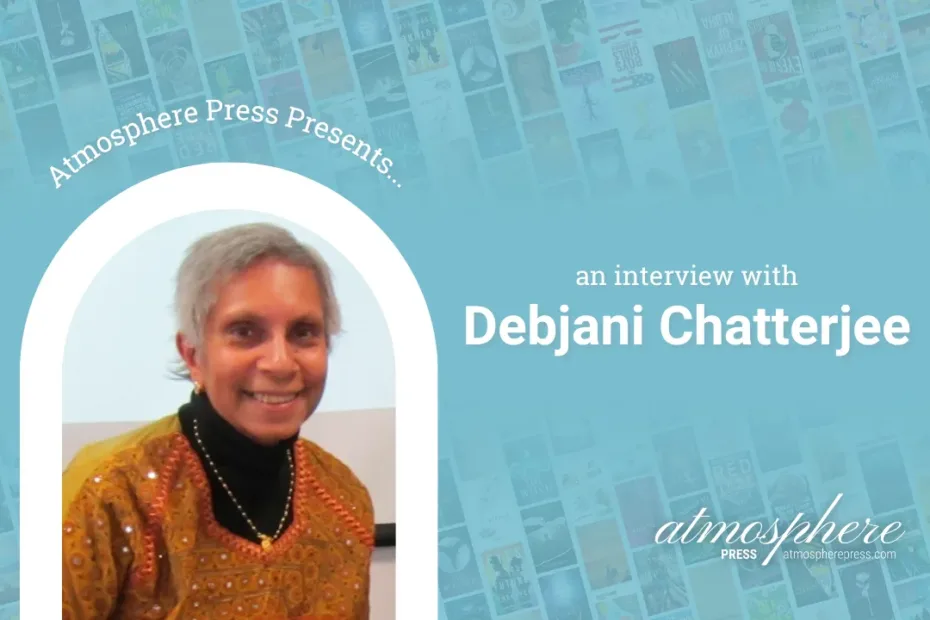
Indian-born Debjani Chatterjee has been called a poet “full of wit and charm” (Andrew Motion), “Britain’s best-known Asian poet” (Elisabetta Marino), and “a national treasure” (Barry Tebb). She is also an editor, children’s writer, translator, storyteller, Olympic torchbearer, and arts psychotherapist. Her seventy-five-plus books include I Was That Woman, The Most Beautiful Child, and Namaskar: New & Selected Poems.
Her The Elephant-Headed God & Other Hindu Tales was a Children’s Book of the Year. Other prize-winning books include Barbed Lines, The Redbeck Anthology of British South Asian Poetry, and Rainbow World. Major prizes include the Peterloo Poetry Prize, Raymond Williams Community Publishing Prize, and Muse India Poetry Translation Prize. On her fiftieth birthday, Debjani received an honorary doctorate from Sheffield Hallam University. She is also an honorary Fellow of the Royal Society for Literature and an Associate Fellow of the Royal Literary Fund. In 2008, she received an MBE.
Debjani attended seven schools in Japan, Bangladesh, India, and Hong Kong, before studying literature at the American University in Cairo and the University of Kent. After completing a PhD at the University of Lancaster and a PGCE at Sheffield Hallam University, she taught in schools, universities, and the WEA, in Manchester and Sheffield. She also worked in the steel industry and as community relations director in Sheffield and Oxfordshire. A double cancer survivor, she studied counselling and arts psychotherapy, and advocates the therapeutic power of reading, writing, and storytelling.
She has chaired the National Association of Writers in Education, the Arts Council of England’s Translations Panel, Yorkshire Arts Association’s Literature Committee, and Survivors Poetry. Important residencies have included Sheffield Children’s Hospital, the Barbican Centre, the Millennium Galleries, Ilkley Literature Festival, and the Kelvingrove Museum and Art Gallery.
Her most recent book is Laughing With Angels, her eighth full poetry collection.
What inspired you to start writing this book?
There are some themes that recur in my poetry—identity, myths, nature, people, places, history, relationships, language, mental health, etc. My earlier collections have been characterised by a variety of subjects and styles. But my most recent collection, Laughing With Angels, has poems that all have humour and wit as a connecting point. I am fond of animals, and not surprisingly, they have often inspired my poetry. I realised that I have probably written more poems about animals than about any other subject. In fact, one of my books for children, which I also enjoyed illustrating, is a poetry book called Animal Antics. So, it seemed a natural development to collect all my animal and bird poems together in one big book, The Parrot Fortune-teller & Other Poems. There is a good variety of animals, ranging from horses, snakes, and lions to extinct ones like the dodo, and mythical animals like Indra’s flying elephant, Airavata. Although all the poems feature one or more animals, there is considerable variety in the form, perspective, meaning, and intent.
Tell us the story of your book’s current title. Was it easy to find, or did it take forever?
Actually, I would call The Parrot Fortune-teller & Other Poems a finished manuscript rather than a book. I make this distinction because it is, as yet, unpublished. When published—and I hope it may be soon—it will be my ninth poetry collection.
Some of my poetry books take their titles from particular poems contained within their pages. This was the case with my first two collections: I Was That Woman (Hippopotamus Press) and Albino Gecko (University of Salzburg Press). As for Namaskar: New & Selected Poems (Redbeck Press), the “Namaskar” title comes from a poem titled Namaskar, Sir Walter in which I pay tribute to Sir Walter Scot and to my two grandfathers who had admired his work. “Namaskar,” meaning “my soul bows to your soul,” is an Indian greeting that is accompanied by joined hands and a bow of the head. So, quite apart from my book’s title drawing attention to the poem, I felt it also played the important role of greeting my reader.
I do try to give serious consideration to selecting a book title because the title and the book cover will be responsible for a potential reader’s first impression. It did not take long for me to decide to call my new collection The Parrot Fortune-teller & Other Poems. When a book’s title proclaims a connection to an individual poem, I think it is important that the poem is one of the strongest ones in the volume. The Parrot Fortune-teller, written in my thirties, won the Peterloo Poetry Prize and was published in The Guardian and in my debut collection, I Was That Woman, in 1989. The book went out of print a long time ago, but the poem deserves a revival. Calling my latest collection The Parrot Fortune-teller & Other Poems not only highlights a powerful poem, but I also hope the title will intrigue the reader, prompting them to explore the title poem and other contents of the book.
What other professions have you worked in? What’s something about you that your readers wouldn’t know?
My first job was that of a part-time student library assistant at the American University in Cairo Library. I was a sixteen-year-old undergraduate and thrilled to spend time surrounded by books. Libraries have always been my favourite places. For me, they are even more sacred than temples. The work was monotonous and dusty—shelving and shelf-reading. But occasionally at weekends, they would be short-staffed, and I would get to serve at the checkout desk. Happy and proud, I would stamp the books being borrowed.
It was also in Egypt, at sixteen or seventeen, that I began teaching English as a foreign language. This became a regular voluntary activity for at least the next five decades, at my various universities and alongside my working life. At the Sheffield Association for the Voluntary Teaching of English (SAVTE), I was encouraged to qualify in TEFL. For a few years, in the late 1990s, I also had a job-share post at SAVTE, working mainly with refugees who needed to learn English.
I have had many other jobs, but the most challenging for me was working in the steel industry. In the final year of my PhD studies at Lancaster, I attended a careers fair and, at every employer’s desk, I asked if they had any openings for a humanities post-graduate. The British Steel Corporation recruiter was the only one to say yes. He interviewed me straightaway. When asked if I was interested in metallurgy, I gave a politician’s evasive answer. Instead of admitting that I had no interest in the subject, I truthfully mentioned that I had once written an article on “Metallurgy in Ancient Egypt” for an Indian magazine called Science Reporter. I was interested in ancient Egypt and in getting published in magazines at the time. I neglected to say that it was only a small article written for the magazine’s children’s section. Nor did I say that the metallurgy was restricted to gold and silver. Steel was unknown then. I was invited to a more formal interview at the corporation’s Sheffield headquarters for a management trainee post in export sales. I was sure I had impressed with my knowledge of languages, experience of living in several lands, and, of course, my ancient Egyptian metallurgy article! Two or three years later, I learnt that British Steel had been taken to task by the Equal Opportunities Commission for not employing women and had given an undertaking that in the next year they would recruit fifty per cent women graduate trainees. I had obviously struck lucky! Although I don’t know if “lucky” is the right word since I had a rather miserable time of it, especially in the first two years in special bars export sales. There was a very strong drinking culture, and I had never encountered such direct discrimination before—or since. Colleagues would tell me to “go back where I came from” and not take some British person’s job. My line manager would ask me to sing the “Yorkshire national anthem” in public to prove that my home was in Yorkshire! Christmas parties and work social occasions involved running the gauntlet of groping by drunken senior managers. When I needed to show my foreign clients around the manufacturing site, I squirmed with embarrassment to see the disgusting pornography adorning the walls. Life improved dramatically when I moved to the commercial steels marketing department, but even so, I opted for voluntary redundancy after another year.
After my first cancer diagnosis in 2007, I studied counselling. After my second cancer in 2012, I did a second MA—this time in arts psychotherapy practice at Leeds Beckett University. Like my experience in teaching and in community relations, my work in counselling and creative arts therapy has been very important for me. But since childhood, writing has always remained a constant in my life. I feel blessed to be able to call myself a self-employed poet and writer.
Who/what made you want to write? Was there a particular person, or particular writers/works/art forms that influenced you?
Stories, nursery rhymes, and poems in various languages were highlights of my childhood in Japan, India, Bangladesh, and Hong Kong. I would listen to them enthralled. Equally, I enjoyed reading them. From an early age, I found them inspirational. Because they delighted me, I wanted to be a poet, writer, and storyteller, so that I could relive my own delight and also spread that enjoyment to others. As a little girl, I would pester adults around me to tell me stories and poems. Older cousins, too, were targeted, though they were children themselves. At the age of ten, I was making up stories to tell my sister and our friends and staging them as little plays with their help.
During summer vacations, I would visit my maternal grandfather in his cottage in Mussoorie. He loved poetry and would encourage us children to memorise poems. He gave us little medals for reciting them. I would write poems in praise of the hills of Mussoorie and stories about pirates. On my tenth or eleventh birthday, he gave me a copy of Rabindranath Tagore’s Gitanjali (“Song Offerings”). It was Tagore’s own English version of his deeply spiritual poems in Bengali, the book that won him the Nobel Prize. I fell in love with Tagore’s poetry, his stories, his operatic plays, and, later, his paintings. I memorised the Gitanjali poems and recited them each night as prayer. For very many years, I slept with the Gitanjali under my pillow and dreamt of becoming a great poet like my literary hero.
What advice would you give your past self at the start of your writing journey?
My parents told me that writing was not a proper job and that they did not want me to be starving in some attic! I obediently relegated writing to my spare time and undertook many “proper” jobs, most of which I enjoyed, even though sometimes they were jobs I had taken because they were the only ones I could get, and I refused to be unemployed. There were also jobs that I found very frustrating, particularly when I had to face racism and sexism. At such times, I felt sad and often thought I was wasting my life. With the benefit of hindsight, I would now tell my younger self not to be despondent because it would all be worthwhile. My many and varied experiences in paid and voluntary work, even the “bad” ones, have helped me to grow into the person and the writer that I am; they have enriched my life. A writer needs “life experience,” and one can find inspiration anywhere. Sometimes the most challenging experiences can provide the most interesting inspiration. I would advise my younger, naiver, and impatient self to value the qualities of resilience and equanimity.
Are you a writer, too? Submit your manuscript to Atmosphere Press.
Atmosphere Press is a selective hybrid publisher founded in 2015 on the principles of Honesty, Transparency, Professionalism, Kindness, and Making Your Book Awesome. Our books have won dozens of awards and sold tens of thousands of copies. If you’re interested in learning more, or seeking publication for your own work, please explore the links below.