An Interview with E.L. Wilk
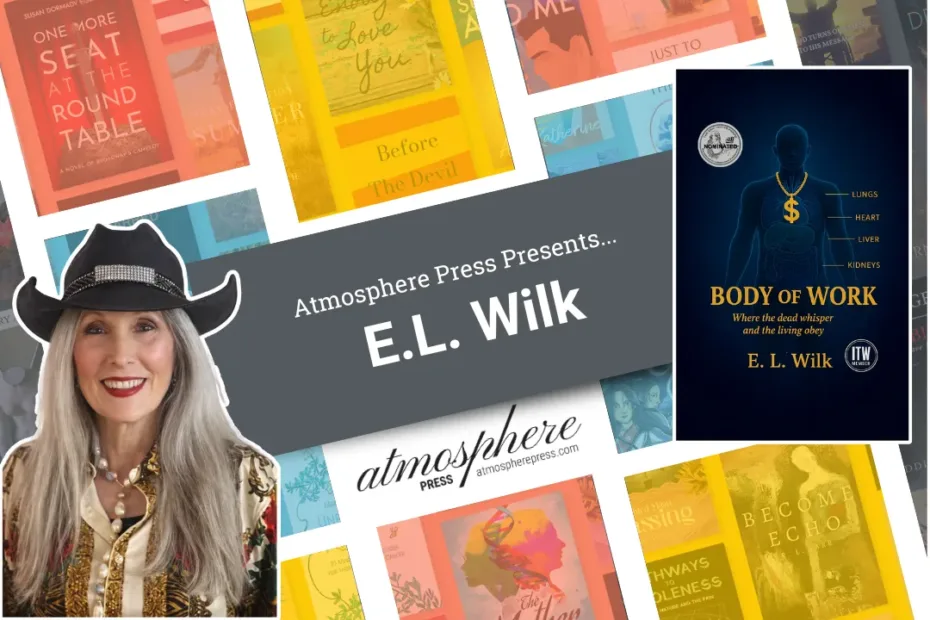
E.L. Wilk is an award-nominated indie author and publisher whose work explores the ethical, emotional, and technological boundaries of modern medicine and artificial intelligence. Her debut medical techno-thriller, Body of Work, examines the global trade in human organs and the consequences of turning the human body into a commodity.
A lifelong entrepreneur and founder of H&E Wilk Press, Wilk brings a business-minded and deeply human perspective to her writing. Her fiction is informed by years of research into biotechnology, medical ethics, and emerging technologies, as well as a longstanding interest in the evolving relationship between humans and intelligent machines.
A graduate of Wellesley College and an alumna of the International School of Brussels, Wilk is an active member of International Thriller Writers and is committed to building meaningful connections with readers, libraries, and literary communities. She is also an amateur astronomer with a lifelong passion for space and exploration.
She lives in Florida and Massachusetts with her husband and their rescue dog, Khaleesi, and continues to develop her growing body of work.
Who/what made you want to write? Was there a particular person, or particular writers/works/art forms that influenced you?
As a child, I devoured books by Roald Dahl, Jonathan Swift, Kurt Vonnegut, Robert Heinlein, Frank Herbert – and so many others that the list feels endless. Stories were my first passport to journeys to faraway planets and extraordinary places.
But one moment stands out more than any other.
In eighth grade, a classmate invited a few of us to join him while his father, Mike Dukakis, taped a PBS television show called The Advocates. We were piled into the backseat of a beige mid-1960s K-car (no seat belts), driven by Johnny’s dad, who was the show’s moderator.
And sitting in the passenger seat – I still can’t quite believe this myself – was Isaac Asimov.
It sounds impossible, but I swear it’s true.
For a book-loving kid, it felt like being handed a glimpse into another universe. That day made writing feel realistic and achievable.
What other professions have you worked in? What’s something about you that your readers wouldn’t know?
Something readers might not know about me is that I’m endlessly curious and still very much a student of life. I take online classes almost every morning, read multiple newspapers, follow research rabbit holes, and happily (sometimes frustratedly) spend hours figuring out how things work – from publishing platforms to audio mastering to medical innovations.
I’m serious about my work, but I don’t take myself too seriously. I love learning and laughing, and I’m usually juggling at least three projects at once – often with my rescue dog, Khaleesi, by my side, reminding me it’s time for a break and her walk in the park.
Tell us the story of your book’s title. Was it easy to find, or did it take forever?
Finding a title was surprisingly difficult. I went through several working titles until one magical evening, when my husband and I were watching a documentary about Diane Warren’s life. At one point, she referred to all of her songs as her ‘body of work,’ and suddenly a light bulb went on in my head.
My book is about the exploitation of people on many levels – about how human bodies and body parts are increasingly treated like recyclable commodities, not unlike plastic and paper on trash day. The buildings that provide life-saving medical services keep getting bigger and more impressive, but I began to wonder: Where do the parts actually come from?
That question led me into months of deep research that opened my eyes to an astonishing and unsettling universe, involving even the most respected institutions, including Harvard Medical School.
Like all writers, I eventually arrived at the essential question: What if?
What if an undocumented person were attacked or mugged – would they feel safe enough to go to the police for help? In many cases, the answer is no.
That realization became the emotional and ethical core of the story. And from that moment, Body of Work was born.
What part of publishing your book made it feel real for the first time?
The first time I truly felt like a real writer was when strangers began leaving five-star reviews on Amazon. Seeing readers I had never met connect with my work was both humbling and exhilarating.
At one point, I had received nearly thirty five-star reviews – before a nameless, cowardly troll swooped in with a one-star rating and no explanation.
Oddly enough, that moment didn’t discourage me. If anything, it felt like a strange rite of passage. I had officially entered the wider world of publishing, where anonymous opinions are part of the terrain.
And in its own way, that single star confirmed what the others already had: My work had reached real readers, and I had become a real writer.
If your book had a soundtrack, what are some songs that would be on it?
It’s funny you should ask me about music. On the very first page of Body of Work, one of my main characters, Ian, raises his voice and says, “Alexa, play the best of The Zombies.”
Alexa replies, “Here is some music by The Zombies,” and the first song that plays is She’s Not There.
That moment sets the tone for the entire story.
Music is woven throughout the book. Olivia, another main character, is the daughter of a piano teacher and a Romani jazz musician. In my mind, I hear Django Reinhardt playing as she scurries through her world, absorbing rhythm and emotion long before she understands them.
At the midpoint of the novel, Olivia plays the piano for her friends and family – a quiet, intimate scene that reveals her inner life. But the deeper musical connection emerges toward the end, when her stepfather reminds us that ‘ghouls’ and bottom feeders are not limited to the medical industry.
He boasts about building his career as a music publisher by exploiting what he calls the three Ds: death, divorce, and drugs.
I especially enjoyed creating him as a malevolent character, because it draws on my own experiences working in the music business many years ago – and on what I learned about how easily power and profit can distort even the most beautiful creation.
What’s one thing you hope sticks with readers after they finish your book?
My objective in writing this novel was to shine a light on some of the many disturbing things that have been carefully hidden from us in plain sight.
What was the most rewarding/meaningful part of publishing your book?
The most meaningful part of publishing Body of Work has been realizing that a story I once carried quietly in my own mind is now renting space in other people’s minds.
This book began with years of research, questions, and moral unease. But it also grew out of personal loss. A close friend of ours, Chris, died from a fentanyl overdose, and that experience brought the realities behind my research painfully close to home.
Writing this novel became a way of trying to understand a system that too often treats human lives as disposable.
What creative projects are you currently working on?
During my travels along what I call the ‘Hypnagogic Highway’ – that half-dreaming, half-awake creative space where ideas take shape – I’ll continue to write this story, because it couldn’t all be told in a single book.
There are still questions to explore, characters to follow, and ethical terrain to navigate. For me, this isn’t just one novel. It’s an ongoing conversation – with myself, with my readers, and with the world around us.
Are you a writer, too? Submit your manuscript to Atmosphere Press.
Atmosphere Press is a selective hybrid publisher founded in 2015 on the principles of Honesty, Transparency, Professionalism, Kindness, and Making Your Book Awesome. Our books have won dozens of awards and sold tens of thousands of copies. If you’re interested in learning more, or seeking publication for your own work, please explore the links below.