An Interview with Helen Montague Foster
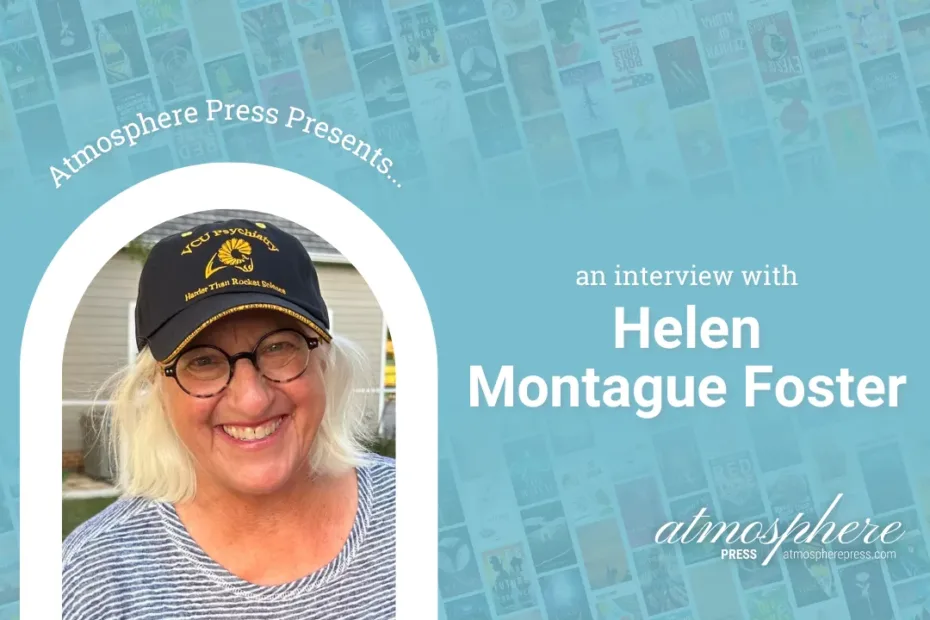
Helen Montague Foster, MD, is a poet, novelist, and Distinguished Life Fellow of the American Psychiatric Association. Before her retirement, she was a Clinical Professor in the Department of Psychiatry of Virginia Commonwealth University School of Medicine. For thirty years she worked in private practice as a psychiatrist in Richmond, Virginia, specializing in the psychotherapy of adults, often writing in literary fiction in her spare time.
In October 2003, she received the Jane F. Deringer Award for overall best at the 22nd Annual Chesapeake Writers Conference, also winning first place for poetry and adult fiction. Her poems have appeared in JAMA, Rattle, Tuck Magazine, Pharos, Hektoen International, and Citizen Jane. Several of her unpublished novel manuscripts placed or were finalists in the Faulkner-Wisdom Competition, the James River Writers Best Unpublished Novel Competition, and/or The River City Publishing First Novel Award. A book-length historical fiction manuscript, Crossing the Same Sea, placed second in the novel category in the 2020 William Faulkner Literary Competition and was published by Atmosphere Press in 2023 as The Silent Hen. Her second novel, Lost Graces, won the Atmosphere Press Book of the Year award for 2024. Her third novel, Tidal Overlook, was released in 2025.
She has been married to Thomas C. Foster for fifty-seven years. They have two married children and four grandchildren and split their time between Richmond and Middlesex County, Virginia, where they canoe on the tidal Rappahannock River.
Tell us the story of your book’s title. Was it easy to find, or did it take forever?
Good question. Originally, I envisioned writing a series of mystery/thrillers with titles from professional terms of art, sort of like those used by lawyers like John Grisham or Scott Turow. My first iteration of Lost Graces was called Projective Identification. I had hoped that would appeal to therapists, but the traditional agent who peddled that novel for me wasn’t able to sell it and once forwarded an upbeat rejection email from a publisher who thought the title was Projectile Identification. Eventually, I fell back on a more traditional title that referred to a character named Grace with multiple personalities. Tidal Overlook, my current novel, features the same characters. My working title was Narcissistic Injuries, which had the same problem with genre-signaling as Projective Identification. I had to come up with something. Most of the action in the novel is set near tidal rivers in Virginia. I came up with Tidal Overlook because I wanted to feature the setting. I love the water and get vicarious pleasure visiting outdoor places via books. The ‘tidal’ part was easy, but I wanted a title that wasn’t taken. In these times of political unrest and fear, I see day-to-day the struggles people can have with empathy fatigue. When do you ignore what’s happening? When do you pay attention? How do you avoid feeling paranoid? That’s where the ‘overlook’ came from. What do you do when you witness things that might be going wrong? Do you pay attention, or do you overlook them? It dawned on me that overlook was a contronym, and I hoped that would capture the tension of having something disturbing in from of you. Do you ignore/overlook or focus on it in the way you do when you stop at a roadside overlook to sightsee?
How did it feel when you first saw your book cover? Or when you first held your book in your hands?
I was really pleased with the cover and grateful to Ronaldo Alves and to Kevin Stone for accepting the photo I provided and wrapping it around the cover. People who live on the Middle Peninsula and Northern Neck of Virginia will recognize the Norris Bridge. I took the photo from a canoe at low tide on an unusually calm day.
Who/what made you want to write? Was there a particular person, or particular writers/works/art forms that influenced you?
I started writing when I was about ten years old. My nickname at church camp was poet. People of my vintage may recall the newspaper and comic book advertisements of the time for Famous Writers School. One of the famous writers was Rod Serling, and he replied to a fan letter from me with a kind letter of encouragement. By high school, the careers I dreamed about were medicine and writing. After I married, when I was home with young children, I wrote a novel about my psychotherapy and had some interest from an editor at Harper & Row. Those were the days of typing manuscripts and mailing them out in boxes to one agent or publisher at a time. We only had one car, but the bookmobile stopped weekly. My brother gave me a subscription to The New York Review of Books, and the bookmobile was able to lend me many of the books I read about, including The Bell Jar. I read about a revival of Harper’s Weekly and sold my first bits of writing to them. I discovered Joyce Carol Oates and I think was influenced by her prose descriptions. When my children reached school age, I went to medical school and for about ten years read only science, which did not help my writing. Later on, I attended SEAK, a writing course in Cape Cod for doctors where Michael Palmer and Tess Garritsen spoke, and I met Betsey Lerner, who wrote The Forest for the Trees, a helpful book. The literary agent who gave me most attention was Tom Epley of the Potomac Literary Agency, who helped me balance my prose with plot and character development. Also, I have been in many writers’ groups and found my fellow writers extremely helpful.
What other professions have you worked in? What’s something about you that your readers wouldn’t know?
My primary profession was psychiatry, but I majored in English in college. I don’t suppose most people would know that I went to medical school with the idea of becoming a primary care physician and still love keeping up with medicine. I think most readers could figure out that I love canoeing. They might not guess that I have written ten novel manuscripts.
What was the most rewarding/meaningful part of publishing your book?
I remember a poet friend saying about her work and mine, ‘always a bridesmaid, never the bride,’ as we got close to winning contests or landing book contracts. I have had three traditional literary agents, each of whom thought they might sell my work. Having my first book published at Atmosphere was a dream come true. The idea that my novels exist in the world as more than stacks of paper or Word files pleases me. The world changes so quickly. My wish is to preserve some of it. Writing is like time travel.
If your book had a soundtrack, what are some songs that would be on it?
It would have bits of classical music, Schumann’s Arabesque Opus 18. Bits of hymns or folk songs, sung a cappella or hummed.
What is one thing you hope readers take away from reading your book?
Don’t give up. (The world is complex and beautiful. We can’t know everything for certain. But love in families is worth striving for.)
What creative projects are you currently working on?
A prequel to Tidal Overlook.
How was working with Atmosphere Press? What would you tell other writers who want to publish?
Publishing with Atmosphere has definitely been worth it for me. Would I have preferred traditional publishing? Yes, but as close as I came, that hasn’t happened, and my heart is no longer open to the challenging work of large-scale submitting to agents. Neither am I as comfortable as I once was with the ever-changing computer landscape. The team at Atmosphere has been a great support.
Are you a writer, too? Submit your manuscript to Atmosphere Press.
Atmosphere Press is a selective hybrid publisher founded in 2015 on the principles of Honesty, Transparency, Professionalism, Kindness, and Making Your Book Awesome. Our books have won dozens of awards and sold tens of thousands of copies. If you’re interested in learning more, or seeking publication for your own work, please explore the links below.