An Interview with Howard Seaborne
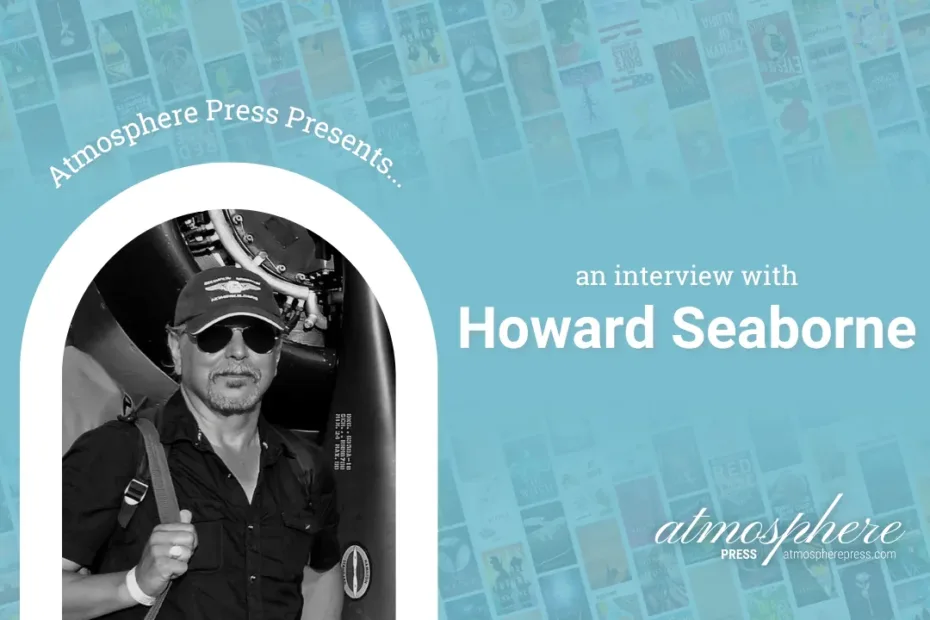
I think you should hear this from me. I could write it in the third person and try to make myself sound interesting, but where’s the accountability? Born the second of five children (perfect positioning), I grew up in the house my parents built on my grandparents’ farmhouse front lawn (all the fun of the farm without the stress of having to be a farmer). There’s a picture of me at age six holding a birthday cake with an airplane on it. I started working (for pay) on the farm around age ten, but my head was in the clouds. If I wasn’t watching airplanes fly over, I was daydreaming about them, reading about them, building models and flying balsa airplanes off the top of sixty-foot silos. I started flying lessons when I was sixteen. I earned my commercial license and flight instructor rating, and I turned professional when I was eighteen. In parallel to all this, starting around age ten, I began writing “novels” in cursive in lined-paper spiral notebooks using those old cartridge-type fountain pens. Glorious adventures of spies and pilots and evil doers. Daydreaming at its finest. I also read. About airplanes. About history. About men and ships and the sea. Around the time I should have been applying to the airlines for a chance to wear the ultimate uniform, half a dozen airlines went belly-up. I tried building hours to meet airline hiring requirements, but for the better part of the next decade, scores of over-qualified pilots applied for every single job opening. I had no chance. While flying air charters, I realized that as much as I love flying, and still do, I might not be cut out to fly from A to B to C to D and back to C then B then A, week in and week out. I needed a creative outlet. A private pilot student of mine named Victor owned an ad agency. He saw something in the kid from the farm with the leather flying jacket, and I found out you could make money by making shit up. I wrote. Vic edited the living daylights out of what I wrote. I learned more about writing from his blue pencil than all the English classes in my limited education. I kept on writing. I kept on flying. And here I am. These days, I fly a Beechcraft Baron and a Rotorway experimental helicopter that I built myself. (Look it up. Rotorway.com) And nothing, I mean nothing, beats that “Peter Pan” moment when being earthbound ends and flight begins. Except maybe writing about it.
Who/what made you want to write? Was there a particular person, or particular writers/works/art forms that influenced you?
Ian Fleming. As a kid, I was absorbed in the 1960s spy genre, with Fleming’s Bond leading the way. I read every Bond novel published (and got in deep trouble when my fifth grade teacher found the salacious Live and Let Die in my desk). I read a lot as a kid, but Fleming triggered something unexpected. At age ten, I started writing bad knock-off spy “novels” in spiral notebooks and I discovered something magical. Writing allowed me to exist in the stories I wrote. Putting pen to paper was like stepping on a Star Trek transporter. I knew no one would ever read what I was writing, because growing up as a practical midwestern farm kid, the notion of writing for a living was crazy. Yet the hours I spent inventing characters and crafting scenes and adventures took me to situations and locations in a way that far exceeded reading such stories. That feeling remains to this day. Opening my laptop isn’t “working on the next novel.” It’s stepping into the world of my characters. Even if none of my novels had ever been published or developed the following they have, I would still be writing them. There’s no better place to be.
What other professions have you worked in? What’s something about you that your readers wouldn’t know?
My readers know my background as a pilot, a flight instructor, and an air charter pilot. The main character in the Divisible Man series has similar aviation experience. My readers may not know that I also had a career in advertising as an artist and writer. I wrote and produced work for television, radio, film, and print. The writing demanded by those jobs called for brevity and keen self-editing. It also demanded a numb ego. Every written word I ever created fell under the critical eye of copy editors, senior creative directors, or paying clients. My work generated a range of responses from awful to award-winning. I learned from both. The best advice I would offer any aspiring writer is to find the best, sharpest editor they can afford. Leave your ego at the door and study every editor’s comment with an objective eye. Never stop learning how to improve the writing.
Tell us the story of your book’s title. Was it easy to find, or did it take forever?
Divisible Man, the title of the first novel in the series and the name of the series itself, came naturally. The Divisible Man series is an invisible man story, so the rhythm of the words is obvious. It is also the story of an ordinary person who discovers he can vanish. In that sense, he is divided between everyday life (a pilot, married, deeply in love with his wife, trying to make a living in aviation) and the degree to which his ability to vanish can be used to deal with tough situations and bad people. Historically, the Invisible Man character created by H. G. Wells was a monster, a murderer, a man driven mad by the perversion of science. Wells’ character assaulted Victorian sensibilities. When Universal Studios followed up their highly successful Dracula monster movie in 1932, they chose another monster … The Invisible Man. The character was ruthless, evil, a mass murderer. The same attributes reprise in modern film interpretations of an invisible character. Worst of all, in each of these cases, the character runs around naked. Divisible Man has none of that. Will Stewart, my main character, has been described by Kirkus Reviews as “the most believable unbelievable character currently running in fiction.” On a humorous note, the expression “Divisible Man” in the first novel springs from a comical mispronunciation by a little girl.
What part of publishing your book made it feel real for the first time?
There is a scene at the end of the first Back to the Future movie when Marty returns to the much-improved present day in which his family is normal and his father is a successful science fiction writer. The point is made by having a box arrive at the McFly house containing the father’s newest published book, “A Match Made in Space.” From my first book to my most recent, every time I receive my first physical copy of a published novel, I replay the scene by stepping to my back door and calling out into the yard, “Uh, now Biff, I want to make sure we get two coats of wax this time, not just one.” That, more than anything else, makes me feel like I just might be a writer.
If your book had a soundtrack, what are some songs that would be on it?
I leave this question to the imagination of the reader. In moments of deep emotion, a reader might hear a tune in their head that I have never heard. In moments of sorrow or loss, they might imagine something from Pink while I’m hearing Sarah Brightman’s “Ave Maria” in my mind. I will admit to an obvious allusion to Amy Shark’s “Adore” in a heart-breaking scene in my third novel. I don’t quote the song in a way that requires licensing, but in my author’s notes, I suggest that the reader download the song before reading that chapter. So far, that hasn’t generated a call from a lawyer.
What’s one thing you hope sticks with readers after they finish your book?
I hope Divisible Man causes readers to daydream, and in those daydreams to wonder what they would do if they had my main character’s ability. My novel Gloria, which is tangent to the Divisible Man series, also asks the reader to imagine what they might change if they could do what that novel’s main character, Henry Halder, can do—which is to revisit and alter memories. I want my stories to linger with the reader, the way the fond memory of a vacation trip lingers.
What was the most rewarding/meaningful part of publishing your book?
Compliments, kudos, positive reviews, and awards are nice, but they are also dangerous in that they can warp my sense of who I am and what I am doing. I accept those things gratefully, especially when they come from a few key individuals whose impressions of the work mean the world to me, but I also set them aside in a safe but well-insulated place. By far, the most rewarding and meaningful part of this entire process is the moment I open my laptop and travel to wherever that new page takes me.
What creative projects are you currently working on?
The fourteenth Divisible Man novel was recently published along with the tangent Gloria, which is set in the same town as the DM series and enjoys appearances by several key DM characters. The fifteenth Divisible Man is steaming to closure on my laptop. The sixteenth is rattling around in my head. There is no end in sight. The series has no limit because I adhere to simple rules: My two main characters are married and mad about each other. I don’t kill off beloved characters just to shock readers. And I am careful not to paint myself into a story arc corner or to “time out” the setting. Each new novel is a new adventure populated by a beloved cast of characters. And if another intriguing idea pops up, you can bet I will be itching to open the laptop (or pick up a fresh spiral notebook) and be transported.
Are you a writer, too? Submit your manuscript to Atmosphere Press.
Atmosphere Press is a selective hybrid publisher founded in 2015 on the principles of Honesty, Transparency, Professionalism, Kindness, and Making Your Book Awesome. Our books have won dozens of awards and sold tens of thousands of copies. If you’re interested in learning more, or seeking publication for your own work, please explore the links below.