An Interview with Jessica C. Wheeler
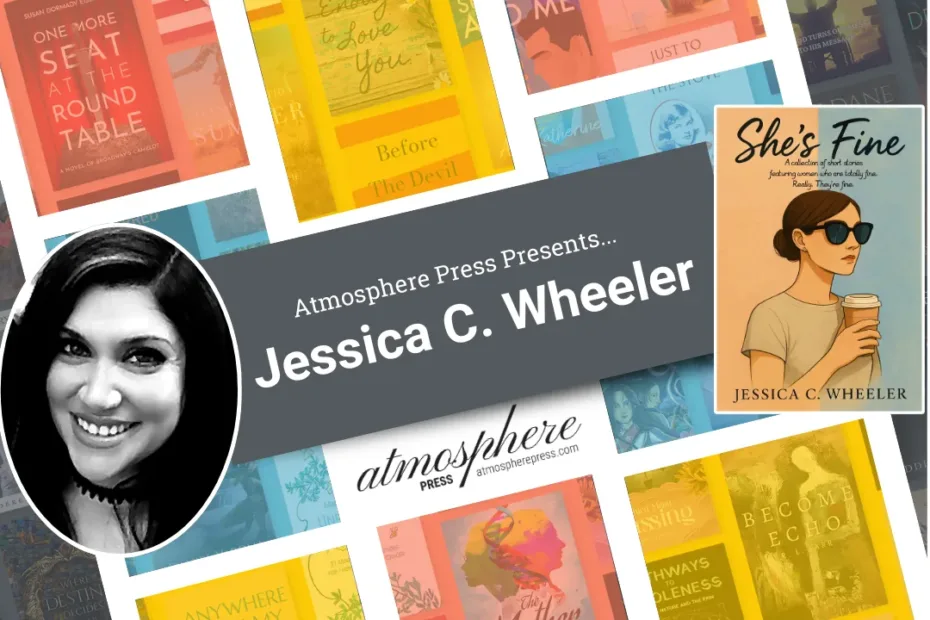
Jessica C. Wheeler is a Connecticut-based author and poet known for her lyrical prose, emotional precision, and a dry, understated perspective on contemporary life. Her writing spans across genres, including poetry, contemporary romance, upmarket fiction, and sharp-edged satire, as seen in her short story collection She’s Fine, which explores the polished absurdities of womanhood and the quiet catastrophes we disguise as composure. Her stories often circle grief, family, and the complicated performance of being ‘fine’ in a world that rarely is. As a lifelong New Englander, she draws constant inspiration from the shifting seasons, particularly autumn, which appears in her work almost as frequently as her characters do. Wheeler resides on the Connecticut coast with her husband and their two young daughters and is currently developing her forthcoming novel.
Who/what made you want to write? Was there a particular person, or particular writers/works/art forms that influenced you?
My roots are in poetry, and it’s still the place I go when I need to recharge my language. That background exerts a stubborn influence on my work, keeping me grounded and perpetually searching for what’s hidden beneath the dialogue. Over time, that lyrical impulse has infiltrated my prose, quietly shaping everything I write. I’ve learned to embrace its intrusion, though my paragraphs still tend to not-so-subtly show up disguised as stanzas.
What other professions have you worked in? What’s something about you that your readers wouldn’t know?
I’ve worn an absurd number of hats – some more flattering than others. I’ve worked in the medical field, been a stay-at-home mom, and taken on freelance writing work in various shapes. Through it all, one thing stayed the same: I wrote. Sometimes on the margins, sometimes at the center, but writing was always where I landed.
Something readers might not know: I am unreasonably good at remembering tiny sensory details. I routinely forget why I walked into a room, but I can tell you in excruciating detail what the sky looked like on a random Tuesday in 2019, or which song was playing during a conversation no one else remembers having. Those small flashes often become the backbone of my stories – characters built around the feeling behind a single, stubborn moment.
Tell us the story of your book’s title. Was it easy to find, or did it take forever?
She’s Fine is the title of the first story in the collection, and it became clear almost immediately that it would be the title of the book as well. The phrase is so familiar, we barely register it anymore. Yet, too often, it’s shorthand for something far more complicated. ‘Fine’ has long served as a polite disguise for every “Please don’t look too closely,” and “I’m ugly crying on the inside,” and “I’m laughing, but I’m actually hanging on by a rogue gray hair.” I think it effectively captures the collection’s central theme: what ‘fine’ really means and how rarely it means what we say. Once I settled on that title, the subtitle was a no-brainer.
What part of publishing your book made it feel real for the first time?
My daughter recently confessed that she and her friends had googled me, which was equal parts flattering and mildly unsettling. Evidently, their thorough research concluded that I am, in fact, ‘a real author.’ I’ll be riding that high for a while.
If your book had a soundtrack, what are some songs that would be on it?
The She’s Fine soundtrack would live somewhere between ‘I’m thriving’ and ‘I just cried in my car in the Target parking lot.’ A playlist that’s suitable for folding laundry or reconsidering your life choices. Think moody, vaguely rebellious indie tracks. Or anything by Alanis Morissette.
What’s one thing you hope sticks with readers after they finish your book?
If anything lingers, I hope it’s a gentle reminder to look at others with a bit more softness and curiosity. Most of us have become experts at the ‘fine’ routine, while an entirely different story plays out behind the scenes. If even one person finishes the book and feels a little less alone in that quiet gap between appearance and reality, I’ll count that as a victory.
What was the most rewarding/meaningful part of publishing your book?
Hearing from women who have found genuine meaning in these stories, beyond the humor, has been one of the most rewarding parts of this journey. I’ve received messages from readers who found themselves in a character, related to a circumstance, or even connected with a single line. Those moments of recognition matter to me more than any metric or milestone.
Still, the most meaningful moment was seeing my daughters hold the finished book in their hands for the first time. Watching them turn it over, trace my name on the cover, and realize it was real. That is when it all truly felt tangible. Seeing it reflected in their eyes, knowing they’re witnessing both creation and possibility – nothing compares to that.
What creative projects are you currently working on?
I am currently developing an upmarket, character-driven novel, while sketching ideas for another contemporary project that plays with humor and heartache in equal measure. In addition, I’m slowly building a companion to She’s Fine, a collection that will offer the same absurdity from a different perspective. I tend to be more productive when I have several pots simmering at once; the real challenge is making sure none of them boil over while I’m focused on stirring the next.
Are you a writer, too? Submit your manuscript to Atmosphere Press.
Atmosphere Press is a selective hybrid publisher founded in 2015 on the principles of Honesty, Transparency, Professionalism, Kindness, and Making Your Book Awesome. Our books have won dozens of awards and sold tens of thousands of copies. If you’re interested in learning more, or seeking publication for your own work, please explore the links below.