An Interview with Justin Hughes
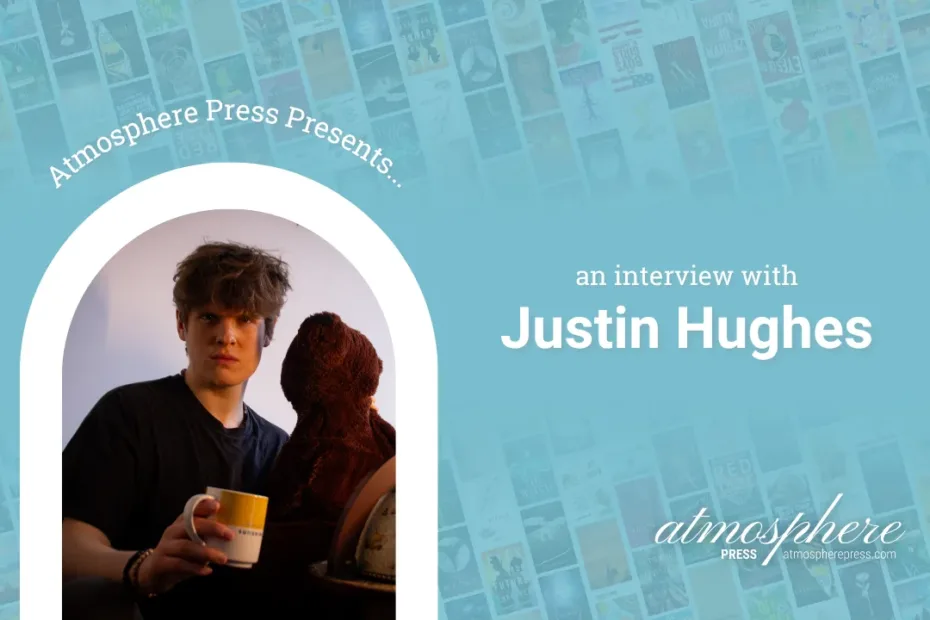
Twenty-two-year-old writer, musician, and indie filmmaker Justin Hughes was born in Warrington, England, on April 12, 2004. Growing up in Cheshire, Hughes would write short stories and television pilot screenplays for fun before eventually taking the step into long-form work.
During his time as a student at the University of Chester, Hughes was published as part of the 2025 issue of the university’s literary magazine Pandora’s Box. During these years, Hughes also wrote his debut novel, Saffron, released on June 1, 2026.
What inspired you to start writing this book?
As well as writing short stories and now a novel, I’ve also been a songwriter for years. In 2023, I released a conceptual, self-produced hip-hop EP titled Saffron. I had created the character of Saffron, a stalking figure in a yellow cloak, to represent, in some sort of way, my deepest anxieties and feelings of hopelessness. The thoughts and feelings that sit in the pit of your stomach and never really go away—the stuff you try to ignore. I found the bright saffron-yellow colour to be one that may not be traditionally frightening or gloomy, but one that is bright and distracting. It’s a colour you can’t ignore as it glows in the corner of your vision. Once the EP was complete, I was still obsessed with the concept and how effective a metaphor it could be, so I decided to develop it into a longer story, this time with made-up characters.
If your book had a soundtrack, what are some songs that would be on it?
The immediate music that comes to mind is from the album I Didn’t Mean To Haunt You by Quadeca. It is a gorgeous, tragic concept album from the perspective of a man who has taken his own life and found himself as a sort of lost spirit, reflecting on, and at times regretting, his decision. It features a huge, eternal ambient soundscape. Haunting piano chords. Whining, broken vocals.
The grim, suicidal ideation of the lyrics. The feelings of hopelessness, desperation, and tragedy. The inescapable nature of the situation. The loss of control. Consequences of the past weighing the protagonist down. I feel Saffron’s own protagonist, Toby Shire, may deeply relate to these feelings. This would be the book’s soundtrack.
The 2009 soundtrack to the film Coraline also comes to mind, I might add. I found myself listening to certain tracks from it a lot while writing this book. It’s a mix of innocence, beauty, and horror that sets the tone nicely. Particularly tracks Exploration, Playing Piano, and Cocobeetles.
What books are you reading (for research or comfort) as you continue the writing process?
The book is complete! Set to release on June 1, 2026. As I begin work on my second novel, however, I’ve recently read Misery by Stephen King, 1984 by George Orwell, and I’ve just started Matt Haig’s brand-new novel, The Midnight Train.
What other professions have you worked in? What’s something about you that your readers wouldn’t know?
My day job, so to speak, is freelance video editing. I’ve done it since I was fourteen years old and am rather pleased to be doing it alongside my writing. Other than that, I write songs, produce music, and direct music videos. I’ve recently written and directed a couple of short films, too.
Who/what made you want to write? Was there a particular person, or particular writers/works/art forms that influenced you?
I grew up as a Doctor Who fanatic. That show is so unrestricted in its potential for storytelling. Being a Doctor Who fanatic, alongside being generally unacademic and creatively inclined, has meant that I was sort of destined to be a storyteller. It literally, I believe, wired my brain that way. So, with dreams of somehow finding myself writing Doctor Who one day, I pursued a degree in TV production to try and get myself into the right rooms as a screenwriter.
After years of writing undeveloped scripts, however, I found myself feeling sort of deflated, as I simply had no means, funds, or connections to get anything I wrote commissioned. So, desperately wanting to be able to write something that other people could actually consume in some completed form, I turned to writing books instead. An art that I’ve fallen deeply in love with. I think I may well do this for the rest of my life. (Until the Doctor Who offer comes through.)
Where is your favorite place to write?
My favourite place to write is at any of the small, local coffee shops dotted all around the city of Chester. However, I unfortunately tend to be most inspired to write in the middle of the night, half-asleep, sitting at my desk.
What advice would you give your past self at the start of your writing journey?
I’d tell myself not to get so caught up in the right and wrong ways of writing a book. There is no objectively correct story structure. You don’t need to put plot point C on page fifty-whatever. Everything is guidelines. Averages. Subjective. The only way to write and to improve as a writer is just to write. (And read. Lots.)
What’s one thing you hope sticks with readers after they finish your book?
Beyond the grief and the tragedy, I want readers to come away from Saffron feeling in touch with their humanity, and perhaps with a little more empathy for all the complex characters in their own lives. We, as humans, experience so much and cope with what we’ve experienced in nuanced, often confusing, sometimes concerning ways. I won’t say that’s okay. Sometimes it might not be okay. Sometimes there might be a real issue that must be addressed. We can, however, keep that nuance and that complexity in mind.
Are you a writer, too? Submit your manuscript to Atmosphere Press.
Atmosphere Press is a selective hybrid publisher founded in 2015 on the principles of Honesty, Transparency, Professionalism, Kindness, and Making Your Book Awesome. Our books have won dozens of awards and sold tens of thousands of copies. If you’re interested in learning more, or seeking publication for your own work, please explore the links below.