An Interview with Kayden Etter
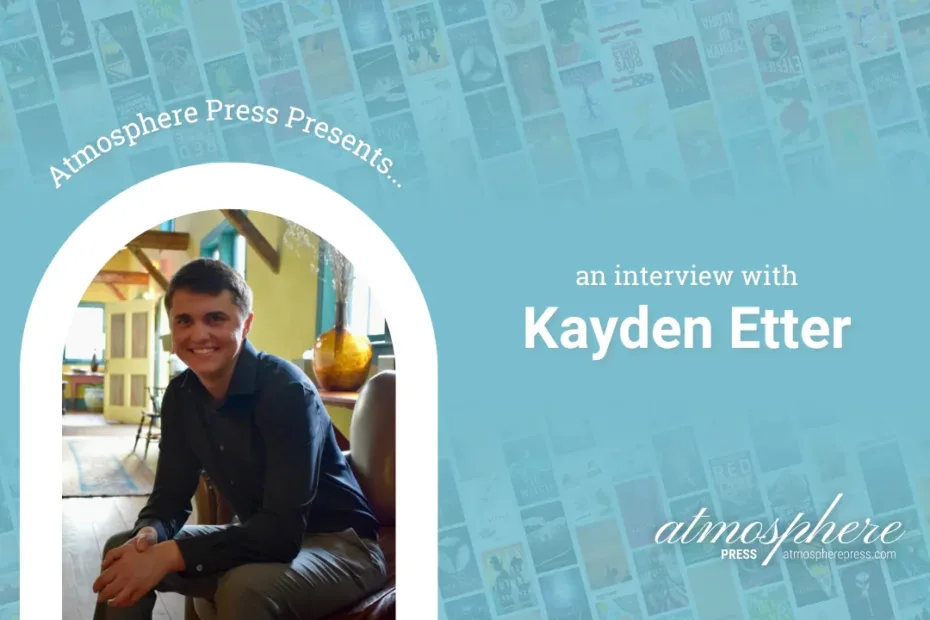
Hi. I’m Kayden. I’m a writer, professional overthinker, history nerd, gamer, coffee drinker, occasional chaos goblin, and Spider-Man enthusiast whose commitment to the bit probably passed “reasonable” several years ago.
Mostly, though, I write about becoming. Becoming who you are, someone you never expected to be, brave enough to leave things behind, visible after spending years trying very hard not to be.
Basically, I am fascinated by that weird stretch of life between who you were told to be and who you eventually realize you are. Sometimes I explore that through fiction.
My debut novel, Ink & Saltwater, puts a trans man aboard the RMS Titanic in 1912, because apparently having a lifelong Titanic obsession wasn’t enough. I also needed to turn it into several years of research, emotional damage, and a book. The novel began with a question I couldn’t leave alone: What might it have meant to be queer or transgender in 1912?
But history isn’t the only place I go looking for stories.
I also write personal essays about identity, courage, relationships, joy, grief, change, and all the strange little moments that somehow alter the direction of a life. Sometimes they’re serious and sometimes they’re funny. Frequently they begin with me thinking, “Huh. That’s weird,” and end several thousand words later with an existential crisis and a metaphor I have become emotionally attached to.
I like writing about people in the middle of things. People figuring themselves out. People who have screwed up. People starting over. People choosing themselves. People discovering that courage rarely feels particularly courageous while you’re actually doing the scary shit.
Basically, people and their experiences. Fiction about the lives we rarely see. Essays about the lives we’re still figuring out. Especially regarding my own life.
Because despite my tendency to disappear down historical rabbit holes and research one completely unnecessary detail for three hours, I’ve never really been interested in perfect heroes. I’m interested in human beings trying.
When I’m not writing, I’m usually gaming, listening to music, drinking coffee, spending time with my dog, researching something nobody asked me to research, or finding increasingly elaborate excuses to pretend I’m Spider-Man. There is also a decent chance I am creating something I absolutely did not need another project for. Most of them (all of them) need caffeine.
If you’ve found your way here because you like stories about identity, messy humanity, courage, weird history, becoming yourself, or figuring life out while pretending you definitely know what you’re doing … welcome. I think you’ll fit in just fine.
Who/what made you want to write? Was there a particular person, or particular writers/works/art forms that influenced you?
I’ve always loved storytelling, but there is one person who played a pretty significant role in convincing me that maybe my own words were worth something.
His name is Mr. Tesmond, or Mr. T, as I knew him. He was my high school English teacher in Geneseo, Illinois.
For one of his assignments, I wrote an essay in which I came out to him. At the time, I identified as a lesbian, and he was the first adult I felt comfortable enough to tell.
I remember him writing a personal note on the back of that essay, encouraging me to consider getting it published.
Naturally, I did absolutely nothing with that suggestion because fear won that particular battle.
But I kept writing.
Looking back, that moment mattered more than I probably understood at the time. Someone had read something deeply personal that I’d written and saw value in it. He didn’t just see an assignment. He saw a story worth sharing.
I think that’s stayed with me throughout my writing journey. I’m drawn to stories about identity, belonging, and the complicated process of becoming yourself. I’m especially interested in the things people carry privately and what happens when they finally find somewhere safe enough to put them down.
And now, more than a decade after that English class, I’ve written a novel.
Apparently, I just needed a little time to take the hint.
What inspired you to start writing this book?
I’ve been fascinated by Titanic for practically my entire life. At some point, though, my fascination shifted away from the ship itself and toward the people aboard it.
We know what happened to Titanic. We know the timeline, the iceberg, the sinking, and the aftermath. But what about all the people whose names survived while their private lives didn’t?
What did they dream about? Who were they in love with? What secrets were they carrying? What did they think their lives would look like when they reached New York?
Eventually, those questions led me somewhere much more personal.
What might life have looked like for someone like me in 1912?
That’s where Thomas Bennett came from.
I wanted to explore what it might have meant for a transgender man to board Titanic under his chosen name, surrounded by strangers who had no previous version of him to compare against.
For Tom, the voyage represents freedom. He gets to introduce himself on his own terms, make friends, fall in love, and begin imagining a future that actually belongs to him.
Of course, the reader knows something Tom doesn’t.
That tension became central to the book. I wanted to write about the lives unfolding aboard Titanic before it became a tragedy. People were laughing, flirting, arguing, eating breakfast, and making plans.
Tom was one of them.
I wanted readers to know him as a person before they knew him as another passenger aboard a doomed ship.
Tell us the story of your book’s title. Was it easy to find, or did it take forever?
I love the title Ink & Saltwater because those two things represent different forces running through the novel.
The ink comes from Tom’s journal, which his cousin Clara gives him before he leaves. Writing becomes a way for him to put things into words that he isn’t always able to say aloud. His journal holds his fears, his hopes, and the parts of himself that he wants to preserve.
The saltwater is the Atlantic. It represents the voyage, the freedom Tom believes is waiting on the other side, and, inevitably, the tragedy we know is coming.
There’s a tension between those two things that I really love.
The ocean is enormous, indifferent, and capable of taking almost everything. But ink gives Tom a way to leave something behind.
His name. His thoughts. His story.
The title ultimately reflects one of the questions at the heart of the novel: What remains of a life when the person who lived it is gone?
For Tom, the answer is partly found in the words he leaves behind.
Personal detail to add: Was this the original title, or did you go through several? The answer above explains its meaning without inventing how you arrived at it.
If your book had a soundtrack, what are some songs that would be on it?
I feel like this book would need a soundtrack that starts with possibility and slowly becomes emotionally devastating.
There’s a lot of hope in the beginning of Ink & Saltwater. Tom is finally stepping into a life he’s spent years imagining. He’s making friends, discovering what it means to belong, and allowing himself to fall in love.
I would want the music to capture that feeling of finally being able to breathe, but with this quiet awareness that something terrible is approaching.
And because I’m apparently incapable of writing a Titanic novel without hurting my own feelings, we’d eventually need a few songs that make you stare at the ceiling for a while.
Possible Songs:
“The Story” by Brandi Carlile
“The Night We Met” by Lord Huron
“I Lived” by OneRepublic
“Saturn” by Sleeping At Last
What other professions have you worked in? What’s something about you that your readers wouldn’t know?
Before becoming a published author, I’ve worked in digital marketing.
Writing has been something I’ve carried with me through different stages of my life, even when it wasn’t what I was doing professionally. I think a lot of people imagine authors sitting in beautiful offices, drinking coffee, and peacefully producing masterpieces.
My experience has involved considerably more overthinking.
As for something readers might not know about me, I’m a gamer, a lifelong Titanic nerd, a coffee enthusiast, and someone with a perhaps unreasonable appreciation for Spider-Man.
I also have a Twitch alter ego named Sirulean.
So, there’s a version of me who spends an enormous amount of time thinking about queer historical fiction and another version who just wants to play video games.
They coexist surprisingly well.
What books did you read (for research or comfort) throughout your writing process?
A significant amount of my research involved Titanic history, passenger accounts, photographs, and material about daily life aboard the ship.
I was especially interested in third class because that’s where Tom spends most of the novel. I wanted to understand what the spaces felt like, how passengers might have interacted, what they ate, and what ordinary life looked like during those few days at sea.
The other major component was trying to understand queer and transgender experiences in the early twentieth century without imposing a completely modern perspective on the characters.
There’s a delicate balance there. I didn’t want to write a modern trans character who just happened to be wearing Edwardian clothes. But I also didn’t want to treat the gaps in the historical record as evidence that people like Tom couldn’t have existed.
I found myself returning to the importance of asking what the sources could actually tell me and being honest about the places where fiction had to imagine the possibilities.
And, of course, researching Titanic is an incredibly efficient way to spend three hours investigating a detail that eventually appears in one sentence.
What advice would you give your past self at the start of your writing journey?
Stop waiting until you’re no longer afraid. Seriously.
For a long time, I think I treated confidence as something I needed to acquire before I was allowed to share my work. I imagined that eventually I’d reach this magical point where I felt completely prepared, knew exactly what I was doing, and could put something I’d written into the world without being terrified.
I’m still waiting for that version of myself to show up.
Writing a book has taught me that you can be proud of something and absolutely scared shitless of sharing it at the same time.
I’d also tell my younger self to stop being so concerned about whether the stories he wants to tell are important enough. You don’t have to write the next great American novel. You don’t need everyone to understand what you’re doing. You don’t even need to know exactly where the story is going when you begin. You just have to care enough about it to keep showing up.
And I’d probably tell him to listen to Mr. T a little sooner. It would’ve saved us about a decade.
Although, knowing me, I probably would’ve ignored that advice, too.
What’s one thing you hope sticks with readers after they finish your book?
I hope they remember Tom as a person.
Of course, being transgender is an important part of his story, but I never wanted that to be the only thing readers saw when they looked at him.
He’s funny. He’s anxious. He overthinks absolutely everything. He makes friends, falls in love, gets embarrassed, and occasionally has no idea what the hell he’s doing.
He wants what so many of us want: a life that feels like his own and people who love him for who he actually is.
I hope readers remember those ordinary, human parts of him just as much as the larger historical tragedy.
And I hope the book leaves them with one question: Whose stories are we still missing?
There are so many people throughout history whose lives were never fully documented. We might have their names, dates, or a photograph, but we don’t know what it felt like to be them. We can’t recover every story, and fiction shouldn’t pretend it can. But we can remember that those people were real. They loved. They hoped. They had ordinary Tuesday afternoons. They imagined futures.
Tom is fictional, but the possibility of a life like his deserves space in our imagination. If readers finish Ink & Saltwater thinking a little more about the humanity behind the names in a history book, then I’ll feel like I’ve accomplished something meaningful.
Are you a writer, too? Submit your manuscript to Atmosphere Press.
Atmosphere Press is a selective hybrid publisher founded in 2015 on the principles of Honesty, Transparency, Professionalism, Kindness, and Making Your Book Awesome. Our books have won dozens of awards and sold tens of thousands of copies. If you’re interested in learning more, or seeking publication for your own work, please explore the links below.