An Interview with Richard H. Moon
Richard H. Moon is an award-winning screenwriter, producer, family man, care-provider for several dogs and cats, curler, archer, hiker, musician, physics tutor, SFF nerd, literature aficionado, history obsessive, and kitten fosterer. He has a physics degree but has never let that get in his way. He’s always ready to geek out about story and character and deep meaning and also cool robots, and he supports every human out there who makes art with their own hands and bodies and minds. He lives with his family in Southern California, on the ancestral and unceded land of the Hahamonga people.
Tell us the story of your book’s title. Was it easy to find, or did it take forever?
The title took forever and was a struggle the whole way. I had a variety of working titles, and for a lot of them I was trying too hard to suggest minor elements of the setting (such as the fact that ancient Egypt considered north to be ‘down’ and south to be ‘up’), but none of them quite worked. They all felt tacked-on in a way that bugged me, and I kept trying other things.
Then, one day, I was on a jog, and listening to the original cast recording of Jesus Christ Superstar (as I do now and then; I love that show), and happened upon the lyric ‘To conquer death, you only have to die.’ And that struck me like a bolt of lightning. To Conquer Death was, in their own way, what every character in the book was trying to do, most subconsciously. It was also the driving motivation behind what was causing the plot to begin with. On top of everything else, it just slapped in a way none of my previous attempts had. As soon as I tried it out with my fellow writers, and they all loved it, I knew I had found the actual title that the book had always wanted.
How did it feel when you first saw your book cover? Or when you first held your book in your hands?
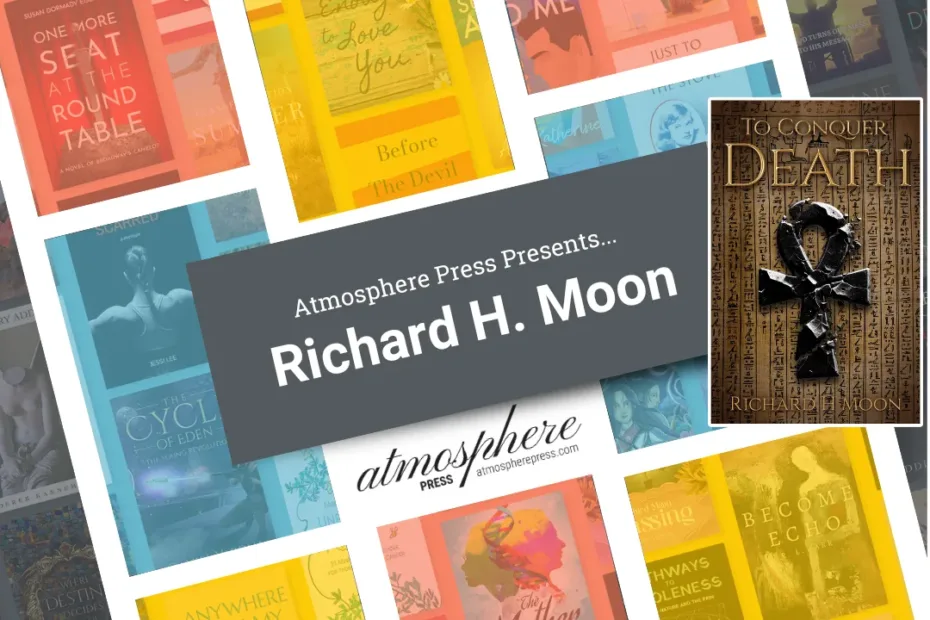
When I first saw the final cover, it felt like coming home. The image, which came about after only a handful of revisions on the initial work of the wonderful artist Kevin Stone, and which owes a heck of a lot to an idea my wife put forward, did such a fantastic job of visualizing the tone I’d wanted to set for the first impression anyone would get of the book that I cannot imagine any other way it could possibly have come together.
Similarly, holding the proof copy of the book for the first time felt like sitting in a theater with an audience and seeing your own movie play for the first time. It was real, it had weight, it was a book-book-book. No longer the ephemeral ideas that I’d hosted in my head for years and struggled to put into words. A real book. I don’t think I stopped smiling that whole day.
Who/what made you want to write? Was there a particular person, or particular writers/works/art forms that influenced you?
I was a voracious reader as a kid (and still am), and very early on knew I wanted to do what all of the writers I read could do, and make someone else have the experience I got every time I started a new book. Margaret Weiss and Tracy Hickman were huge influences on me, as well as Steven Barnes and Larry Niven and Jerry Pournelle, but it was Colleen McCullough and Gore Vidal who really made me realize how much epic storytelling there was in history. Really realizing that it was not the setting or the gimmicks of genre that drew me in to every work I loved, but the people, was a big moment for me that opened my eyes to how I wanted to construct my own stories.
As to what makes me want to write, well, I often say that I’ve tried not writing, and just couldn’t hack it.
What other professions have you worked in? What’s something about you that your readers wouldn’t know?
I have been a physics tutor, an assistant on a horse rehabilitation farm, a copy writer for an architectural firm, a film producer, screenwriter, copy editor, digital intermediate technician, production assistant, a town council member, and a volunteer research compliance committee member, and a totally volunteer curling instructor.
Something most people would not know about me is that I have been in three different drum and bugle corps, love baking, and have baked while listening to drum and bugle corps shows.
What was the most rewarding/meaningful part of publishing your book?
Aside from the joy of having something that has existed only in my head or in a computer file suddenly be in a real, physical form, the experience of having people who have read the book (without me having to beg them to give it a read, such as what happens with screenplays!) telling me how much they enjoyed it, especially when one particular moment or another has stuck with them.
If your book had a soundtrack, what are some songs that would be on it?
Over the Hills and Far Away by Led Zeppelin; To Ashes and Blood by Woodkid; If I Had a Heart by Fever Ray; and the Gerard Way and Ray Toro version of Hazy Shade of Winter; along with a lot of movie music by Zimmer, Jerry Goldsmith, and Junkie XL.
What is one thing you hope readers take away from reading your book? How do you envision your perfect reader?
I just hope people who read the book enjoy the journey and want more. My perfect reader is simply someone who loves reading books, especially grounded fantasy, unexplored areas of our common history, mythology, and who enjoys going on an adventure.
What creative projects are you currently working on?
I’m co-directing a narrative podcast for Voyage Media, have two feature screenplays on option, and am working hard on a science fiction western as my next novel.
How was working with Atmosphere Press? What would you tell other writers who want to publish?
Working with Atmosphere was a delight, and I would heartily recommend them to anyone else who is looking at self-publishing and feeling overwhelmed. In indie film production, one of the most important AND hardest parts is putting together the right team of professionals to get the project made. In considering taking on publishing my book myself, I knew that would be the hardest part of the process, as well, and with Atmosphere I found an avenue that already had the professionals connected and the resources lined up to let me focus on the book and getting it into the best shape possible for my eventual audience.
Are you a writer, too? Submit your manuscript to Atmosphere Press.
Atmosphere Press is a selective hybrid publisher founded in 2015 on the principles of Honesty, Transparency, Professionalism, Kindness, and Making Your Book Awesome. Our books have won dozens of awards and sold tens of thousands of copies. If you’re interested in learning more, or seeking publication for your own work, please explore the links below.