
An Interview with Richard Scharine
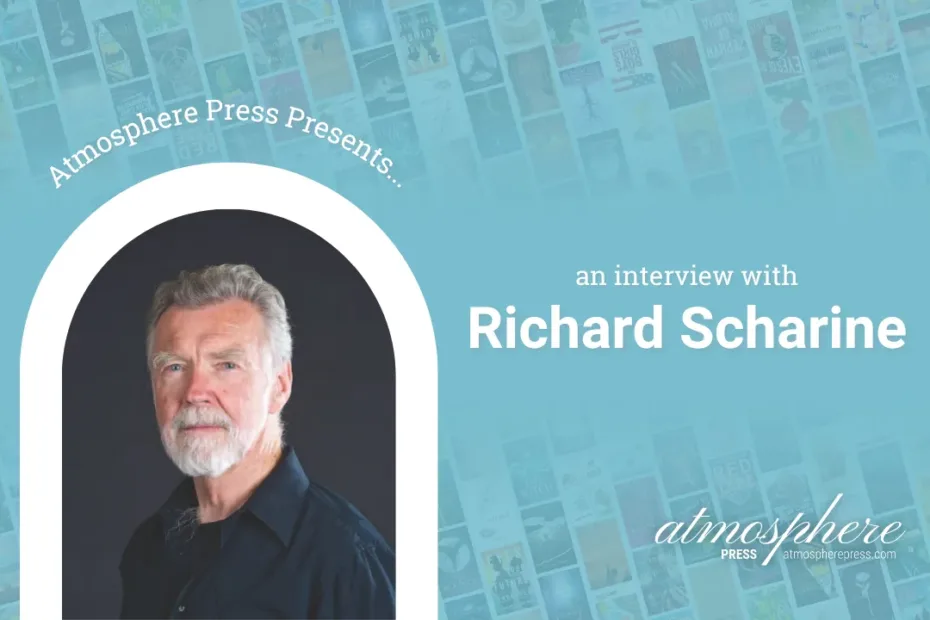
Born in the back room of a Wisconsin tenant farm, went to a one-room grade school, and rode a bus fifty-two miles to high school. A peacetime army veteran who discovered theatre and my wife-to-be the same week my college football career ended. Began writing fiction only after my college teaching career ended with five awards, a Fulbright lectureship in Poland, and acting in seven foreign countries.
Tell us the story of your book’s title. Was it easy to find, or did it take forever?
The first story in the book and the first to be written, it was based on two events in my life: the crippling of my legs and a Southwest Airline strike that left me stranded for ten days away from home. The central character finds shelter in a residential hotel and falls in love with its owner, whose home and office is on ‘the third-floor front’ of the hotel.
How did it feel when you first saw your book cover? Or when you first held your book in your hands?
The woman is only a shadowy silhouette inside a window. To penetrate her mystery, you have to go inside.
Who/what made you want to write? Was there a particular person, or particular writers/works/art forms that influenced you?
I was still teaching part-time at the University of Utah when I was diagnosed with cancer in 2020. When I got out of the hospital, I was physically unable to go anywhere, and thanks to the Covid epidemic, there was no place to go. I began writing fiction on the grounds that even if I was a lousy writer, I was probably going to die anyway.
What other professions have you worked in? What’s something about you that your readers wouldn’t know?
I was raised on a farm (4-H, FFA, et.al.), was a peacetime infantry veteran, went to college to become a veterinarian, discovered theatre and – except when I was directing or acting – taught college theatre history for the rest of my life. Every event in my stories is historically verifiable, but the way I put the events together makes them fiction.
What was the most rewarding/meaningful part of publishing your book?
Woman in the Third Floor Front is my third Atmosphere Press book. Almost all the stories in my first book, The Past We Step Into, had been rejected by other publications. Atmosphere Press realized Past was one twelve-chapter story, i.e. a book.
If your book had a soundtrack, what are some songs that would be on it?
The story of The Woman in the Third Floor Front depends a great deal upon the popular music of several eras. Nancy Wilson’s Guess Who I Saw Today leads to the central character’s crippling and to the place where the airline strike strands him. The woman used to sing in a local bar and grill where the musicians performing Jim Reeves’ He’ll Have to Go, and the woman responding with its sequel, He’ll Have to Stay, foreshadow the decisions the two potential lovers will make. There are a half-dozen other examples.
What is one thing you hope readers take away from reading your book? How do you envision your perfect reader?
My stories happen in specific places at specific times. The more the reader knows about current events and history, the more convincing the fiction is. For example, the dream sequence which climaxes When I Go, I Leave No Trace, pulls together the very real Utah incidents which precede it.
What creative projects are you currently working on?
Hopefully, my next book will begin with The Body in the Barrel, a murder mystery inspired by the actual discovery in the drying up Lake Meade of a barrel with a body in it. Add to that identification by dental work and an FBI agent trying to avoid losing his job for having been assigned to investigate the January 6, 2021 insurrection five years earlier. Also included (among many others) is Tenth Car, the story of a corrupted America perhaps not too far away, and Enemy of the People, in which an unnamed president tries to rid himself of a reporter who has secrets of his own.
Are you a writer, too? Submit your manuscript to Atmosphere Press.

Atmosphere Press is a selective hybrid publisher founded in 2015 on the principles of Honesty, Transparency, Professionalism, Kindness, and Making Your Book Awesome. Our books have won dozens of awards and sold tens of thousands of copies. If you’re interested in learning more, or seeking publication for your own work, please explore the links below.