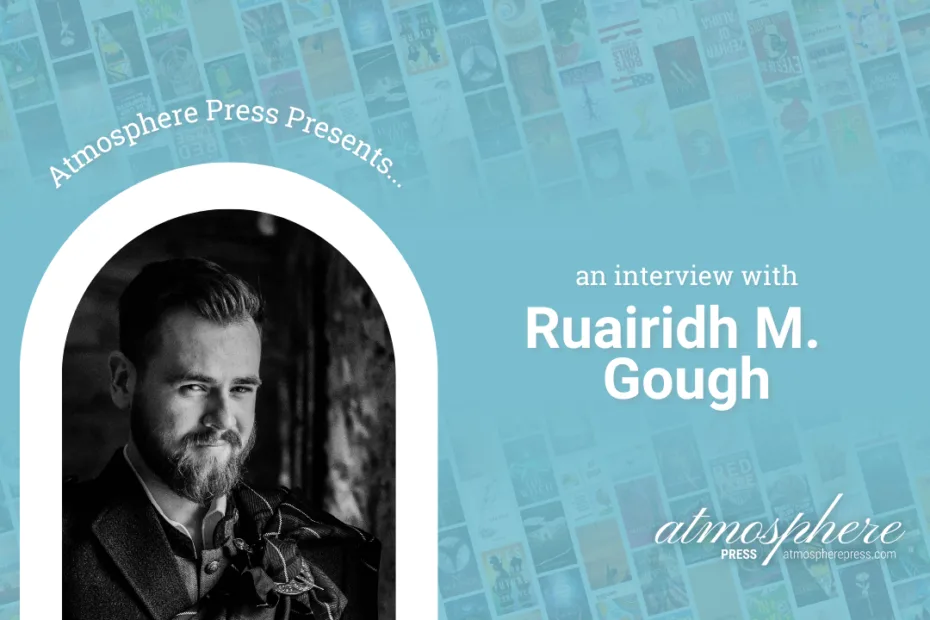
Ruairidh M Gough, Scotland-based historical fiction author, was shortlisted as part of Penguin’s WriteNow program 2023 and invited to read at the Edinburgh International Book Festival as part of their On the Road event in 2022.
If your book had a soundtrack, what are some songs that would be on it?
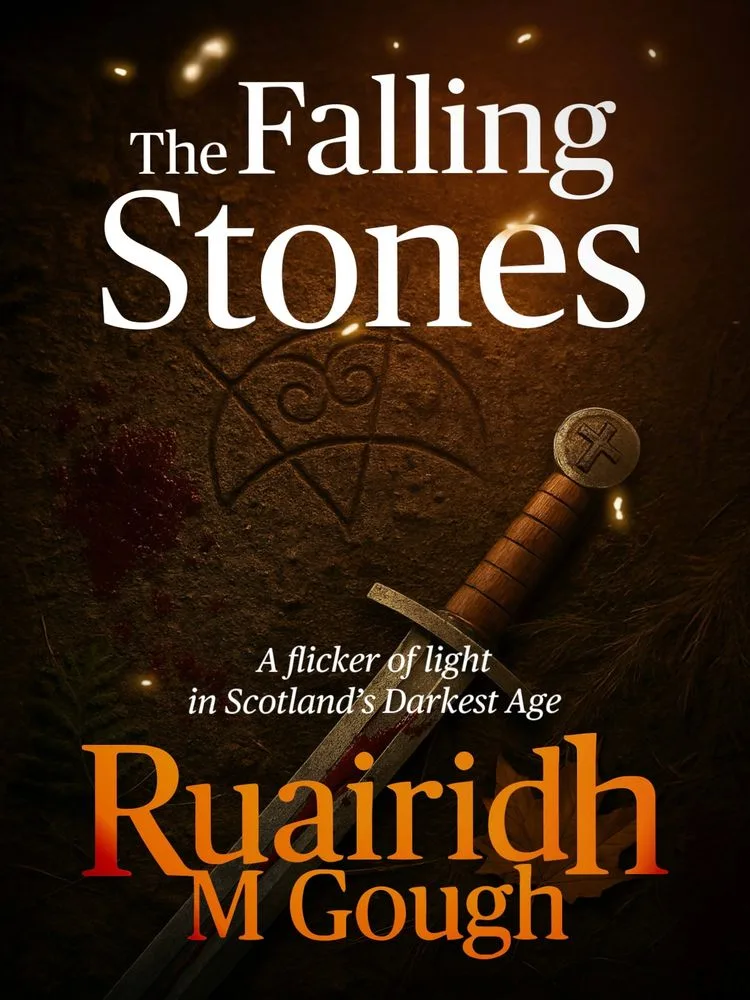
If we’re talking scores, my dream team would have to be the composer Bear McCreary, the artist behind the Outlander soundtrack, and the band Niteworks, which does Scottish techno-folk. I’d love to hear what that sounded like. As you might guess from that answer, they feature heavily in my writing music playlists for The Falling Stones, along with Sarah Schachner and Trevor Morris.
But in terms of songs, I’m a big Florence and the Machine fan. I think her later work, which carries a lot of folkloric depth to it, would be a great fit. So, anything from her newest album, Everybody Scream. I think she’s got the raw, primal, and earthy spirituality to her music that would tie in really well to the Pagan world of The Falling Stones. Let’s face it, anything would sound good with the power of Florence Welch’s voice behind it!
What books are you reading (for research or comfort) as you continue the writing process?
I love historical fiction, but, particularly when I’m working on a manuscript, I tend to stray as far from what I’m writing as possible. One of my favourites has to be the Bobiverse series by Denis E. Taylor. Phenomenal sci-fi writer, I’m a big fan of all his work, but my favourite has to be that.
For anyone interested, it’s about a sci-fi loving engineer who dies in an accident shortly after signing up to have his head cryogenically frozen, only to wake up as a replicated AI version of himself. He goes on to explore the galaxy and although never lacking in wit or sci-fi pop references, his story dives deep into some very topical questions about a digital afterlife and so much more.
So this week, after a long day spent reading up on the Picts and writing about roundhouses and currachs, I’ve liked to relax with Ray Porter narrating Not Till We Are Lost by Denis E. Taylor. For being as stark in contrast to sixth century Scotland as you can get and covering some very important issues highly relevant to today’s day and age, I couldn’t recommend the series enough.
What other professions have you worked in? What’s something about you that your readers wouldn’t know?
I started out as a dishwasher. I suspect the cafe staff didn’t want me out front scaring the customers away. But I would have to say that it was my early and unwitting interest in stories and history and philosophy that helped me to slowly increase my confidence.
Since then, I’ve worked as a professional illustrator, a civil servant, a kitchen designer, even as an English foreign language teacher working in China. For the past few years though I’ve really invested my time in community work, supporting families affected by child poverty and advocating for systemic change.
I think that diversity in career background and being exposed to different cultures, views, and ways of life have really informed my writing and helped me to grow as a person. I’ve come a long way since being too awkward to work front of house in that cafe, though admittedly they did let me be a waiter after the first year, and by the third I was on reception in the museum next door, so it’s been a slow transition and not an overnight transformation!
What advice would you give your past self at the start of your writing journey?
I would say… ‘In ten years’ time, you’ll be picking up spelling errors in emails sent by teachers.’ Sounds random! But I spent my whole childhood and into being a young adult being unable to spell the simplest words. Honestly, my wife recently looked back on our old messages from when we first met and it’s a wonder she understood what I was even trying to say.
I’m dyslexic, so spelling and writing has always been really hard for me. Thankfully, I got a lot of support in school and that set me up for where I am today, but it really wasn’t until I discovered that I had to tell stories that I was able to overcome that aspect of my ‘learning difficulty.’
I realise now, looking back, that all throughout my life I was writing stories. Plots, characters, relationships, yes, even dramatic fight scenes, they were all there, all along, but I just wasn’t writing them down. Because I believed I couldn’t. Then, one day I was writing a note down for what I’d hope to one day turn into a graphic novel, only to find I’d written a chapter. From then on, there was no stopping the words from tumbling out and anything autocorrect didn’t pick up, I eventually learned how to get right.
I never set out to improve my spelling, or grammar – though I have no shame in admitting the purpose of some punctuation still eludes me – but I think that’s why I got better at it.
Now, in my professional life, people look sceptical when I tell them I’m dyslexic, because I rarely make the errors people might expect from someone with dyslexia. So yes, if I could say anything to my past self at the start of my writing journey, it would be that ‘One day, you’ll forget just how hard it was to use the right their/they’re/there.’ It’s all about practice and practice doesn’t feel like practice when you love what you’re doing.
What’s one thing you hope sticks with readers after they finish your book?
A sense of connection. If not to the characters or even the setting within my work, then to your own environment. The Falling Stones is as much about how we live with the natural world today as much as it is about sixth century Scotland.
Whilst we as people haven’t changed much in the intervening years since the sixth century, the personalities and family dynamics in this book could easily be transplanted into a modern setting with very little needing to be altered about who they are, our interactions with our environment has changed almost beyond recognition. Part of the reason we have so little left of the Picts beyond their stone carvings and hilltop earthworks, is because they lived as a part of the ecosystem. By modern standards, their way of life would be considered entirely sustainable. Which sadly, we are very far removed from today.
So, if there is one thing from The Falling Stones that I hope sticks with readers, it’s that connection to the environment that personifies the Pictish animism I’ve reconstructed.
You can actually read a sample of The Falling Stones next week on the Libraro website. There will be loads of new books on there soon as the Libraro Prize opens to up readers to engage with the entries, and anyone taking part in the reading process could be in with a chance of winning £10,000, so well worth a peek!
Are you a writer, too? Submit your manuscript to Atmosphere Press.