
An Interview with Stewart Bint
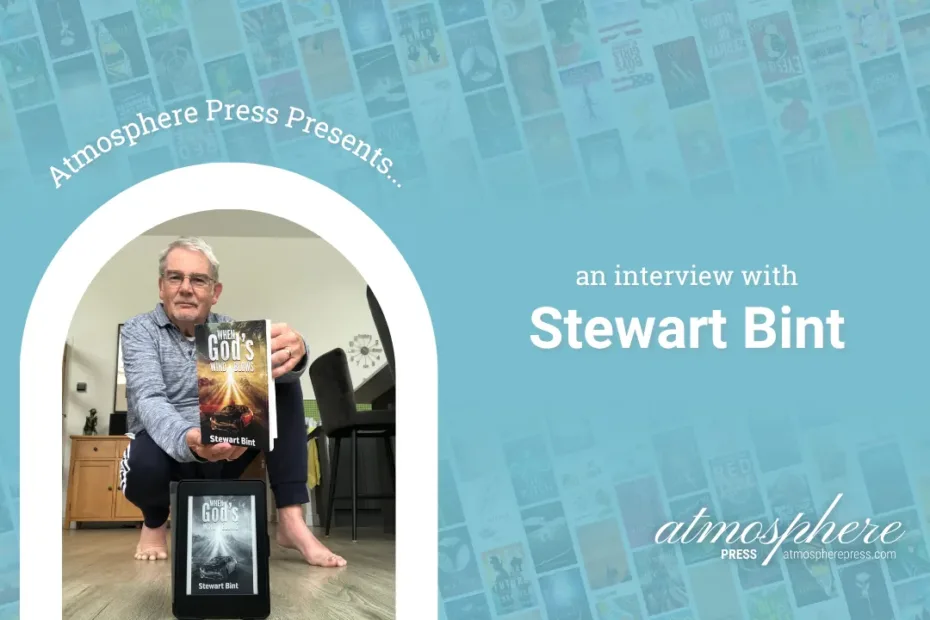
I was born in 1956, and am Dad to two grown up children, and Granddad to two little grandsons.
I guess, now, I’m just an ageing hippy who goes barefoot most of the time.
My aim had been to be a published novelist by the time I was thirty, but I missed that deadline by twenty-six years. I was fifty-six when my first eBook appeared in 2012, and my first paperback came out three years later when I was fifty-nine.
My books aren’t great art, and they’re not great literature, but my readers say my stories are well told and entertaining, which is good enough for me.
What inspired you to start writing this book?
I’d had the basic idea floating around in my head for many years; that premise being a scientist who has had mental blackouts since he was a child. During those blackouts, he functions normally, and no-one notices anything different about him, but when his mind comes back, he has no knowledge or memory of what happened during that time.
I think I must have had a similar blackout, as I don’t know where the idea came from. It’s been in my head for as long as I can remember.
Tell us the story of your book’s current title. Was it easy to find, or did it take forever?
Ah, thereby hangs the rub! The book wound up being the sequel to my first published paranormal novel, In Shadows Waiting, the action taking thirty-eight years afterward.
When I started planning it, it was not intended to be a sequel. It was going to be a standalone sci-fi novel with no connection to the characters or events from In Shadows Waiting.
My original idea was that the blackouts would be linked to a scientific project, with a scientist being the main character. As I was plotting the storyline, I couldn’t see a feasible ending, and there was no conflict, so I quickly realized I needed to change direction, and switched the blackouts to become the paranormal events they are in the book today. The scientist became a retired police inspector, and the conflict was going to be between that character and a criminal he caught twenty-five years earlier, who has just been released from prison.
This raised another barrier, though, in that I’d need to devote a few chapters to getting a hard-nosed ex-policeman to accept the paranormal, and would waste valuable word count. So, who did I know who had already accepted the paranormal and gone through a horrific paranormal experience? Simon Reynolds, in In Shadows Waiting, nearly forty years ago.
Re-reading In Shadows Waiting, I saw how easy it would be to link the two stories, and have the cause of events in When God’s Wind Blows directly connected to what happened in the original book.
The important points from In Shadows Waiting are all dealt with through Simon’s flashbacks and memories, which I hope are handled in a realistic way. Although readers of In Shadows Waiting would learn more about Simon’s early years and experience the gradual paranormal build-up to the shattering climax in 1982, When God’s Wind Blows can be enjoyed in isolation from it.
It was wonderful to get back inside Simon’s head and discover what had been happening in the years since I said goodbye to him.
Overall, since that first book, my writing has become more brutal, but balanced out with humor. Both aspects are found in abundance in When God’s Wind Blows.
Describe your dream book cover.
I’ve been lucky in that my publishers’ art designers have come up with an exciting, stand-out visualization that encapsulates the essence of the story for all six of my covers. I know a book should never be judged by its cover, but I believe the combination of a powerful cover, a memorable title, and an outstanding first paragraph, can hook the reader.
But they’ve got to pick the book up from the shelf, or click it on a website first. So, for the cover, something that shouts at them – striking, intriguing, either bright or dark, that reflects the essence of the story.
If your book had a soundtrack, what are some songs that would be on it?
Definitely Max Ehrmann’s Desiderata (Version Originale). As my main character, Simon, is a radio presenter, there are references to music he plays on his show, including Cold by James Blunt, and drivers license from Olivia Rodrigo, so they would be on it too.
What books are you reading (for research or comfort) as you continue the writing process?
I tend to read a lot of books by up-and-coming indie authors, and always review on Amazon, Goodreads, and my blog. Recent ones have been all six books in The Water Tower series by Chris Vobe, Welcome To The Zoo from Paul Smith, two books in Evelyn Chartres’ The Clara Grey Adventures, The Forest of Forgotten Time by Michele E. Northwood, North Paradise by Alex James Eccleston, and a selection of children’s books by Richard Shore and Graham Hyman.
What other professions have you worked in? What’s something about you that your readers wouldn’t know?
I trained as a journalist in the mid-1970s, and have also worked as a radio newsreader, current affairs presenter, and phone-in show host, corporate communications consultant, magazine columnist, and restaurant critic.
Who/what made you want to write? Was there a particular person, or particular writers/works/art forms that influenced you?
The writing bug infected me when I was seven, thanks to my favorite TV show, Doctor Who. The original series back in 1963 inspired me when I became enraptured by the storylines, which could take place at any time in Earth’s history and future, and on any planet anywhere in the universe. I started creating my own worlds and characters, writing my stories in little blue notebooks until my parents bought me a typewriter for my ninth birthday. My make-believe worlds became invaluable after my dad died when I was eleven. I retreated more and more into those places where I was in control of my characters’ fate, knowing that whatever happened to them in the story, they’d be okay in the end. My worlds were certainly better than the real one at that time.
But then life and work got in the way of fiction, until friends convinced me to give it a go.
Where is your favorite place to write?
My office, which is light and airy. And if the weather’s warm enough, sitting in the garden writing with a pen and paper.
What advice would you give your past self at the start of your writing journey?
Keep believing and it’ll happen. When you hold that first paperback in your hand for the very first time, it will all be worthwhile.
What’s one thing you hope sticks with readers after they finish your book?
Four of my five novels, and some tales in my collection of short stories, explore different ways of humans continuing to exist after death in some form or another – individual ghosts, spirits, reincarnation, even one character who was violently raped and murdered centuries ago becoming a guardian angel in When God’s Wind Blows. Psychologists will probably say it all stems from my dad’s death when I was eleven, and this underlying message about death not being the end is my way of hoping he still exists in another plane.
And that’s what I hope my readers retain long after they’ve turned the final page.
Are you a writer, too? Submit your manuscript to Atmosphere Press.

Atmosphere Press is a selective hybrid publisher founded in 2015 on the principles of Honesty, Transparency, Professionalism, Kindness, and Making Your Book Awesome. Our books have won dozens of awards and sold tens of thousands of copies. If you’re interested in learning more, or seeking publication for your own work, please explore the links below.