
An Interview with Timothy Dreszer
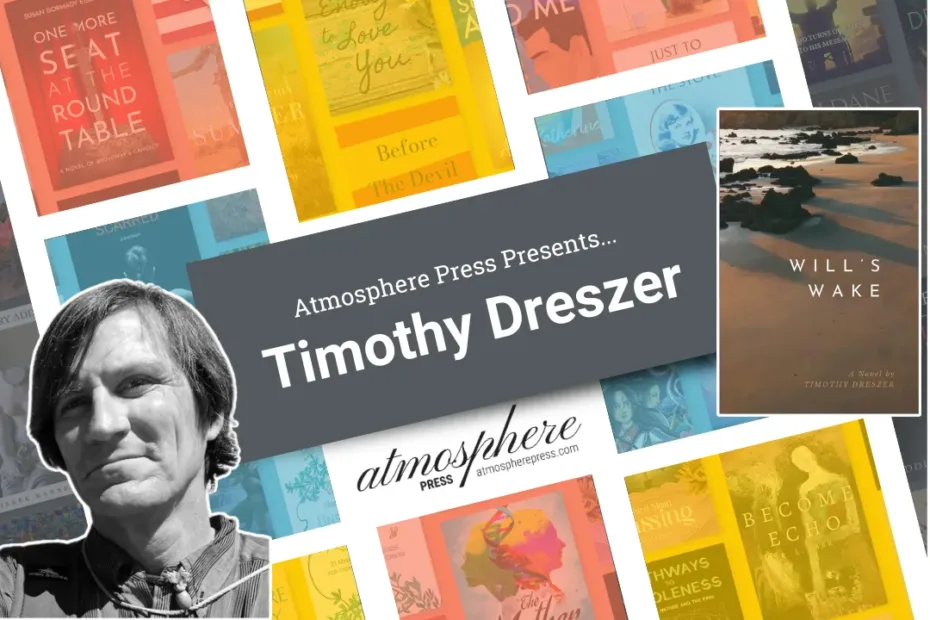
Timothy grew up in Houston, within NASA’s pious penumbra. At seven, he endured mundane family trauma when his parents divorced, and he was forced to live with his mother against his will. By his twenties, when his brother was diagnosed with schizophrenia, Tim learned to appreciate the poetic humor in his own ‘tortured’ life. Escaping family and suffocating humidity, he found refuge in the redwoods on the edge of the Pacific and distraction in nature, science, and engineering. This led from psychology to biology to bioinformatics via degrees and a career along the way. While his head was occupied with writing code and scientific papers, his heart was beating stories colored by complicating human emotion. Timothy’s debut novel is Will’s Wake and has been independently published under the imprint Umgapa Sky. Though he anticipated living alone with a cat, his wife and two adult children have rescued him from that ascetic fate. Presently, he’s most likely riding his bike with no hands near the ocean.
What inspired you to start writing this book?
Long ago, I dreamed up the basic story and four of the main characters of this novel. Early attempts carried me off into the weeds, however. The mental illness of Tony, like that of my own brother, seemed to overpower the other characters. It took years of perspective before I was able to understand that Tony really was a somewhat minor, though key, player. Instead, it is the emotional journeys of the other characters that should make this worth reading. Alone in the forest not long ago, I tossed a mud clod into a creek, and as the current swept away the evidence, I realized that it was time to let this story pass through me.
Tell us the story of your book’s current title. Was it easy to find, or did it take forever?
The title, Will’s Wake, came to me unbidden. It’s as if Sirrus suggested it to James, while I was busy trying to get him to speak up. Or perhaps Rich bellowed it into the cave while Shree conjured an amusement park ride. In any case, the name may not ring a bell unless you read the book.
If your book had a soundtrack, what are some songs that would be on it?
This book has somewhat of a soundtrack already, sounding through its pages. As it takes place in 1981 to 1982, much of the music is period-appropriate. Jim, a grad student, is obsessed with Yes, a group that Tony introduced him to. He plays Sound Chaser by Yes at full volume in his car. Jim also name-checks Pink Floyd’s Interstellar Overdrive and Dire Straits. Rebecca mostly listens to hits on the radio, specifically Stevie Nicks’ Edge of Seventeen. We do get a glimpse of her record collection, though, where Tony discovers his Coltrane album, sorted next to Carol King’s Tapestry. It’s nothing but Grand Funk Railroad and ZZ Top on repeat for Wendy’s brother and his friends. Shree jams to Queen’s Crazy Little Thing Called Love, which she no doubt heard in her mom’s car. She also enjoys Mahler’s Fifth Symphony when her grandmother takes her. For Tony, it’s Coltrane, Louis Armstrong, and Yes. Finally, in the epilogue, we meet Trish, who references Annie Lennox and the Tom Tom Club. To complete the soundtrack, I would have to get someone to record Preacher in Hell and Smoking on the Swing-set, since Annabelle’s group, Asperger’s Cafe is, of course, fictional.
Who/what made you want to write? Was there a particular person, or particular writers/works/art forms that influenced you?
When I first read the opening of Crime and Punishment, I was startled by Dostoevsky’s ability to place me inside the mind of a murderer. This is when I learned that good storytelling was about more than telling a good story. Since Raskolnikov’s escape, it isn’t enough anymore to be swept up in the action or puzzled by how a crime was carried out. What thrills me is being inside the minds of other people as each feels situations from their unique perspective. The invitation to join in often depends on a character with easily recognized motivations. Intriguing characters have mindsets that evolve, or perhaps mutate, over time. But the most fascinating characters are driven to do things we would never do ourselves yet are motivated by emotions we recognize and thoughts that make sense to them in the moment. Good storytelling can humble us in our fallibility as isolated humans, while in the very same words, proving we’re connected.
Where is your favorite place to write?
On my couch in the living room after everyone is asleep. Late at night seems to be my optimal time for writing creatively. I am thinking about situations and characters throughout the day, whenever I’m alone. Much of this book was conceived on long bike rides through a state park. So, when I sat down to write, I usually had a clear idea of what I wanted to do. Of course, over the few days, I thought about what didn’t work before trying again.
What advice would you give your past self at the start of your writing journey?
The more you make your characters believable, the more they will have minds of their own. Trust them to make their own choices and have their own rationales. Your job as a writer is to put them into difficult, even painful situations. Their job is to find their way through them. The more you try to control your characters, the shallower they’ll be. Obviously, I am not suggesting that the plot lines and interactions are beyond your control. But when your own characters surprise you, a creative window has opened. That said, resist the natural urge to protect your characters from harm. They are fictional after all.
What’s one thing you hope sticks with readers after they finish your book?
Obviously, I hope Shree, Wendy, Jim, Sirrus, Annabel, Tristan, Rich, and even Gunther linger with readers. Often, people hear ‘emotional’ and think tear-jerker. I hope readers are touched by the gamut of emotions in the pages of Will’s Wake. To me, the life tissue of the story is the fear, self-doubt, loneliness, embarrassment, moral conflict, recognition, pride, humor, affection, love, and even awe. While this story attempts to find some meaning, I hope it’s remembered as an ‘emotional’ read.
Are you a writer, too? Submit your manuscript to Atmosphere Press.

Atmosphere Press is a selective hybrid publisher founded in 2015 on the principles of Honesty, Transparency, Professionalism, Kindness, and Making Your Book Awesome. Our books have won dozens of awards and sold tens of thousands of copies. If you’re interested in learning more, or seeking publication for your own work, please explore the links below.