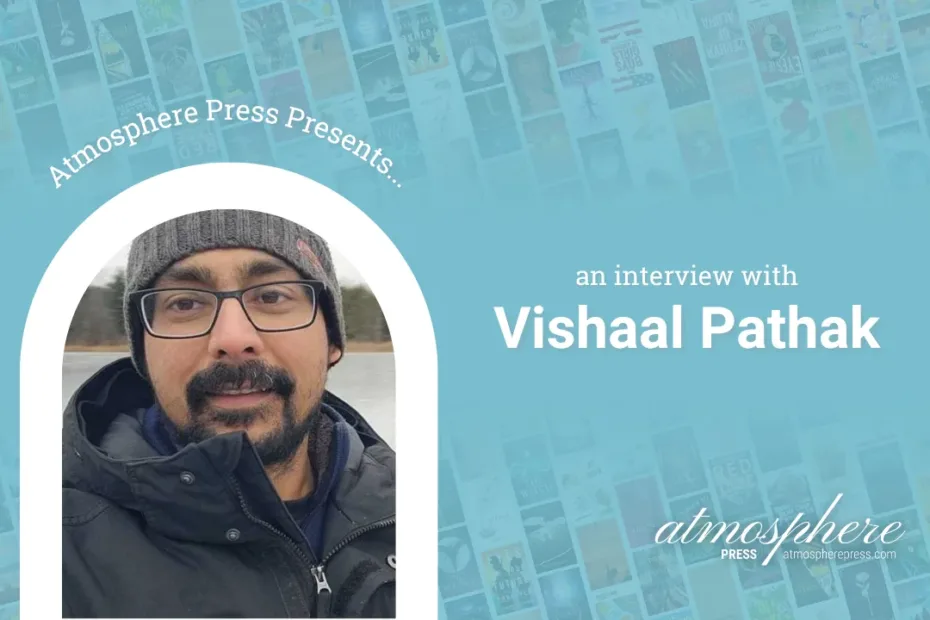
An Interview with Vishaal Pathak
My work primarily explores visceral feelings and experiences such as grief, trauma, and emotions that overwhelm the human body. Body’s supreme capabilities fascinate me—the same bodies that hold generations’ worth of grief and trauma can still opt for more vulnerability, whether for intimacy, healing, or profession. Writing helps me comprehend and express the pain, beauty, and meaning embedded in such human experiences. I write because I think I see something that others don’t yet. I write so that the invisible, the atypical, the misunderstood, the inwardly grieving, have a shot at representation, attention, and, perhaps, redemption.
My work has appeared in “ARTS by the People,” Five on the Fifth, Ghudsavar, Kitaab, The Hooghly Review, The Perch Journal, Vermilion, and elsewhere. My manuscript Snowflakes in a Desert was completed under the mentorship of acclaimed writers Adam Foulds and Shyam Selvadurai. I’d say I’m just getting started.
Who/what made you want to write? Was there a particular person, or particular writers/works/art forms that influenced you?
Like most other writers, I’m rather introverted and find writing as the only medium suited for the unhurried, measured, thought-through articulation natural to me. Everyone needs an outlet—creatives don’t necessarily look for a creative outlet, it’s the only outlet natural to them. So, I’ve never not been writing. It’s just that I began sending out my work only about half a decade ago.
I genuinely enjoy and appreciate the work of many writers, but the ones that’ve influenced me the most are Kazuo Ishiguro, Arundhati Roy, Franz Kafka, and J. D. Salinger. They’ve made me want to pick up the pen time and again to first write the barebones of a scene, then add some flesh, then dress it up in colours, and, lastly and most importantly, pour some soul into it.
What inspired you to start writing this book?
More like what transpired for me to start writing this book. Life. And a lot of chatter on and off social media.
I’ve realized people don’t necessarily form a favourable opinion of the aloof—people who often stay quiet, lost or living in a bubble of their own, just doing their thing. It’s almost as if the quiet one’s silences can be filled in with whatever the louder one’s fears and anxieties habituate them to, as if the former’s actions can be coloured with the darkest, coarsest of paintbrushes, and their failings can be read rather deeply into, misattributed to whatever the general consensus may be. Well, if no one would rather come and ask them, I’m here to write paragraph after paragraph detailing the quiet inner life of the atypical, the misfits. Hopefully, my fiction helps us see them in a more positive (or at least neutral) light.
Tell us the story of your book’s title. Was it easy to find, or did it take forever?
Great question. Well, it definitely has stuck for so long now that I can’t recall when I came up with it. As the book takes the form of post-mortem ramblings of an (earthly and otherworldly) outcast waiting for liberation, I’d been using “The Runaway Ghost” as the working title. The title obviously didn’t have any gravitas to it, so I continued looking for an alternate title. The name Snowflakes in a Desert began to take shape around the time the word “snowflake” began to be used as a euphemism for anyone (millennials, mostly) rightfully complaining about something. And I thought, if we’re snowflakes, what does it make this barren soulless land then—an intellectual/spiritual desert? The naysayers should probably get some credit for the name then. Of course, the name serves another purpose—one will have to read the book to figure that out.
If your book had a soundtrack, what are some songs that would be on it?
It would have lots of Nick Drake, Snow Patrol, and John Mayer. M83 and Explosions in the Sky, too. Particularly:
“Hanging on a Star”, “The Thoughts of Mary Jane,” “Place to Be,” and “Northern Sky” by Nick Drake.
“Alone Together” and “A Temporary Life” by Marconi Union.
“Wait” by M83.
“In Your Atmosphere” and “Slow Dancing in a Burning Room” by John Mayer.
“Your Hand in Mine” and “First Breath After Coma” from Explosions in the Sky.
And let’s not forget “Chasing Cars” by Snow Patrol.
What advice would you give your past self at the start of your writing journey?
I made copious notes, including scenes, dialogues, the protagonist’s inner ramblings and witty observations for the book that I kept telling myself I was going to start writing any moment now. I did that for nearly three years. Every time I had a new thought, I’d capture it in a word file, but without any context or accompanying comments. By the time I eventually started writing the book, the notes had swelled up to book-length itself. But the entire thing was so out of order, I officially abandoned writing the book at least thrice. For the notes to be usable, I had to go over them hundreds of times. Every time I started a new chapter, I’d have to go through the entire thing in hopes I’d find the needle(s) in the haystack. Even when I gradually started splitting the file into smaller ones, adding comments, segregating them topic-wise, moving already used notes to a separate file—the needle pricked before it could stitch. I’m just glad I was able to use some of them and finish the manuscript. Moral of the story: Make useable, organized notes; leave comments so your future self can thank you. That’s the advice I’d give my past self.
What’s one thing you hope sticks with readers after they finish your book?
I hope readers admire the heart and soul put into the book. (Blood, sweat, and tears weren’t enough.) I also hope I can nudge readers somewhat to spare some time and think of the people they generally wouldn’t worry themselves over. There’s a host of people in this world who are quietly and inwardly grieving but are never lent so much as a patient ear. They’ve been the atypical, the misunderstood so much they’ve slipped through the cracks. Let’s listen to them and their stories and make them feel un-invisible again.
Are you a writer, too? Submit your manuscript to Atmosphere Press.
Atmosphere Press is a selective hybrid publisher founded in 2015 on the principles of Honesty, Transparency, Professionalism, Kindness, and Making Your Book Awesome. Our books have won dozens of awards and sold tens of thousands of copies. If you’re interested in learning more, or seeking publication for your own work, please explore the links below.