An Interview with Diane Skye Gropper
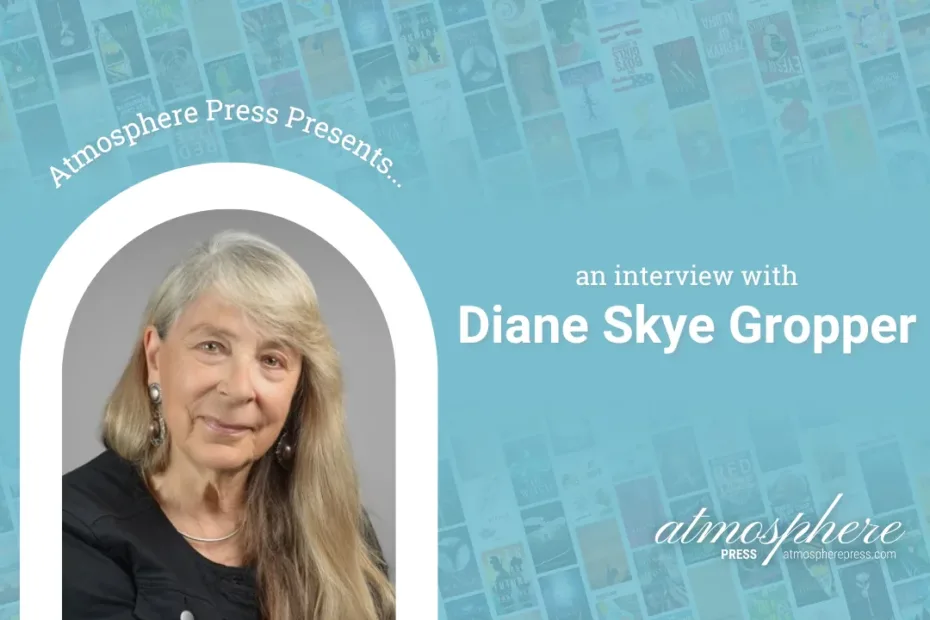
Diane Skye Gropper has been a professional writer throughout most of her long career. She spent nearly two decades as a writer and editor at a major financial magazine, where she won several journalism awards, and as a freelance writer/editor. She later worked as a marketing strategist and writer at a financial firm and then formed her own marketing communications company that served some of the leading names in investment management. Since then, she has continued to work and write in various capacities in the financial industry. Skye graduated from the College of William and Mary in Virginia with a BA in economics and did extensive graduate work in economics at the City University of New York.
Skye has been reading and writing poetry for much of her life. Her study of Buddhism, Native American spirituality, and other spiritual paths over the past thirty-five years has heavily influenced her poetic writing and is the primary source of inspiration for Dancing Through Seafoam, her first published collection of poems.
Who/what made you want to write? Was there a particular person, or particular writers/works/art forms that influenced you?
I think I am a born writer. I remember writing elaborate reports on books and other topics in grade school and I still have some of those handwritten tomes! In middle school, I had two English teachers who profoundly shaped me; one taught me how to properly structure written pieces, and the other helped me develop the self-confidence to express my creativity through my writing. I am deeply indebted to both of them. In my early twenties, I developed a distinct sense that I had some sort of life mission that, at least in part, involved writing a book. At the time, it seemed like an impossibly lofty goal, but decades later, I have finally reached it by publishing Dancing Through Seafoam, my book of spiritual poetry. It doesn’t surprise me that I have chosen to write poetry because I view it as a particularly elevated form of writing. I have been writing and reading poetry for years and my all-time favorite poets are Robert Frost (sigh, sheer genius) and William Carlos Williams. Nor does it surprise me that my writing is spiritually oriented because spiritual growth, I have discovered, is also a big part of my mission in this life. For forty years, I have been studying Buddhism, Native American teachings, and other spiritual paths—all of which have provided inspiration for this collection of poetry.
What other professions have you worked in? What’s something about you that your readers wouldn’t know?
Writing has played a prominent role in my professional life. I spent more than a decade as a financial journalist, winning several journalism prizes along the way. I subsequently moved into the financial industry, working in marketing, regulatory, and other roles that involved high-level writing. People sometimes express surprise that someone who spent an entire career in the hard-nosed world of finance could be the author of spiritual poetry. But I see no incongruity there. We all have disparate parts of our personalities and, to my mind, the analytical disciplines of finance have enhanced the quality of my spiritual studies and poetic writing.
Tell us the story of your book’s title. Was it easy to find, or did it take forever?
The title of my book, Dancing Through Seafoam, actually came from a poem in the collection about a child of mine who died—see “In Absentia.” In it, I write that in my dreams, I often see this child (she was a girl) dancing like a gypsy through the seafoam on Cape Cod—one of my favorite places on earth, where my family and I have spent a great deal of time. As I put the book together, it occurred to me that this is an apt metaphor for the multiple lives we live, according to Buddhist, Native American, and other spiritual paths. All of them teach that we travel the circle of life not once, but many, many times, taking on a new identity in each life so we can learn and grow and inch our way up the evolutionary spiral toward enlightenment. Each life goes by in the blink of an eye, like a dance through the seafoam that disappears almost as fast as it forms along the seashore. One moment, it and you are there—and the next, both are gone. To my mind, this was the title that the book was looking for.
What part of publishing your book made it feel real for the first time?
The publishing process felt real for the first time when I found the cover artwork for my book. Again and again, in my dreams, I had seen a beautiful young woman in a long dress dancing along the edge of the sea, with the sun setting behind her. I knew this was the image I wanted for the cover. When I went online to do a search, I immediately found that exact image, to a T. I could not believe my eyes. Talk about dreams driving reality. I purchased the image on the spot and sent it to my publisher, Indigo River. The result is a book cover that is incredibly entrancing and magical.
If your book had a soundtrack, what are some songs that would be on it?
The number one song on my book’s soundtrack would be “And When I Die.” It was originally written and recorded by the gifted Laura Nyro, but did not achieve fame until Blood, Sweat & Tears released it on the band’s self-titled album in 1968. Powered by lead singer David Clayton-Thomas’s bluesy voice, the song’s lyrics address the natural order we all face: Death is inevitable but so is the rise of new life to take our place when we are gone.
There’s no denying this natural order exists, but is it driven by reincarnation or random rebirth? I guess that’s something we each need to decide for ourselves. For me, this song is a beautiful reminder that life is fleeting, not final. We arrive, love, lose, learn, fail, begin again, and keep moving. We take our hard-won lessons with us as we step out of one life and into the next to “carry on.”
What’s one thing you hope sticks with readers after they finish your book?
My greatest hope is that the experience of reading my poetry stays with my readers in some way. That it has impact, some sort of lasting impact, because the themes or the language or the pathos resonate with them and make them feel bigger and better for having read it. My poetry also has an evocative, uplifting quality that I hope is an antidote to the discord and darkness of today’s world. As I often tell people, you don’t have to be a Buddhist or believe in multiple lives or even be spiritual to connect with my poetry. You just need to be alive.
What creative projects are you currently working on?
I am currently writing another collection of spiritual poetry—we’ll see where that takes me! Please see my website for more information: www.skyegropper.com.
Are you a writer, too? Submit your manuscript to Atmosphere Press.

Atmosphere Press is a selective hybrid publisher founded in 2015 on the principles of Honesty, Transparency, Professionalism, Kindness, and Making Your Book Awesome. Our books have won dozens of awards and sold tens of thousands of copies. If you’re interested in learning more, or seeking publication for your own work, please explore the links below.