
An Interview with Ben Thompson
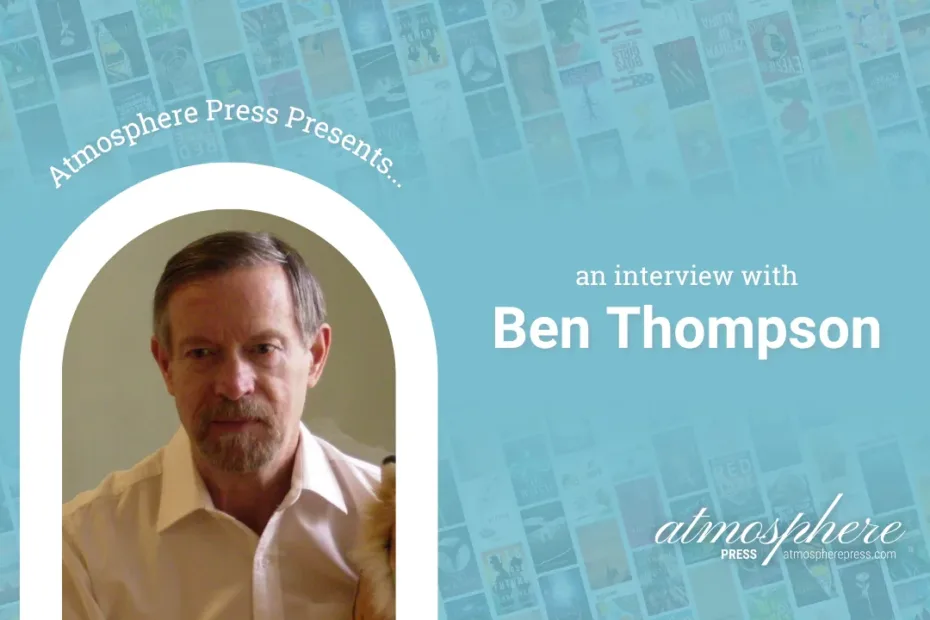
Worked as a manual labourer, music teacher, peace activist, and computer programmer before moving to China at the age of fifty to study Mandarin. Drawn into the world of Chinese television and film acting, I stayed for over ten years and played foreign devils in more than seventy television series and films, most notably the 8th Lord Elgin in the CCTV drama-documentary Yuanmingyuan. I was active in the Beijing Actors Workshop and wrote several plays which were performed in the Peng Hao Theatre; Peking Roulette was also performed in New York.
Who/what made you want to write? Was there a particular person, or particular writers/works/art forms that influenced you?
I grew up in a literary family, but I started to write poetry seriously when I left university; I became aware of how incomplete I was and the writing was a way of climbing out of myself and overcoming my limits. I never thought about publishing until I had been writing for quite a few years. I was inspired by several “confessional” poets at the beginning; Ted Hughes was an inspiration, and also some of Randall Swingler, because I knew his family. But I feel very strongly that the writing was a process that I needed and it never came from a desire to make a particular kind of poem; Hughes inspired me because he seemed to have a way of seeing nature with new eyes. I wanted my own way of seeing.
What other professions have you worked in? What’s something about you that your readers wouldn’t know?
I worked in many professions, labouring and computer programming, but for four years I worked in the peace movement, opposing medium-range nuclear missiles in Europe; I wrote a pamphlet about the missile base in Comiso, Sicily (name “Comiso”), and the Italian FGCI bought one hundred copies of it, which was a first publishing success. Later, I collaborated on a book about Reagan’s SDI (Strategic Defense Initiative).
Tell us the story of your book’s title. Was it easy to find, or did it take forever?
The book’s title was quite easy, because the poem White Tulip had a special meaning for me. When I was twenty-seven, I left the countryside and moved to London to live in a large squat around Kings Cross. We had a huge block of apartments which had been emptied for renovation, and a lot of young people moved in and lived there for a few years. Soon after I got there, I went for a walk in Regent’s Park and saw a white tulip and the poem popped up; it seemed to me to represent those years of freedom and exploration. So, I made it the title poem of the book.
What part of publishing your book made it feel real for the first time?
It didn’t feel real till it happened. I learned to be wary when I won a bursary from the BBC for a verse radio drama. The head of drama at the BBC was itching to broadcast it, but they had a brand-new commissioning department which decided not to, no reason given. So, I learned that nothing is published until it actually comes out. The radio drama was a severe disappointment and one big reason why I went to China. But going to China was far better for me that the BBC ever could have been.
If your book had a soundtrack, what are some songs that would be on it?
Brahms’ Piano Concerto No. 1 in D minor and Faure’s Requiem.
What’s one thing you hope sticks with readers after they finish your book?
In China, I spent two months in the Shaolin Temple studying kung fu. My kung fu level never rose above appalling, but the old guy who was teaching me said, “Remember, it must be beautiful,” and I think that whatever else a poem does and whatever content it contains, “it must be beautiful.” What beauty actually is, though, is a big question, but I think it has something to do with a communication that goes beyond oneself. So, I want the reader to retain a sense of beauty.
What was the most rewarding/meaningful part of publishing your book?
The most rewarding part of publishing is that I have a solid foothold in the world of literature. The first thing I asked the publisher was whether his books went into the National Poetry Library. My grandfather wrote poetry and his books are there, my father wrote poetry and his books are there, my uncle wrote poetry and his books are there, etc. The most rewarding thing about reading the poems is those occasions when someone comes up afterwards and seems to have been visibly moved by something I read. I don’t want to write “good” poems; I want to write poems that move people and make them reflect.
What creative projects are you currently working on?
I have a new book of poems I’ve been writing for the past fourteen years, in a remote forest in County Clare. The book is nothing like White Tulip; it reflects the growing sense of crisis I have felt in Western civilization since I came back from China, plus my own sense of getting old and frail, of course. I have been trying one or two publishers, but I don’t know if it is a commercially viable project. Still, quite a few of the poems have been published in the journal of the Bertrand Russell Peace Foundation, and a few have been translated and published on Chinese blogs, so they do get read by a few people.
Are you a writer, too? Submit your manuscript to Atmosphere Press.

Atmosphere Press is a selective hybrid publisher founded in 2015 on the principles of Honesty, Transparency, Professionalism, Kindness, and Making Your Book Awesome. Our books have won dozens of awards and sold tens of thousands of copies. If you’re interested in learning more, or seeking publication for your own work, please explore the links below.