An Interview with Gianfranco Fagotto
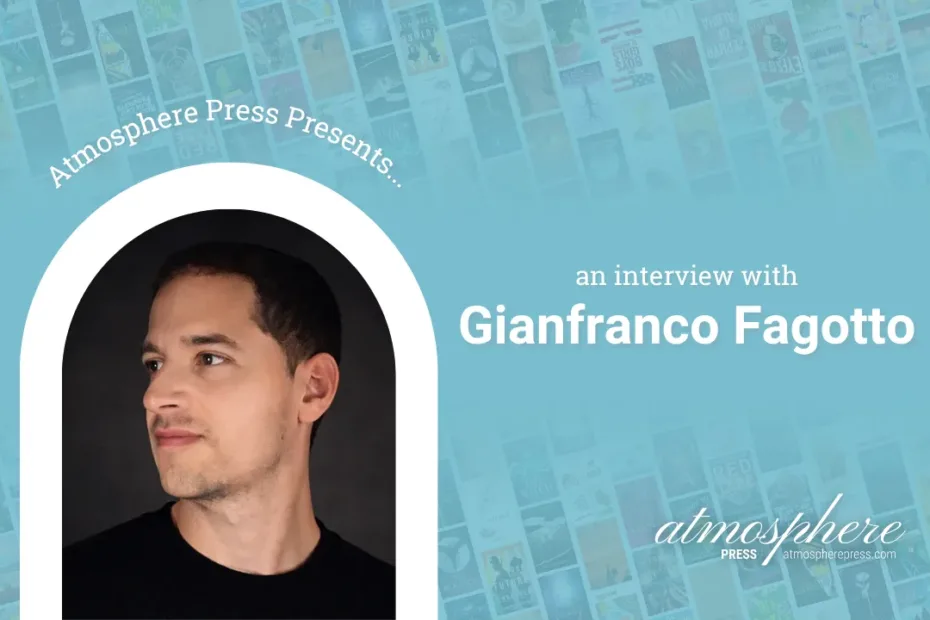
Gianfranco Fagotto is an Italian Ecuadorian creative director, designer, artist, musician, and storyteller. His professional background spans brand design, visual communication, publishing, and digital experiences, bringing a strong visual sensibility and narrative discipline to Soul-Dreamer.
Having lived across Latin America, Europe, Africa, and Asia, Fagotto brings a unique global perspective to speculative fiction. This experience informs the world-building of Soul-Dreamer, where cities from Milan to Kyoto become more than settings: they are living, atmospheric landscapes shaped by memory, language and human experience.
Driven by a lifelong curiosity for psychology, science, art, and philosophy, Fagotto creates speculative narratives that explore grief, identity, and the hidden structures of human memory. His work across visual art and music reflects the same fascination with emotion, atmosphere, and the unseen forces that shape human experience.
He lives in London with his wife and their cat, a constant companion during the long hours spent imagining new worlds.
What inspired you to start writing this book?
Soul-Dreamer began with a simple question: what if our dreams are more than dreams? I’ve always been fascinated by the invisible threads that connect memory, loss, creativity, and the search for meaning. I wanted to write a story that explored those ideas through an emotional, character-driven adventure rather than through philosophy alone.
At its heart, Soul-Dreamer is about hope, resilience, and the search for meaning. It is about discovering who we really are when everything familiar is stripped away, and about the courage it takes to keep searching for light, even when life feels consumed by darkness. I wanted readers to finish the book entertained, but also reflecting on their own dreams, fears and purpose.
Tell us the story of your book’s current title. Was it easy to find, or did it take forever?
Finding the right title took time, as expected. I explored many different possibilities, searching for something that captured the novel’s mystery, emotion, and spiritual depth without revealing too much. Every title either felt too literal, too complicated, or simply lacked the right rhythm.
Eventually, I realised the answer had been hiding in plain sight: Soul-Dreamer. It is simple, memorable, and captures the heart of the story. The title can be interpreted in different ways: is it someone who dreams with their soul, someone searching for their soul through dreams, or someone whose soul itself is a dreamer? I love that readers can bring their own meaning to it, just as they will bring their own interpretation to the story.
Describe your dream book cover.
My dream cover would feature a solitary figure standing in a rain-soaked Victorian London street. In front of them stands an impossible doorway floating between two buildings. Through the doorway, we glimpse a universe of memories, cities, and dreams. Their shadow points towards the door while they face away from it, suggesting a journey into the unknown and the hidden layers of reality.
If your book had a soundtrack, what are some songs that would be on it?
If Soul-Dreamer had a soundtrack, it would be as genre-defying as the story itself. In my mind, it moves effortlessly between ambient electronica, minimalist classical music, industrial rock, and world music, reflecting the novel’s journey across cities, cultures and states of consciousness.
Radiohead’s Everything in Its Right Place and Jon Hopkins’ Abandon Window capture the unsettling atmosphere of the opening chapter, where the familiar world begins to unravel. The raw energy of Soda Stereo and Rage Against the Machine echoes one of the character’s rebellious spirit in Quito, while Nine Inch Nails embodies the villain’s seductive vision of perfect order through technology. For the novel’s quieter, more emotional moments, I hear Ludovico Einaudi’s Nuvole Bianche and Puccini’s Coro a bocca chiusa, music that allows grief, hope and wonder to breathe.
More than anything, I imagine Soul-Dreamer sounding like a dream that never stays in one genre for long and is constantly shifting, surprising, and inviting the listener into another reality.
What books are you reading (for research or comfort) as you continue the writing process?
I tend to rotate between books on art, philosophy, and science fiction. The only problem is that I’ll start one book, stumble across another that fascinates me, and suddenly I’m reading three at once, so it can take me ages to actually finish one! It’s probably the occupational hazard of being endlessly curious.
I regularly return to Jorge Luis Borges’s Labyrinths for the way it bends logic and challenges our perception of reality. Neil Gaiman’s The Sandman continues to inspire me with the mythology it builds around dreams, while Susanna Clarke’s Piranesi creates one of the most extraordinary living spaces I’ve ever encountered in fiction, where architecture becomes almost a character in its own right.
I’m naturally drawn to works that explore how people try to rationalise and give visible form to invisible emotions, especially grief, memory, and hope. At the moment, I’m reading The Tibetan Book of Living and Dying, which feels particularly resonant with many of the themes explored in Soul-Dreamer.
What other professions have you worked in? What’s something about you that your readers wouldn’t know?
At my core, I have always been a creator, whether working as a digital artist, art director, creative director, or musician. Creating has always been the way I understand and process the world.
Having grown up across different cultures and continents, and speaking Italian, Spanish, English, and French, I developed an early fascination with how language, imagery, and perspective shape the way we experience reality. Shaping visual systems, brand narratives, and musical soundscapes are all different expressions of the same instinct: storytelling.
What readers might not immediately realise is how directly my multidisciplinary background informs Soul-Dreamer. My experience in design, art, and music influenced not only the visual identity of the book, but also its atmosphere, pacing, and emotional architecture.
For me, writing fiction is not just about constructing a sequence of events. It is about creating an entire experience through imagery, rhythm, space, and emotion. The same principles that guide a visual composition or a piece of music also shape the worlds I build on the page.
Who/what made you want to write? Was there a particular person, or particular writers/works/art forms that influenced you?
I am driven by a fundamental need to create across mediums, but I firmly believe that every person should write at least one book during their life. A novel allows an artist to construct an entire internal universe without the constraints of commercial briefs. My writing is influenced by surrealist visual art, film scoring, and psychological architecture. The idea that our subconscious is a physical space waiting to be explored, is important for my writing.
Where is your favorite place to write?
At home. I need a quiet environment where I can immerse myself completely in the world I am creating: a desk, a notebook, tea, and enough space to develop visual mood boards and story maps without interruption. Writing Soul-Dreamer often involves moving between words, images and structures, so having that creative space is essential.
What advice would you give your past self at the start of your writing journey?
Don’t confuse control with safety, and don’t try to complete the map before you’ve lived the scene.
At the beginning of my writing journey, I spent a lot of time trying to engineer every sci-fi rule, world-building detail, and plot mechanism before allowing the story to breathe. Looking back, I would tell my past self to trust the emotional truth of the characters first.
The best discoveries often happen when you allow characters to surprise you. Their fears, contradictions, and desires should shape the journey rather than forcing them to simply follow a perfectly planned outline. The world can evolve around them, but the human experience must always remain at the centre.
What’s one thing you hope sticks with readers after they finish your book?
I hope readers walk away understanding that growth is not about erasing pain, and that love is not about possessing someone through memories of who they were. In a world obsessed with optimising every aspect of our lives, including our sleep, emotions and subconscious, I want Soul-Dreamer to remind people that some parts of being human are not problems to solve. Some depths are meant to be witnessed with empathy, not mapped for control.
Are you a writer, too? Submit your manuscript to Atmosphere Press.
Atmosphere Press is a selective hybrid publisher founded in 2015 on the principles of Honesty, Transparency, Professionalism, Kindness, and Making Your Book Awesome. Our books have won dozens of awards and sold tens of thousands of copies. If you’re interested in learning more, or seeking publication for your own work, please explore the links below.